
EMAIL:
lh@longhuamachine.com
TELL/whatsapp:
+8619305527239  English English
Views: 0 Author: Site Editor Publish Time: 2026-09-26 Origin: Site


Choosing between a 500T die casting machine and a 900T die casting machine is not simply a question of whether your casting is “medium” or “large.” The correct capacity depends on several parameters working together: projected casting area, required cavity pressure, total aluminum shot weight, mold dimensions, tie-bar clearance, opening stroke, production cycle, automation, and future product plans.
A 900T machine provides substantially more clamping force and a larger die space than a 500T machine, but that does not automatically make it the better investment. An oversized machine can increase equipment cost, floor-space requirements, power demand, mold-handling complexity, and peripheral-equipment investment. A machine that is too small creates the opposite problems, including insufficient locking force, limited shot capacity, mold-fit restrictions, flash, unstable filling, or no room for future tooling.
For buyers evaluating an aluminum die casting machine, the correct approach is to compare the actual casting and die requirements against the technical capabilities of both machine sizes.
Longhua Die Casting Machine Co., Ltd. manufactures cold-chamber die casting machines across a wide tonnage range. Its current die casting machine series includes both 500T and 900T standard configurations, allowing buyers to compare machine capacity around their real production requirements.
The difference between 500T and 900T begins with clamping force but extends much further into the machine structure.
Based on the current Longhua standard-series specifications, the main differences are:
Specification | 500T Die Casting Machine | 900T Die Casting Machine |
|---|---|---|
Clamping Force | 5000 kN | 9000 kN |
Opening Stroke | 580 mm | 800 mm |
Die Thickness Range | 320–800 mm | 400–1000 mm |
Tie-Bar Space | 760 × 660 mm | 960 × 960 mm |
Ejector Stroke | 120 mm | 190 mm |
Ejector Force | 240 kN | 360 kN |
Injection Force | 450 kN | 775 kN |
Injection Stroke | 580 mm | 760 mm |
Plunger Diameter | 70 / 80 / 90 mm | 80–110 mm |
Aluminum Injection Weight | Approx. 6.9 kg | Approx. 13.5 kg |
Max. Casting Area at 40 MPa | Approx. 1250 cm² | Approx. 2350 cm² |
Motor Power | 22 kW | 37 kW |
Approx. Machine Size | 7.7 × 2.1 × 3.1 m | 10 × 3 × 3.5 m |
Reference Machine Weight | Approx. 20 T | Approx. 45 T |
These values immediately show that moving from 500T to 900T is not a minor capacity upgrade. The 900T machine provides about 80% more nominal clamping force, substantially greater mold space, almost twice the listed aluminum injection capacity, and a much larger physical machine structure.
The correct decision therefore needs to answer two questions. First, can the 500T machine safely and consistently produce the part? Second, if it can, does the project have a credible reason to move to 900T for larger tooling, higher shot weight, additional cavities, or future production expansion?
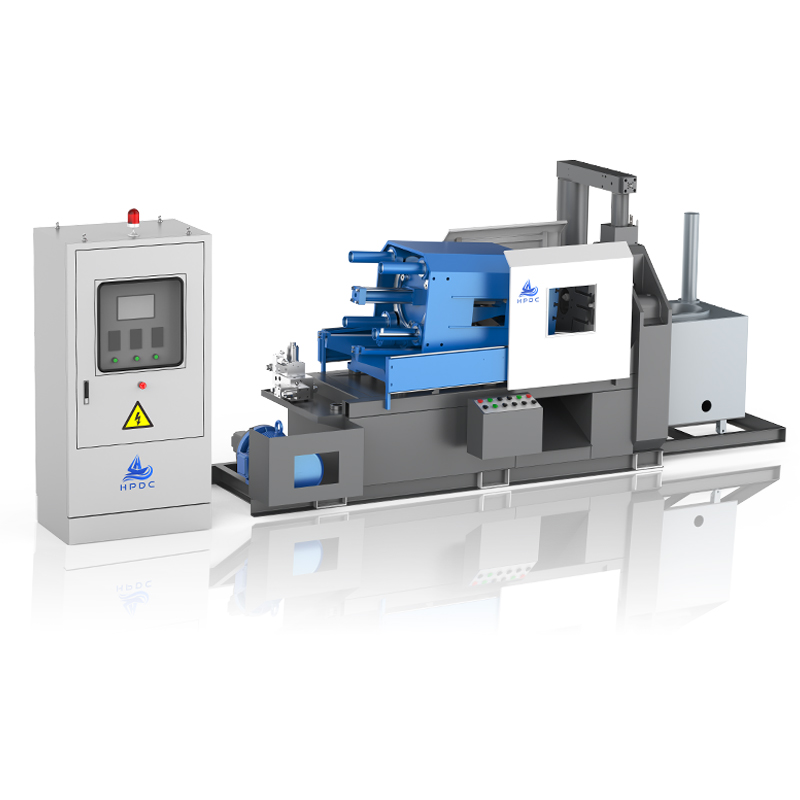
Clamping force should be calculated from the pressure acting across the projected area of the casting and runner system. This is more reliable than choosing the machine from part weight alone.
During injection, molten aluminum generates pressure inside the die cavity. This pressure tends to separate the moving and fixed die halves. The machine must provide enough locking force to keep the die closed throughout filling and intensification.
In simplified terms, the required force is influenced by:
Projected casting area × cavity pressure × safety allowance
The projected area should include more than the finished component. Depending on the die design, the runner, gates, overflow areas, and multiple cavities can increase the total area exposed to pressure.
This explains why a relatively light but broad, thin-walled casting may require a larger machine than a heavier but compact component. A large flat housing, cover, structural bracket, electronics enclosure, or motor component may create a large projected area even when its finished weight is moderate.
Longhua's 500T standard machine lists a maximum casting area of approximately 1250 cm² at 40 MPa, while the 900T configuration lists approximately 2350 cm² under the same reference pressure condition.
These values are useful for preliminary comparison, but buyers should not treat them as universal maximum part sizes. The actual cavity pressure required for a specific casting depends on geometry, alloy, wall thickness, filling conditions, quality requirements, and die design.
A project operating close to the 500T machine's practical clamping limit deserves careful review. Moving to 900T may provide additional process margin, but the investment should still be justified by actual production requirements rather than simply adding tonnage for comfort.
A die casting machine can have sufficient clamping force and still be unsuitable if its injection unit cannot deliver the required quantity of molten aluminum.
Longhua's standard 500T configuration lists approximately 6.9 kg aluminum injection weight, while the standard 900T configuration lists approximately 13.5 kg. This difference can become decisive when casting larger housings, multi-cavity tools, or parts with substantial runners and overflows.
The required shot weight should include:
Finished casting
Runner system
Gates
Overflow
Biscuit
Process allowance
A 4 kg finished casting does not automatically require only 4 kg of injection capacity. Once the complete metal system is considered, the actual shot requirement can be significantly higher.
The 900T machine also provides a longer injection stroke and larger plunger options. Its listed 760 mm injection stroke and 80–110 mm plunger range provide a different shot-volume envelope from the 500T machine's 580 mm stroke and 70–90 mm plunger range.
Plunger size also affects casting pressure. Selecting a larger plunger increases available shot volume but changes the pressure relationship. This is why machine sizing should evaluate shot sleeve diameter, plunger diameter, filling ratio, injection force, metal pressure, and required filling speed together.
A casting with thin walls, long flow paths, narrow ribs, or difficult-to-fill sections may require strong injection dynamics even when its total weight fits comfortably within the machine's maximum shot capacity.
For this reason, buyers should provide Longhua Die Casting Machine Co., Ltd. with the casting drawing, runner concept if available, alloy, total estimated shot weight, and critical wall thickness before choosing between the two machine sizes.
Mold fit is often the factor that immediately eliminates one machine option.
A 500T machine may provide sufficient locking force for a casting but still be unsuitable if the mold is too large to fit between the tie bars. The 900T machine provides considerably more space for wider and thicker tooling.
Longhua's 500T standard configuration lists:
Tie-bar spacing: 760 × 660 mm
Die thickness: 320–800 mm
Opening stroke: 580 mm
The 900T configuration increases these to:
Tie-bar spacing: 960 × 960 mm
Die thickness: 400–1000 mm
Opening stroke: 800 mm
This additional space can matter when a project uses large mold bases, complex sliders, multiple cavities, hydraulic core pulls, larger cooling circuits, or substantial ejection structures.
Opening stroke is also important after the casting has solidified. There must be enough distance for the mold to open, the casting to clear the die, the extractor to enter, and the spray equipment to access the cavity.
The 900T machine's longer opening stroke can therefore support larger tooling and castings that physically require more removal space.
Before requesting a quotation, send:
Mold length
Mold width
Mold thickness
Mold weight
Required opening distance
Ejection stroke
Core-pull configuration
Injection position
If tooling already exists, send the actual mold drawing rather than relying on nominal dimensions. This is especially important when replacing another brand of machine because tie-bar spacing, shot position, platen dimensions, and pressure-chamber geometry may differ between manufacturers.
A 500T die casting machine can be the more practical choice when the casting, mold, and production requirements fall comfortably within its operating range.
The main advantage is not simply a lower purchase price. A smaller machine also requires less factory space, has a lower reference machine weight, uses a smaller drive system, and normally requires smaller peripheral equipment.
Longhua's 500T cold chamber aluminum die casting machine uses a compact configuration relative to larger-tonnage equipment and can be suitable for a wide range of medium-sized aluminum components.
Typical situations where 500T may be appropriate include projects where:
Projected area remains safely within the required clamping capacity.
Total aluminum shot weight fits comfortably within the injection unit.
Mold dimensions fit the 760 × 660 mm tie-bar space.
Maximum die thickness stays within the machine range.
580 mm opening stroke provides adequate extraction clearance.
Planned production does not require a substantially larger multi-cavity die.
Possible applications can include cookware, medium housings, pump components, hardware, lighting components, motor parts, automotive brackets, and other medium-sized aluminum castings, provided the actual die and process requirements are suitable.
The important phrase is provided the requirements are suitable. Product category alone should never determine tonnage.
A 500T machine can also be attractive for factories producing several moderate-volume products because dies, robots, sprayers, furnaces, and other peripherals remain more manageable than those required around a 900T cell.
If the project clearly fits within 500T capacity and there is little probability of moving to significantly larger tooling, purchasing 900T simply for unused capacity may reduce the efficiency of the investment.

A 900T die casting machine becomes more relevant when one or more project requirements approach or exceed the practical limits of a 500T machine.
The first reason is projected area. A broader casting or multi-cavity die may require more locking force to resist cavity pressure consistently.
The second is shot capacity. If total aluminum requirement begins approaching the practical capacity of the smaller injection unit, the larger machine provides more room for shot volume and plunger selection.
The third is mold size. A mold requiring more than 760 × 660 mm of tie-bar clearance cannot be solved by adjusting the 500T injection settings. It requires a machine with a larger closing unit.
The fourth reason is production strategy. A company may currently run one cavity on a smaller machine but plan to use a two-cavity mold to increase output. The larger mold, runner system, projected area, and shot weight can shift the project into a higher machine class even when the individual casting itself has not changed.
A 900T machine may therefore make sense when:
The casting has a larger projected area.
The mold requires approximately 960 × 960 mm class tie-bar clearance.
Total shot weight is above the comfortable range of the 500T system.
A multi-cavity strategy increases metal and clamping requirements.
The casting needs greater opening or ejection capacity.
Future products are expected to require larger dies.
The 900T machine should not be selected solely because management expects “more production.” A larger clamping unit does not automatically shorten solidification time, spraying time, extraction time, or trimming time. Production capacity depends on the complete die casting cell.
No. This is one of the most important distinctions between machine capacity and production capacity.
A 900T machine can handle a larger process envelope, but output per hour depends on the complete casting cycle.
A production cycle may include:
Mold closing
Metal dosing
Injection
Intensification
Solidification
Mold opening
Casting extraction
Spraying
Air blowing
Core movement
Part transfer
Trimming
If a 500T machine uses a well-designed two-cavity die and a balanced automated cell, it may produce more finished components per hour than a 900T machine operating a larger single-cavity casting with a long cooling time.
Automation becomes especially important as machine size increases.
The ladler must deliver the correct amount of metal quickly and consistently. The extractor or robot must handle the casting weight. The die casting servo sprayer must reach the larger die surface while maintaining the required spray cycle. Conveyors, trimming systems, furnaces, cooling systems, and safety equipment must all be sized accordingly.
Bigger peripheral equipment also increases investment.
Therefore, when comparing 500T and 900T, ask suppliers to evaluate the complete target cycle time, not just the machine's injection specifications.
The jump to 900T changes factory requirements significantly.
Longhua's 500T standard-series machine is approximately 7.7 × 2.1 × 3.1 m and has a reference lifting weight around 20 tonnes. The 900T machine is approximately 10 × 3 × 3.5 m and has a reference machine weight around 45 tonnes.
The 900T configuration also lists a 37 kW motor compared with 22 kW for the 500T standard machine.
These differences affect:
Foundation design
Factory floor space
Installation route
Crane capacity
Electrical supply
Cooling requirements
Hydraulic oil volume
Maintenance access
Peripheral-equipment dimensions
Safety fencing
Furnace capacity
A buyer considering 900T should therefore confirm that the factory can accommodate the complete cell rather than checking only whether the press itself fits.
An automated 900T cell needs working space around the press for metal handling, part extraction, mold spraying, operators, maintenance, tooling changes, and safety systems.
If the factory already uses 500T-class equipment, upgrading to 900T may also require larger cranes and mold-handling equipment because tooling weight typically increases with platen and casting size.
These supporting investments should be included in the machine-selection calculation.
Buying only for today's part can sometimes create an early second investment. Buying too far beyond realistic future requirements can create years of unused capacity.
The best approach is to review the next several planned casting projects before finalizing machine size.
Ask:
Will future castings have larger projected areas?
Are heavier shot weights expected?
Will molds become wider or thicker?
Is multi-cavity production planned?
Are automotive or motor components becoming larger?
Will automation be added later?
Will existing molds transfer to the new machine?
If the current project fits a 500T machine comfortably but several confirmed future projects require 700–900T capacity, the larger machine may provide a strategic advantage.
However, vague expectations such as “we may make larger parts someday” should not automatically justify 900T.
A more disciplined method is to create a machine-loading table:
Project | Required Clamp Force | Shot Weight | Mold Size | Suitable Class |
|---|---|---|---|---|
Part A | Current data | Current data | Current data | 500T |
Part B | Planned data | Planned data | Planned data | 500T |
Part C | Planned data | Planned data | Planned data | 900T |
If most confirmed work falls comfortably within 500T capability, the smaller machine may provide better utilization. If several approved projects require the larger envelope, 900T becomes easier to justify.
Before choosing between the two machines, send Longhua Die Casting Machine Co., Ltd. the following information:
Selection Factor | What to Provide |
|---|---|
Casting | 2D/3D Drawing |
Alloy | Aluminum Grade |
Finished Weight | Part Weight |
Shot Weight | Casting + Runner + Overflow |
Projected Area | Total Pressure Area |
Cavities | Current and Future |
Mold Size | L × W × H |
Mold Weight | Actual or Estimated |
Wall Thickness | Minimum and Typical |
Output | Parts per Hour / Day |
Target Cycle | Complete Cycle Time |
Automation | Ladler, Extractor, Sprayer, Robot |
Quality | Porosity, Leakage, Dimensions |
Factory | Layout and Utilities |
Future Products | Planned Part Range |
From this information, the machine supplier can check four essential conditions:
1. Does the machine provide enough clamping force?
2. Does the injection unit provide enough shot capacity and pressure?
3. Does the mold fit inside the closing unit?
4. Can the complete production cell achieve the required output?
If the answer to all four is yes for the 500T machine, moving to 900T requires a separate economic or future-capacity justification.
The difference between a 500T vs 900T die casting machine is much greater than 400 tonnes of additional nominal clamping capacity.
Longhua's 900T standard machine provides larger tie-bar spacing, greater die thickness capacity, longer opening and injection strokes, more ejection force, and nearly twice the listed aluminum shot capacity of its 500T configuration. These differences make the 900T class appropriate for larger projected areas, heavier shots, larger molds, and more demanding tooling.
However, a 500T machine can provide a more efficient investment when the casting and mold fit comfortably inside its process envelope. It requires less factory space, lower supporting infrastructure, and smaller peripheral equipment while still supporting a broad range of medium-sized aluminum die castings.
Longhua Die Casting Machine Co., Ltd. provides both 500T die casting machine solutions and larger machines within its cold chamber die casting machine range.
The correct capacity should be selected from the casting, projected area, total shot weight, mold dimensions, required injection performance, automation, and future production plan. Machine tonnage should be the result of that analysis, not the starting assumption.
A: The 900T machine provides greater clamping force, larger die space, higher aluminum shot capacity, longer opening stroke, and greater ejection capacity. Longhua's standard 500T machine provides 5000 kN clamping force, while its 900T configuration provides 9000 kN.
A: Longhua's current standard 500T specification lists approximately 6.9 kg of aluminum injection weight. Actual usable shot capacity depends on plunger diameter, filling ratio, alloy, casting design, runner system, and process settings.
A: Longhua's standard 900T configuration lists approximately 13.5 kg of aluminum injection weight. Buyers should calculate the complete shot, including the casting, runner, gate, overflow, and biscuit.
A: No. Part weight alone does not determine machine size. Projected area, required cavity pressure, total shot weight, mold dimensions, tie-bar spacing, injection performance, and opening stroke must also be checked.
A: A 900T machine should be considered when the project requires more clamping force, greater shot capacity, larger mold space, additional opening stroke, larger multi-cavity tooling, or capacity for confirmed future products that exceed the 500T process envelope.
A: No. Output depends on the complete cycle, including injection, solidification, extraction, spraying, cooling, core movement, and trimming. A larger machine provides more process capacity but does not automatically create a shorter cycle.
A: Longhua's standard 500T specification lists approximately 760 × 660 mm tie-bar spacing and a die thickness range of 320–800 mm. Actual mold compatibility should be verified using the complete mold drawing.
A: The current standard-series specification lists approximately 960 × 960 mm tie-bar spacing, a 400–1000 mm die thickness range, and an 800 mm opening stroke, providing considerably more tooling space than the 500T machine.
