
EMAIL:
lh@longhuamachine.com
TELL/whatsapp:
+8619305527239  English English
Views: 0 Author: Site Editor Publish Time: 2026-08-11 Origin: Site


Improper chiller sizing poses a direct threat to die casting profitability. Undersized units cause severe thermal fatigue in your tooling. They also force operators to extend cycle times to compensate for poor heat removal. Conversely, oversized equipment needlessly inflates your capital expenditure. It also drives up daily operational energy usage. Sizing a cooling system for a die casting cell proves highly complex. It goes far beyond standard injection molding setups. You must manage extreme molten metal temperatures from aluminum, zinc, and magnesium. You also have to properly integrate Temperature Control Units (TCUs) into your thermal loop. This guide breaks down the essential engineering variables, calculation frameworks, and facility requirements. We will show you how to specify the correct cooling capacity. You can finally stop relying on risky rules of thumb and engineer a precise thermal solution.
Precise thermal management directly dictates your production success. Die casting requires rapid, controlled heat extraction. If you miscalculate your cooling needs, the entire operation suffers. You must view chiller capacity as a core driver of factory output.
Solidification rates depend entirely on consistent cooling capacity. The die must absorb heat from the molten metal quickly. The chiller fluid then removes this heat from the die. A 10% deficit in cooling capacity causes the tool to run hot. You must then wait longer for the metal to freeze solid. This extends your cycle time by several seconds per shot. Those lost seconds compound rapidly over multiple shifts. You will face massive annual yield losses due to undersized cooling equipment.
Inadequate heat removal directly creates casting defects. When a chiller fails to pull enough thermal energy, hot spots form inside the die cavity. These localized temperature spikes ruin part quality. You will encounter several common defects:
Properly sized chillers eliminate these hot spots. They maintain a stable temperature gradient. This drastically reduces your scrap rate.
Dies represent a massive capital investment. Thermal shock destroys them prematurely. Rapid, aggressive temperature fluctuations cause the steel to expand and contract unevenly. This leads to heat checking and surface cracking. A stable chiller capacity smooths the internal temperature curve. It reduces the severity of thermal spikes during each shot. Consistent cooling extends die life and protects your tooling investment.
You cannot size a chiller based on machine tonnage alone. Die casting machines require customized thermal calculations. You must analyze the specific materials, throughput rates, and auxiliary equipment.
Different alloys contain varying amounts of thermal energy. Aluminum 380 holds a different heat load than Zamak 3. You must define several core variables before doing any math. Find the specific heat of your chosen alloy. Identify its latent heat of fusion. This is the massive energy released when liquid metal transitions to a solid state. You also need to record the exact pouring temperature and the desired ejection temperature.
Next, establish your processing metric. You need to know the pounds or kilograms of metal processed per hour. Multiply your total shot weight by your maximum shots per hour. This figure forms the absolute baseline for your heat load calculation.
The die casting machine generates substantial internal heat. Hydraulic pumps run under extreme pressure. Motors operate continuously. You must extract this mechanical heat to prevent hydraulic fluid breakdown. A dedicated die casting machine chiller circuit often handles this specific load. Check your OEM specifications immediately. The manufacturer will list the exact heat exchanger requirements for the hydraulic side. Never guess this number. Overheated oil degrades seals and causes unpredictable machine behavior.
Temperature Control Units complicate the cooling loop. TCUs use thermal oil or pressurized water. They preheat the die before production starts. During active casting, they reverse roles and extract heat to cool the tool. TCUs then transfer this extracted energy into your central chiller system. You must account for this heat transfer. Calculate the required delta-T across the TCU heat exchanger. Your central chiller must handle this secondary thermal load effortlessly.
Engineering frameworks replace guesswork. You must use standard thermodynamic principles to size your equipment accurately. Clear math prevents costly specification errors.
We use a standard thermodynamic formula to calculate cooling needs. The equation is Q = m × c × ΔT. Let us break down these variables:
This formula quantifies the raw thermal energy leaving the molten metal. You must also add the latent heat of fusion to this total. This gives you the absolute minimum cooling requirement.
Calculations typically yield results in BTU/hr or kcal/hr. Industrial chillers use different capacity ratings. You must convert your raw heat load into standard equipment sizing. One refrigeration ton equals 12,000 BTU/hr. In metric systems, one kilowatt (kW) equals approximately 3,412 BTU/hr. Divide your total BTU/hr figure by 12,000 to find your baseline tonnage.
Cooling Capacity Conversion Reference
| Heat Load (BTU/hr) | Equivalent Tons | Equivalent kW (approx) |
|---|---|---|
| 120,000 | 10 Tons | 35 kW |
| 240,000 | 20 Tons | 70 kW |
| 360,000 | 30 Tons | 105 kW |
| 480,000 | 40 Tons | 140 kW |
Many buyers arbitrarily add a 30% safety factor to their calculations. We advise against this generic padding. It leads to oversized equipment and wasted electricity. Instead, logically allocate a 10% to 15% buffer. Apply this buffer to specific parasitic losses. Pipes gain heat from ambient factory air. Heavy-duty pumps add friction heat directly into the water. Mineral scale slowly builds up in channels and degrades thermal transfer over time. A 15% buffer safely covers these real-world inefficiencies.
Selecting the right equipment format depends heavily on your factory environment. Air-cooled units offer distinct advantages for specific operational footprints.
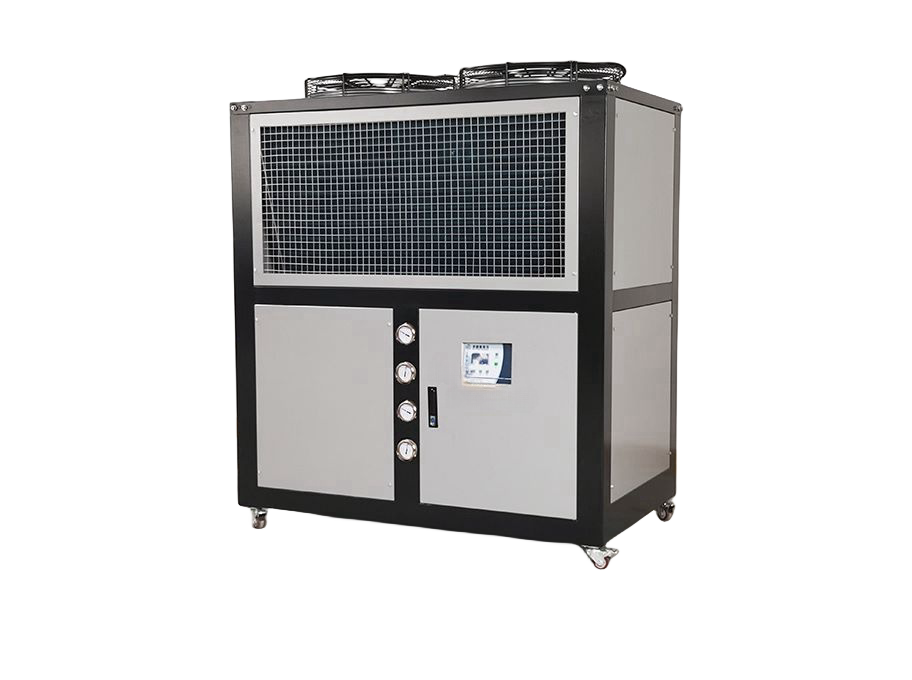
Many foundries lack centralized cooling tower infrastructure. Erecting a new tower requires massive plumbing work and structural reinforcement. Facilities often prefer to avoid the strict compliance regulations attached to open water systems. Furthermore, modern plants favor a decentralized layout. Installing an independent Air-Cooling Chiller next to each die casting cell provides excellent redundancy. If one unit requires service, the rest of the factory keeps running.
You must pay strict attention to ambient factory temperatures. Manufacturers typically rate air-cooled chiller capacities at 90°F or 95°F. Die casting floors get incredibly hot. Your ambient air might easily reach 110°F during summer months. Hotter air absorbs less heat from the condenser coils. The chiller loses active cooling capacity as the room warms up. You must derate the unit based on these peak summer temperatures. Review the manufacturer’s performance curve. A unit rated for 30 tons at 90°F might only deliver 24 tons at 115°F. Always size the compressor for the hottest day of the year.
Air-cooled units generally require a larger physical footprint than water-cooled alternatives. They also reject hot air directly into your factory space. You must plan for proper ventilation. However, they drastically simplify your ongoing maintenance routines. You eliminate complex chemical water treatments. You never have to dose anti-microbial agents or manage cooling tower blowdown. Maintenance primarily involves keeping the condenser fins clean and free of factory dust. This streamlined upkeep makes them highly attractive for busy production floors.
Specifying the raw refrigeration capacity solves only half the problem. You must also focus on fluid delivery and water quality. Ignoring these mechanical aspects guarantees failure.
Raw tonnage proves completely useless if the fluid never reaches the hot spots. Die casting tools feature complex, narrow cooling channels. These restrictive pathways create massive resistance. A standard pump will stall against this backpressure. You must prioritize pump pressure (PSI) alongside flow rate (GPM). If the pump cannot push water through the die's restrictions, the fluid boils inside the tool. Always specify high-pressure pumps designed for heavy industrial molds.
Water quality dictates long-term performance. Foundries often use untreated city water or well water. This causes disaster. Minerals precipitate out of the water at high temperatures. They attach to the hot internal walls of the die channels. This creates hard mineral scale. Scale acts as a powerful thermal insulator. A thick layer of scale ruins heat transfer entirely. A reliable industrial process cooling chiller needs a clean, closed-loop fluid path. Advocate for closed systems. Install proper filtration. Maintain strict fluid quality standards.
Chiller location impacts performance heavily. Some plants put the unit on the roof or far across the building. Long pipe runs create two severe problems. First, the pump loses pressure fighting the distance and gravity. Second, the fluid absorbs heat from the surrounding air before it ever reaches the machine. If you must locate the equipment remotely, you must insulate all pipework heavily. You must also upsize your pumps to overcome the additional friction loss.
Moving from theory to procurement requires discipline. You must gather precise data and evaluate vendors rigorously.
Do not request a chiller quote blindly. Gather hard data first. Demand specific numbers from your die casting machine manufacturer. Ask them for the exact hydraulic heat rejection rates. Next, consult your tooling engineer. Get the exact shot weight, cycle time, and recommended tool temperatures. You need this complete thermal profile before talking to a chiller salesman.
Evaluate your potential suppliers carefully. Follow these specific vetting steps:
Vendors who refuse to provide these documents usually sell generic, undersized equipment.
Take action today. Gather your specific alloy data. Record your shot weights. Measure your peak summer factory temperatures. Compile this information into a single technical brief. Schedule a verified thermal analysis with a specialized cooling engineer. They will use your exact data to generate a precise equipment specification.
Specifying chiller capacity requires strict engineering calculations. It is not a guessing game. Relying on basic machine tonnage leads to disastrous equipment sizing. You must evaluate the specific alloy heat signatures, extreme ambient temperatures, and complex die channel restrictions. The right cooling capacity directly protects your bottom line. It maximizes your daily yield, eliminates porosity defects, and minimizes expensive scrap. Gather your precise throughput data immediately. Consult an experienced technical sales team to finalize your exact equipment sizing.
A: We recommend separate circuits. Hydraulics require cooling at around 85°F. Dies operate at vastly different temperature profiles. Trying to cool both with one fluid loop compromises efficiency. Dual-circuit chillers or completely separate systems provide better thermal stability for each distinct process.
A: The exact loss depends on the compressor type and refrigerant. Generally, an air-cooled unit loses 5% to 10% of its rated capacity for every 10-degree rise above its baseline design temperature. Always review the manufacturer’s ambient performance curve for precise derating figures.
A: Your system likely suffers from inadequate pump pressure or severe heat exchanger fouling. Narrow die channels create high pressure drops. If the pump cannot overcome this resistance, flow rates plummet. Additionally, mineral scale acts as an insulator, drastically reducing actual heat transfer rates.
