
EMAIL:
lh@longhuamachine.com
TELL/whatsapp:
+8619305527239  English English
Views: 0 Author: Site Editor Publish Time: 2025-10-21 Origin: Site


Have you ever wondered how products in your car or phone achieve such precise shapes and smooth finishes? The performance of an aluminum die cast machine plays a key role in modern manufacturing. When you use a die casting machine with high speed, precision, and efficiency, you get better product quality and lower costs. Take a look at how these aspects affect your results:
Performance Aspect | Impact on Product Quality and Efficiency |
|---|---|
Production Speed | Quick turnaround for large quantities |
Precision | Tight tolerances and high dimensional accuracy |
Surface Finish | Smoother parts, less post-processing |
Material Waste Reduction | Less waste, more savings |
You see, strong aluminum die casting performance ensures your products meet industry standards and stay cost-effective.
High-speed aluminum die casting machines improve production efficiency and reduce costs.
Precision in die casting ensures parts meet exact specifications, minimizing defects.
Durable machines lead to less downtime and lower maintenance costs, enhancing productivity.
Energy-efficient die casting technologies lower operational expenses and support sustainability.
Aluminum die casting provides lightweight, strong components ideal for automotive, aerospace, and electronics.

Understanding the performance metrics of an aluminum die cast machine helps you achieve the best results in aluminum pressure die casting. Each metric—speed, precision, durability, and energy efficiency—directly shapes the outcome of the die casting process. When you focus on these factors, you improve the quality of die casting parts, increase high production efficiency, and control operational costs.
Speed in the aluminum die casting process determines how quickly you can produce parts. The injection speed of the die casting machine is critical. For example, typical values include 2.5m/s, 2.7m/s, 3.0m/s, and 3.5m/s. The position where the machine switches to high speed, such as at 450mm, 460mm, or 470mm, affects how well the molten aluminum fills the cavity. If you set the speed correctly, you reduce micropore defects and improve the mechanical properties of aluminum die casting parts.
Faster injection speeds help you achieve high production efficiency.
Proper speed settings lower the risk of defects in the aluminum die casting process.
Adjusting the speed ensures the aluminum fills every part of the mold, which is essential for complex shapes.
When you optimize speed, you get more aluminum pressure die casting parts in less time, which lowers your production costs and keeps your process competitive.
Precision is the ability of the aluminum die cast machine to produce parts that match exact specifications. In aluminum pressure die casting, you use several measurement methods to check precision:
Measurement Method | Description | Precision Level |
|---|---|---|
Dimensional Measurement Techniques | Tools like calipers, micrometers, and CMM are used to check part sizes. | ±0.1 mm to ±0.01 mm |
Coordinate Measuring Machines (CMM) | High-precision tool for critical dimensions, often used in high-spec applications. | Most accurate measurement available |
You also use non-destructive testing to check the integrity of die casting parts without causing damage. Dimensional analysis ranges from simple visual checks to advanced CMM measurements. Quality control during series production relies on these tools to ensure every aluminum pressure die casting part meets your standards.
Precision in the aluminum die casting process reduces defect rates. Here are some common defects and their impact:
Defect Type | Description | Impact on Quality |
|---|---|---|
Short Shots | Occurs when the mold is not completely filled with molten metal. | Leads to incomplete parts, affecting functionality. |
Porosity | Formation of voids within the casting due to trapped gas. | Weakens the material, reducing mechanical strength. |
Warpage | Distortion of the casting during cooling. | Affects dimensional accuracy and fit of components. |
If you maintain high precision, you avoid these problems and ensure your aluminum pressure die casting parts are reliable, especially for automotive and aerospace applications.
Durability measures how long your aluminum die cast machine can operate without failure. In aluminum pressure die casting, you want a machine that withstands repeated cycles of the die casting process. Durable machines reduce downtime and maintenance costs. When your die casting machine lasts longer, you produce more aluminum die casting parts over its lifetime.
Durable machines handle the high pressures and temperatures of the aluminum die casting process.
You spend less on repairs and replacements.
Consistent durability means your production schedule stays on track.
A focus on durability ensures your investment in aluminum die cast machines pays off with reliable, long-term performance.
Energy efficiency in aluminum pressure die casting affects your operational expenses and environmental impact. The melting and holding stages in the aluminum die casting process use a lot of energy. Traditional methods can be wasteful, but new technologies help you save.
Aspect | Percentage Contribution |
|---|---|
Energy consumption in die casting | 25% |
Melt-shop energy consumption | 77% |
For example, Isomelting technology achieves 99% energy transfer efficiency. When you use this technology in your aluminum die cast machine, you lower your energy costs and reduce your carbon footprint. Energy-efficient machines also help you meet environmental regulations and improve your company’s reputation.
Tip: Choosing an energy-efficient aluminum die cast machine not only saves money but also supports sustainable manufacturing.
By focusing on speed, precision, durability, and energy efficiency, you maximize the benefits of aluminum pressure die casting. These metrics help you deliver high-quality die casting parts, keep production costs low, and maintain a competitive edge in the industry.
Aluminum die casting offers a unique set of advantages that make it a top choice for many industries. When you use this process, you gain lightweight strength, cost-effectiveness, excellent surface finish, and outstanding corrosion resistance. These benefits of aluminum die casting help you create high-quality die casting parts for automotive, aerospace, electronics, and defense applications.
You often need components that are both strong and light. Aluminum die casting delivers a high strength-to-weight ratio, which means you get parts that can handle heavy loads without adding unnecessary weight. The process forms a fine-grained microstructure, giving the parts extra durability. Engineers can optimize material distribution during the process, so you get lightweight nature and high performance in every part.
For example, in the automotive industry, manufacturers use aluminum alloy die casting to produce engine blocks and transmission housings. These parts must be strong but not heavy. In aerospace, the lightweight nature of die casting parts helps reduce fuel consumption while maintaining structural integrity. This combination of strength and low weight is one of the main die casting advantages.
Note: The high strength-to-weight ratio of aluminum die casting parts allows you to design lighter vehicles and aircraft without sacrificing safety or reliability.
You want to keep production costs low while maintaining quality. Aluminum die casting stands out for its excellent economic benefits. The process uses low-cost raw materials and produces parts with minimal impurities and porosity. You also benefit from the ability to create complex shapes and thin walls, which reduces material waste and machining time.
Finished productions with exceptional surface finish
Low-cost raw materials
Lessening of impurities and porosity
Longevity
Thickness precision (less than 1.5 thickness is achievable)
Can produce parts with very complex designs
Production costs for aluminum die cast components can vary. The price of a single part ranges from a few cents to several dollars, depending on complexity, tooling, and finishing. In the automotive sector, tight margins mean you must watch aluminum prices and adjust your pricing structures. Tooling costs depend on part complexity, while casting costs include the price of aluminum and machine operation. Finishing costs change based on the detail level required.
When you choose aluminum die casting, you gain excellent economic benefits and efficiency, especially for high-volume production.
A smooth surface finish is important for both function and appearance. Aluminum die casting gives you die casting parts with excellent surface quality right out of the mold. You can choose from several finishing options to meet your needs:
Surface Finish | Typical Cost/cm² | Best Use Cases |
|---|---|---|
Anodizing | $0.10–$0.30 | Electronics, medical devices |
Powder Coating | $0.12–$0.35 | Automotive, outdoor parts |
Polishing | $0.20–$0.50 | Premium/luxury visible components |
Electroplating | $0.25–$0.60 | Electrical parts, chrome appearance |
Sand/Shot Blasting | $0.05–$0.15 | Industrial, pre-coating surface prep |
Chromate Coating | $0.03–$0.08 | Aerospace, electronics, cost-sensitive parts |
Clear Coating | $0.10–$0.25 | Visual metal parts, branding applications |
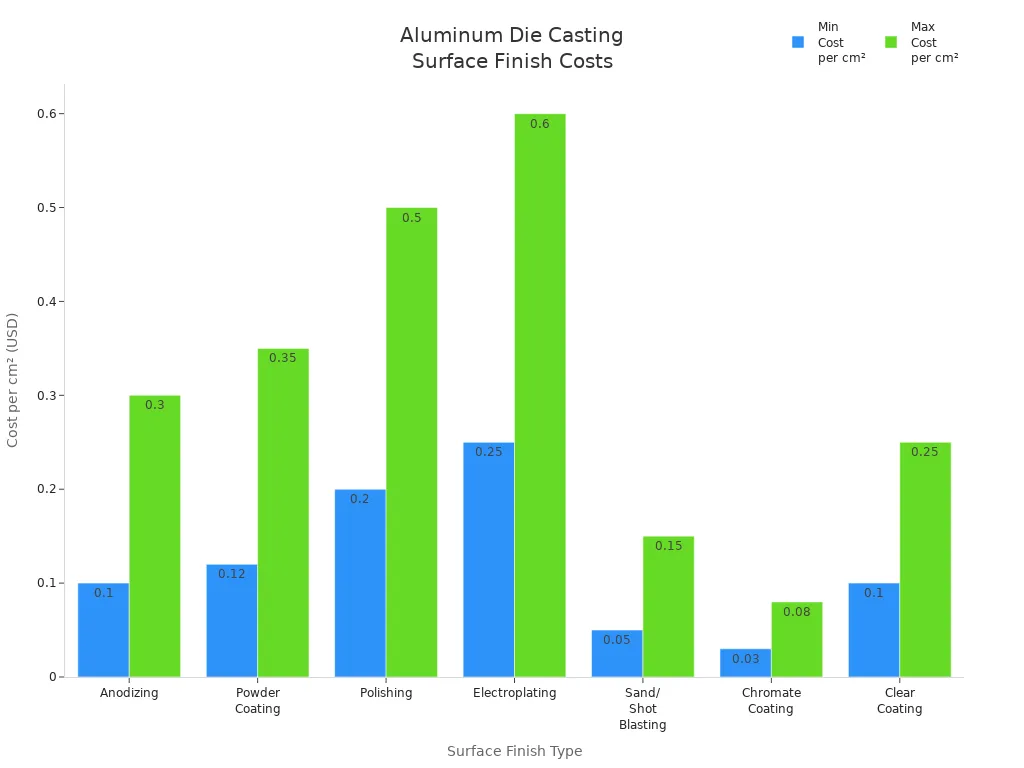
Surface treatments like anodizing and powder coating not only improve appearance but also add protection. In automotive and aerospace, anodizing enhances corrosion resistance and surface hardness. Coatings improve wear resistance and give parts a premium look. You can select the right finish for your application, whether you need durability, conductivity, or visual appeal.
Surface treatments enhance corrosion resistance, which is crucial for automotive and aerospace applications.
Improved wear resistance extends the life of components under high stress.
Aesthetic appeal is important for consumer-facing automotive parts.
You need die casting parts that last, even in harsh environments. Aluminum die casting provides excellent corrosion resistance, making it ideal for outdoor and high-moisture applications. Aluminum does not rust because of its low iron content. It forms a protective oxide layer that shields the surface from further damage.
Aluminum is known for its corrosion resistance, making it a popular choice for die casting.
It is rust-proof due to its low iron content in the chemical composition.
While aluminum can corrode under certain environmental conditions, it does not rust.
Advanced treatments like CastGuard™ anodizing increase salt spray resistance and extend service life, especially in marine or high-salt environments. Higher silicon content in aluminum alloys improves corrosion resistance, while copper content can reduce it. Compared to other casting methods, aluminum die casting offers superior protection:
Casting Method | Corrosion Resistance | Suitability for Outdoor Applications |
|---|---|---|
Aluminum Die Casting | Excellent | Yes |
Sand Casting | Moderate | Limited |
Permanent Mold Casting | Moderate | Limited |
You can rely on aluminum die casting for products that face moisture, chemicals, or outdoor exposure. This durability is especially important in automotive, aerospace, and defense, where long-term performance matters.
Tip: Choosing aluminum die casting ensures your parts resist corrosion and maintain quality, even in challenging environments.

Aluminum die casting plays a vital role in many industries. You can see its impact in the automotive industry, aerospace and defense, and electronics. Each field relies on die casting parts for their unique needs. Let’s explore how these applications benefit from the process.
You find aluminum die casting everywhere in modern vehicles. The automotive industry uses this process to create strong, lightweight, and precise components. Some of the most common die casting parts include:
Engine blocks
Intake manifolds
Gearbox housings
Electronic covers
Chassis components
Heat sinks
Fan impellers
Battery covers
These parts help reduce the overall weight of vehicles. When you use lighter components, you improve fuel efficiency and lower emissions. The strength-to-weight ratio of aluminum die casting parts also means you do not sacrifice safety or durability. This makes die casting applications essential for building reliable and efficient cars.
In aerospace, you need parts that are both light and strong. Aluminum die casting meets these demands by producing complex shapes with tight tolerances. Here are some typical aerospace die casting parts:
Aerospace Parts | Description |
|---|---|
Wings | Lightweight, strong, and essential for flight stability |
Engine Components | High-performance and durable for aircraft engines |
Structural Brackets | Provide support and stability in aircraft structures |
Landing Gear Parts | Require strength and durability for safe takeoff and landing |
Interior Fittings | Intricate designs for function and aesthetics |
Die casting allows you to create intricate parts without adding extra weight. This improves fuel efficiency and performance. The process also ensures high precision, which is critical for safety in aerospace and defense.
You rely on aluminum die casting to make electronic devices more efficient and durable. The process produces die casting parts that protect sensitive electronics and manage heat. Common applications include:
Component Type | Application Description |
|---|---|
Bus Bar | Power distribution in electrical systems |
Electrical Panel Enclosure | Shields electronics from dust and moisture |
Circuit Breakers | Ensures electrical safety |
Junction Boxes | Protects connections from the environment |
Inverter Housings | Guards against impact and interference |
Transformers | Uses aluminum’s thermal conductivity for heat management |
Battery Packs | Efficient heat management in power supplies |
Electric Motor Parts | Rotor housings, stator frames, end covers, and fans |
Actuators, Arms, Levers | Internal components for consistent operation |
Aluminum die casting parts offer excellent thermal conductivity. This helps electronic devices stay cool and last longer. The smooth finish and corrosion resistance also protect against wear and damage.
You see aluminum die casting in many defense applications. Military vehicles, aircraft, and communication systems all use die casting parts for their strength and reliability. Some key products include:
Product Type | Benefits |
|---|---|
Military-grade aluminum | Lightweight strength for mobility and fuel efficiency |
Components | Dimensional precision for critical operations |
Castings | Corrosion resistance in harsh environments |
Military vehicles | Reduced weight without losing strength |
Engine parts | Improved operational range and fuel efficiency |
Protective armor | Enhanced tactical mobility and durability |
Aluminum die casting ensures that defense equipment remains reliable in extreme conditions. The process delivers parts with high strength-to-weight ratios and excellent corrosion resistance. This is especially important in aerospace and defense, where performance and safety cannot be compromised.
Tip: When you choose aluminum die casting for your applications, you gain lightweight, strong, and precise parts that meet the highest industry standards.
When you want to get the best results from your aluminum die cast machine, you need to understand what influences its performance. Four main factors play a role: machine design, maintenance, operator skill, and material quality. Each one affects how well your die casting machine works and the quality of your die casting parts.
The design of your aluminum die cast machine sets the foundation for reliable die casting. Several aspects of machine design make a big difference:
Optimized part design helps you create stronger, more durable die casting parts.
Careful material selection for machine components increases lifespan and reduces breakdowns.
Cooling control ensures even solidification, which prevents defects.
Defect prevention features, such as advanced gating systems, reduce scrap rates.
Intelligent automation allows for precise control and repeatability in the die casting process.
Proper aluminum casting design is essential for producing high-quality die casting parts that meet industry standards.
Regular maintenance keeps your die casting machine running smoothly. You benefit in several ways:
Enhanced equipment longevity—routine checks extend the life of your aluminum die cast machine.
Improved production efficiency—scheduled servicing reduces unexpected downtime and keeps your production on track.
Optimal product quality—maintenance helps you spot and fix issues before they affect your die casting parts.
Tip: Set up a maintenance schedule to protect your investment and avoid costly repairs.
Your skill as an operator directly impacts the performance of the die casting machine. Key skills include:
Machine maintenance—performing regular upkeep prevents defects.
Calibration—adjusting settings ensures consistent die casting quality.
Material selection—choosing the right alloy matches the mechanical needs of your die casting parts.
Process monitoring—watching the process closely lets you catch and fix problems early.
Skilled operators help you achieve better results and fewer defects in every die casting cycle.
The quality of the aluminum alloy you use affects both output and reliability. Different alloys offer unique properties:
Property | Alloy A380 | Alloy A383 | Alloy A360 |
|---|---|---|---|
Strength and Hardness | Very high | Balanced | High corrosion resistance |
Fluidity and Castability | Moderate | Superior | Moderate |
Corrosion Resistance | Moderate | Moderate | Very good |
Thermal Conductivity | Moderate | Moderate | Excellent |
Ductility | Lower | Moderate | Higher |
Machinability | Moderate | Good | Good |
Shrinkage Resistance | Lower | Higher | Moderate |
High-quality materials give you stronger, more precise, and longer-lasting die casting parts. Good fluidity reduces defects, while strong alloys resist wear and deformation.
By focusing on these four factors, you can maximize the performance of your aluminum die cast machine and produce top-quality die casting parts for any application.
You can achieve manufacturing success when you focus on die casting machine performance. Every benefit and application of die casting depends on how well your machine works. If you want the best results, you should schedule regular maintenance and train your team to operate the equipment skillfully. When you select or upgrade your die casting equipment, always consider performance first. This approach helps you get the most from aluminum die casting and ensures your aluminum parts meet industry standards.
An aluminum die cast machine injects molten aluminum into a mold under high pressure. You use it to create precise, strong, and lightweight parts for many industries. This machine helps you achieve high production speed and excellent surface finish.
You use a cold chamber die casting machine for metals with high melting points, like aluminum. The molten metal stays outside the machine and gets poured into the chamber. Hot chamber machines work better for zinc alloys and have the metal inside the machine.
A high pressure die casting machine gives you better part accuracy and smoother surfaces. You can produce complex shapes quickly. This machine also reduces defects and material waste, making it ideal for automotive and electronics manufacturing.
You should look for a die casting machine supplier with a strong reputation, reliable support, and advanced technology. Check if they offer both aluminum die cast machines and zinc alloy die casting machines. Good suppliers provide training, spare parts, and maintenance services.
You can use some machines for both aluminum and zinc alloy die casting, but you must check compatibility. Cold chamber die casting machines work for aluminum, while hot chamber machines suit zinc alloys. Always follow the manufacturer's guidelines for best results.
