
EMAIL:
lh@longhuamachine.com
TELL/whatsapp:
+8619305527239  English English
Views: 0 Author: Site Editor Publish Time: 2025-10-15 Origin: Site


Die casting machines help you create high-precision metal parts by injecting molten metal under high pressure into molds. You use these machines with non-ferrous alloys like aluminum and zinc to produce parts with exact shapes and smooth surfaces. Industries such as automotive, aerospace, electronics, and construction rely on die casting machines for strong and durable components. Growing demand for these machines is clear, with the global market expected to reach $5.78 billion by 2030 as you seek more efficient ways to manufacture complex parts.
Die casting machines create precise metal parts by injecting molten metal into molds under high pressure. This process is ideal for producing large quantities of identical parts.
There are two main types of die casting machines: hot chamber and cold chamber. Choose hot chamber for low melting point metals like zinc, and cold chamber for higher melting point metals like aluminum.
Die casting offers many benefits, including high precision, cost-effectiveness for mass production, and minimal post-processing. This makes it suitable for industries like automotive and electronics.
Safety is crucial when operating die casting machines. Modern machines include features like emergency stops and temperature monitoring to protect operators.
While die casting is efficient, it has limitations such as high initial costs and is not suitable for small production runs. Consider these factors when planning your manufacturing process.
You use die casting machines to create metal parts with high accuracy and repeatability. These machines force molten metal into a mold cavity under high pressure. The process allows you to produce complex shapes with smooth surfaces and tight tolerances. You often choose die casting when you need large quantities of identical parts, such as automotive components or electronic housings.
There are two main types of die casting machines you will encounter:
Type of Die Casting Machine | Description |
|---|---|
Hot Chamber Die Casting Machines | Used for metals with lower melting points, allowing faster cycles and shorter production times. |
Cold Chamber Die Casting Machines | Suited for metals with higher melting points, melted separately and fed into the machine manually. |
Hot chamber machines work best for metals like zinc and magnesium. Cold chamber machines handle metals such as aluminum and copper alloys. You select the type based on the alloy you want to use and the properties you need in your finished parts.
Die casting machines offer several features that help you achieve consistent quality and efficiency. Here are some of the most important capabilities:
High Injection Velocities: You can inject molten metal at high speeds, which helps fill the mold quickly and reduces the risk of defects.
Thin-Walled Parts: These machines allow you to create parts with thin walls, saving material and weight.
Dimensional Accuracy: You get parts with tight tolerances, often within ±0.001 to ±0.004 inches, depending on the material.
Superior Surface Finish: Fast fill times and smooth die walls give your parts a clean, finished look right out of the mold.
Parts with minimal porosity also exhibit more consistent mechanical properties, higher dimensional accuracy, and better surface finishes.
Modern die casting machines come in a range of sizes and capacities. You can find machines that handle small, intricate parts or large, heavy components. Many machines now include automation features, such as robotic arms and automatic part removal, to boost productivity and safety.
Type of Machine | Size Range | Capacity Range | Automation Features |
|---|---|---|---|
Cold Chamber | Dozens to several thousand tons | Up to 5,500 T | Can integrate with automatic peripheral equipment for production |
Vertical | Mainly small to medium-sized | Lower production efficiency | Less automation, mainly for special products like motor rotors |
Hot Chamber | Varies based on material | Depends on the specific machine | Typically higher automation for specific alloys |
Safety is a top priority when you operate die casting machines. Modern machines include features such as:
Enclosure and guarding systems to protect you from hot metal and moving parts.
Emergency stop buttons for quick shutdowns.
Temperature and pressure monitoring to prevent dangerous conditions.
Automatic lubrication and cooling systems to keep the machine running smoothly.
Safety sensors and proximity switches to detect if someone is too close to moving parts.
Technological advancements have improved die casting machines over the past decade. You now benefit from:
Automation integration for faster, more reliable production.
Improved cycle times, which let you make more parts in less time.
Enhanced quality control, including vacuum systems that remove contaminants.
Electric servo motors, which save energy and reduce maintenance.
When you use die casting, you can expect high-speed production, strong and lightweight parts, and excellent consistency. These machines help you meet the demands of industries that require precise, durable, and attractive metal components.
You follow a precise die casting process to create high-quality castings with tight tolerances and smooth surface finishes. This metal casting process uses non-ferrous alloys and hardened steel dies to produce parts that meet strict requirements. Here is how you complete the die casting process from start to finish:
Mold Preparation
You begin by cleaning and lubricating the die. Preheating the die helps the molten metal flow smoothly and prevents defects in the parts.
Metal Melting
You melt the selected non-ferrous alloy, such as aluminum or zinc, in a furnace. You monitor the temperature to ensure consistency and purity throughout the process.
Injection of Molten Metal
You inject the molten metal into the die cavity under high pressure. This step is the core of the die casting process and ensures that the metal fills every detail of the mold.
Cooling and Solidification
You allow the metal to cool and solidify inside the mold. The cooling system in the die helps control the temperature and speeds up the process.
Ejection of the Casting
You use ejector pins to remove the solidified part from the mold. This step must be done carefully to avoid damaging the parts.
Trimming & Finishing
You trim off any excess material, such as sprues or runners. You may also deburr or coat the parts to achieve the desired finishes.
The average die casting process cycle takes between 30 seconds to 1 minute. You measure the cycle time from the start of one injection to the next. Each phase of the process adds to the total cycle time, so efficient operation is key to high-volume production.
You rely on the die casting process to deliver parts with excellent dimensional accuracy and minimal defects. The process produces parts with complex shapes and fine details, making it ideal for industries that demand precision.
You need to understand the main components of the die casting mold and how they interact with the machine. Each part of the mold plays a specific role in the die casting process:
Mold Cavity
This hollow space forms the exterior shape of your part.
Mold Core
The core creates interior features and recesses in the casting.
Sprue
The sprue acts as the main channel for molten metal to enter the mold.
Runner
The runner guides the molten metal from the sprue to the mold cavity.
Gate
The gate controls the flow of metal into the cavity, ensuring even filling.
Ejector System
After the metal solidifies, the ejector system pushes the finished part out of the mold.
Cooling System
The cooling system regulates the temperature inside the mold, which is essential for maintaining the quality of the parts and the speed of the process.
The die casting mold consists of a fixed mold attached to the injection side of the machine and a movable mold that opens to release the casting. The sprue, runner, and gate work together to channel molten metal efficiently into the cavity. The ejector system ensures you can remove the casting without damaging it. The cooling system keeps the mold at the right temperature, which helps you achieve consistent results and extends the life of the die.
You use non-ferrous alloys in the die casting process because they flow easily and fill the mold quickly. Hardened steel dies withstand the high thermal and mechanical stresses of repeated cycles. This combination improves the durability of your equipment and reduces production costs. For example, aluminum die casting can produce up to 150,000 castings from a single die, which saves you money and time.
The die casting process stands out for its ability to create parts with smooth surface finishes and intricate details. You achieve high-quality castings that require little to no additional machining. This process is essential for industries that need reliable, precise, and attractive metal components.
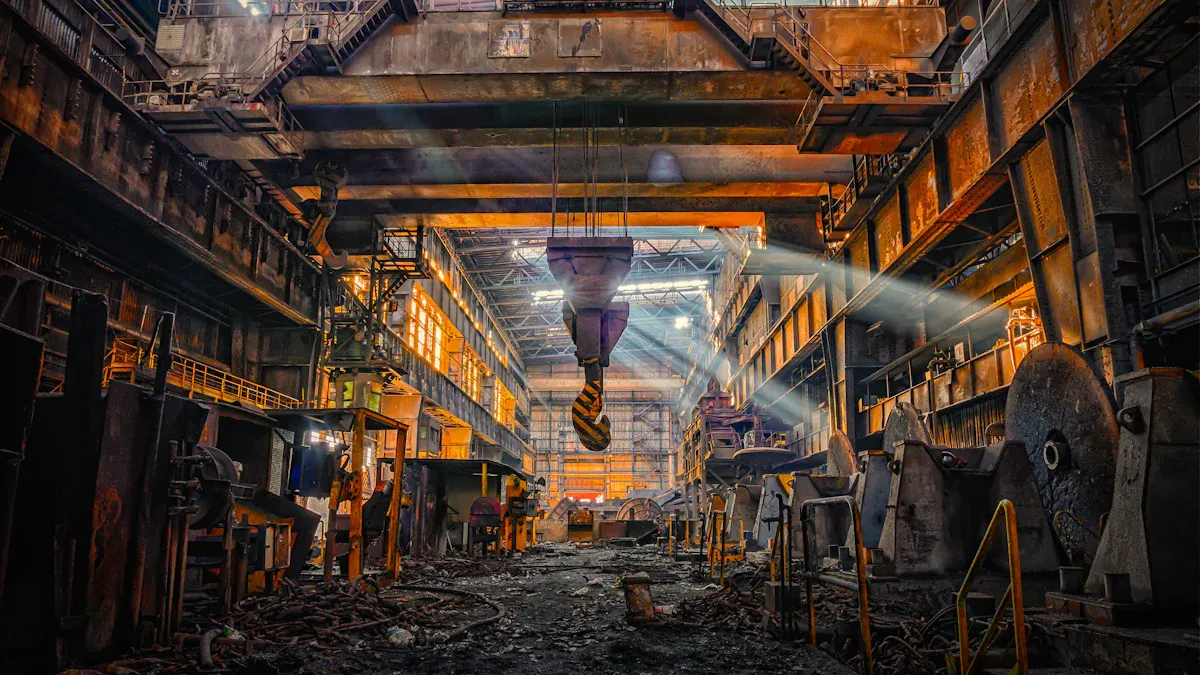
You often choose hot chamber die casting when you need to produce small, precise parts quickly. This method uses a machine where the molten metal stays inside a heated chamber. You inject the metal directly into the mold, which speeds up the process. Hot chamber die casting works best for metals with low melting points, such as zinc, magnesium, and lead alloys. Magnesium die casting is a common application because magnesium flows easily and fills molds well.
Here are the defining characteristics of hot chamber die casting:
Characteristic | Description |
|---|---|
High Production Efficiency | You can complete multiple cycles per minute, making it ideal for mass production of small parts. |
High Precision and Surface Quality | You get parts with excellent dimensional accuracy and smooth surfaces. |
High Degree of Automation | Advanced control systems allow automated operation, reducing manual work. |
Suitable for Low Melting Point Metals | You use metals like zinc, magnesium, and lead alloys. |
Simple Structure | Machines are easy to operate and maintain. |
Wide Application Areas | You find these machines in automotive, aerospace, and electronics industries. |
You see hot chamber die casting in many industries:
Automotive: You make carburetors and gear housings.
Electrical and Electronics: You produce connectors and switches.
Consumer Products: You create small appliance and tool components.
Industrial Machinery: You supply precision parts for pneumatic and hydraulic systems.
You use cold chamber die casting when you work with metals that have higher melting points, such as aluminum, copper, and brass. In this process, you melt the metal in a separate furnace. Then, you ladle the molten metal into the injection chamber of the machine. This method helps you avoid damage to the machine from high temperatures.
Here are the metals best suited for cold chamber die casting:
Metal Type | Properties and Applications |
|---|---|
Aluminum | Lightweight, cost-effective, resists corrosion, perfect for high-volume production. |
Zinc Alloys | Durable, consistent quality, ideal for large-scale production. |
Copper | High strength, great for durable parts. |
Brass | Good for high-strength applications. |
Magnesium | Lightweight, suitable for extreme conditions. |
Cold chamber die casting lets you create strong, complex parts for automotive, aerospace, and industrial uses. You often choose this method for aluminum parts that need to withstand stress and heat.
You need to decide between high-pressure die casting and low-pressure die casting based on your production needs and the type of parts you want to make. High-pressure die casting injects molten metal into the mold at very high speeds. This method gives you rapid cycle times and is perfect for making large numbers of thin-walled or complex parts.
Low-pressure die casting uses a slower process. You fill the mold with molten metal using lower pressure, which takes more time. This method works well for thicker-walled parts and parts that need high internal quality.
Here is a comparison:
Feature | High-Pressure Die Casting | Low-Pressure Die Casting |
|---|---|---|
Production Speed | High production efficiency, rapid cycles | Slower cycle times |
Part Quality | Excellent surface finish, thin-walled parts | High internal quality, thicker-walled parts |
You use high-pressure die casting for engine blocks, suspension components, cylinder heads, aluminum wheels, and heat sinks. Low-pressure die casting is better for complex shapes and parts that need to be strong inside, like pump housings and impellers.
Tip: If you want to produce a high volume of complex, thin-walled parts, choose high-pressure die casting. For thicker, high-quality parts, low-pressure die casting is your best option.
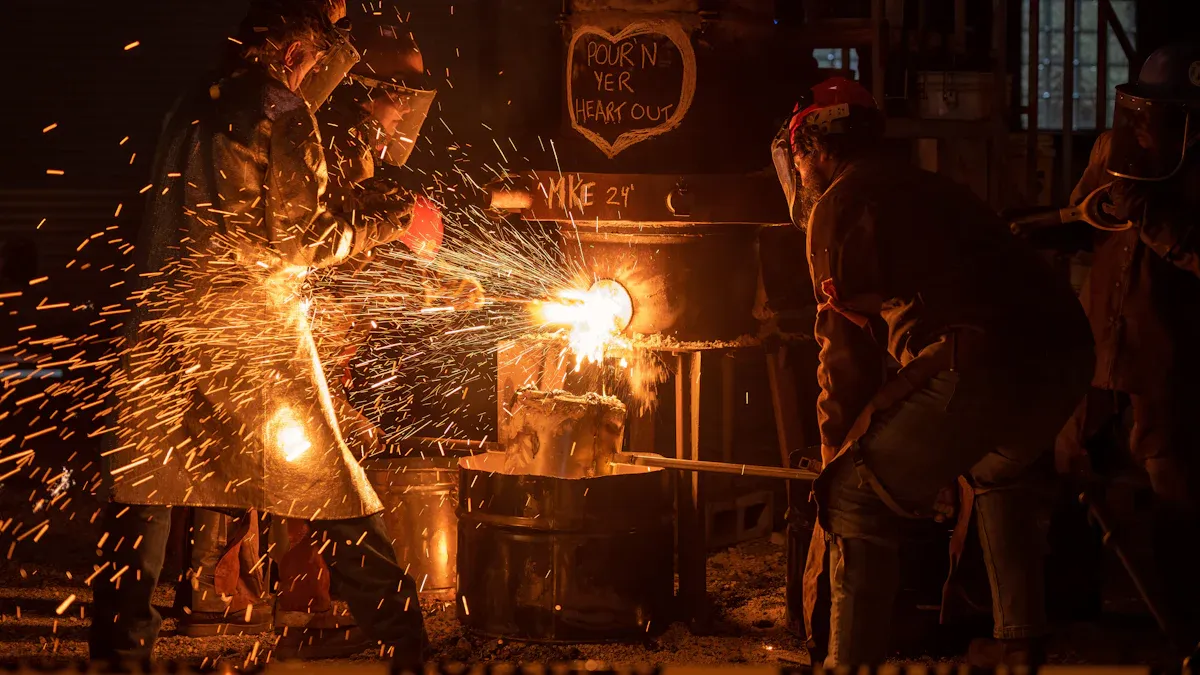
You rely on die casting to produce parts with specific properties for different applications. Aluminum die casting stands out because it offers a balance of strength, weight, and corrosion resistance. You often choose aluminum alloys like A380, 360, 383, 384, 390, and 413 for their unique characteristics. The table below helps you compare these alloys and select the best option for your die casting applications:
Alloy | Corrosion Resistance | Resistance to Hot Cracking | Anodizing | Machinability | Common Applications |
|---|---|---|---|---|---|
A380 | Fair | Very Good | Good | Good | Workbench vises, gear cases, lawnmower housings |
360 | Best corrosion resistance | N/A | N/A | N/A | Special applications with cost premiums |
380 | Best utility and cost | N/A | N/A | N/A | General use |
383/384 | Moderate sacrifice in toughness | N/A | N/A | N/A | Better die filling |
390 | High strength and wear-resistance | N/A | N/A | N/A | Special applications |
413 | N/A | N/A | N/A | N/A | Maximum pressure tightness and fluidity |
You see that the choice of alloy affects the mechanical properties and cost of your die casting parts. Aluminum alloys give you a cost-effective solution for most die casting applications. Magnesium, zinc die casting, and ZA alloys also offer advantages for specific designs. You select the alloy based on the strength, weight, and durability you need for your parts.
The alloy you choose impacts product cost and process efficiency.
Aluminum alloys provide a good balance of strength and weight.
ZA alloys deliver the highest strength for compact die casting applications.
You use die casting to create parts for many industries. Aluminum die casting helps you produce lightweight, strong components for automotive, aerospace, and electronics. Zinc die casting is popular for smaller, intricate parts in consumer goods and industrial equipment. You find die casting applications in the following sectors:
Electronics: You manufacture durable enclosures, heat sinks, and connectors.
Construction: You produce robust fittings, brackets, and machinery housings.
Consumer Goods: You create appliances, power tools, and outdoor gear.
Automotive: You make lighter transmission housings to improve fuel efficiency.
Aerospace: You supply components that enhance aircraft performance and safety.
Renewable Energy: You build parts for solar panels and wind turbines.
Agriculture: You provide machinery components for tractors and harvesters.
Military: You deliver parts for firearms and defense equipment.
Medical: You produce devices and systems for healthcare.
Recreational Vehicles: You manufacture structural and functional parts.
Real-world die casting applications show how you benefit from this process:
Automotive transmission housings reduce vehicle weight and boost fuel efficiency.
Electronics heat sinks improve cooling and processing power.
Aircraft avionics housings protect sensitive electronics in harsh environments.
You also see zinc and other non-ferrous alloys used in oil and gas, marine, shipbuilding, cement, fastener manufacturing, petro-chemicals, engineering, construction, interior design, plastics, and tool rooms. Die casting gives you reliable, high-quality parts for every application.
You gain many advantages when you choose die casting for your production needs. This process stands out for its ability to deliver high-quality parts quickly and efficiently. Here are the main benefits you experience:
High Precision and Consistency
Die casting produces parts with excellent accuracy and uniformity. You rely on this precision for applications in automotive, electronics, and aerospace.
Cost-Effectiveness for High-Volume Production
As your production volume increases, your per-part cost drops. Die casting becomes especially cost-effective for mass production runs.
High Speed and Efficiency
You can produce thousands of parts daily. Short cycle times make die casting ideal for mass production and urgent applications.
Complex Part Geometries
You create intricate shapes and fine details that other processes struggle to achieve. This flexibility opens up new applications in many industries.
Material Versatility
You work with a range of metals, including aluminum, zinc, and magnesium. This versatility supports diverse production requirements.
Minimal Post-Processing
Most parts come out of the die cast machine with a smooth finish. You spend less time and money on additional processing.
Excellent Surface Finish
Die casting delivers parts with a clean, attractive appearance. You often use these parts directly in final applications.
Reduced Material Waste
Efficient material use means you waste less and save more during production.
Enhanced Mechanical Properties
Parts from die casting offer high strength, durability, and resistance to wear and corrosion. You trust these qualities for demanding applications.
Scalability
You can easily scale your production up or down to meet market demand.
Die casting outperforms other metal forming methods like forging or machining. You get more precise parts with fewer flaws, which improves product quality and reduces costs for large production runs.
While die casting offers many benefits, you also face some challenges. Understanding these limitations helps you make informed decisions for your production strategy.
Fault Type | Description |
|---|---|
Leakage | Can hinder production efficiency and part quality. |
Defects in cast parts | Affects the overall quality of the produced items. |
Hydraulic system malfunctions | Can lead to operational failures and downtime. |
Die clamping issues | May cause inaccuracies in the casting process. |
Electrical system failures | Can disrupt the functioning of the die casting machine. |
Limited to non-ferrous metals | Restricts the types of materials that can be used in die casting. |
High initial investment | Requires significant upfront costs for machinery and setup. |
Susceptibility to defects | Inherent risk of producing flawed parts. |
Unsuitable for small projects | Not cost-effective for low-volume production runs. |
Not every project suits die casting.
High initial costs can be a barrier for some manufacturers.
You find die casting less practical for small production runs due to setup costs.
Material and maintenance costs also impact your overall expenses. Prices for non-ferrous metals like aluminum, zinc, and magnesium continue to rise. You must consider tooling, die casting, and secondary processing costs to keep your operation running smoothly.
Die casting involves significant upfront costs for molds and machine setup. You need to test and prepare the molten metal, which adds to your expenses. For small production runs, other methods may be more economical.
You should weigh these limitations against the benefits before choosing die casting for your applications. High-pressure die casting works best for mass production and complex parts, but you need to plan for maintenance and material costs to maximize your investment.
You now understand how die casting machines help you create precise metal parts for many applications. You see that die casting offers high efficiency, especially for automotive and electronics applications. You choose between machine types and alloys to match your production needs. You benefit from advancements in die casting, such as energy-efficient solutions and new materials for demanding applications.
The market for die casting continues to grow, driven by automotive and electric vehicle applications.
You find die casting ideal for high-volume, cost-effective manufacturing.
Die casting gives you reliable results for complex applications. Explore more to see how die casting can improve your production.
You use die casting to create metal parts by forcing molten metal into a mold under high pressure. This process helps you make parts with precise shapes and smooth surfaces. Die casting works best for non-ferrous metals like aluminum and zinc.
You choose die casting when you need large quantities of identical parts with high accuracy. This method gives you fast production, excellent surface finish, and strong parts. Die casting also reduces material waste and post-processing time.
You can use non-ferrous metals such as aluminum, zinc, and magnesium in die casting. These metals flow easily and fill molds quickly. Aluminum is popular because it is lightweight and resists corrosion.
Die casting offers high-speed production, tight tolerances, and minimal finishing work. You get parts with consistent quality and complex shapes. This process is ideal for automotive, electronics, and consumer products.
You may face high initial costs for molds and machines. Die casting works best for high-volume production. It is not suitable for ferrous metals or small production runs. You must also monitor for defects and maintain your equipment.
