
EMAIL:
lh@longhuamachine.com
TELL/whatsapp:
+8619305527239  English English


A temperature control unit helps you manage process temperatures with precision. You will find these devices essential in industries such as pharmaceuticals, chemicals, and engineering, where keeping the right temperature ensures product quality and safety. The market for these systems continues to grow, reaching over USD 100 billion in 2024. With a temperature control unit, you can heat, cool, or preheat equipment for reliable and efficient operations.
Temperature control units (TCUs) are essential for maintaining precise temperatures in industries like pharmaceuticals and food production, ensuring product quality and safety.
Key components of a TCU include pumps, heaters, and controllers, which work together to regulate temperature and improve efficiency in industrial processes.
Using advanced sensors and programmable logic controllers (PLCs) enhances real-time monitoring and automation, leading to better temperature control and reduced risk of equipment failure.
Regular maintenance and safety features in TCUs help prevent overheating and extend equipment life, ultimately saving costs and improving operational reliability.
Choosing the right type of temperature control unit—such as direct injection, closed circuit, or isolated circuit—depends on your specific process needs and desired level of fluid separation.
You use a temperature control unit to manage and regulate the temperature of industrial processes. This device compares signals from a temperature sensor with a set point you select. When the sensor detects a difference, the unit adjusts heat generation to match your desired temperature. The temperature control unit relies on a feedback control system, which includes both a controller and a sensor. You benefit from this system because it keeps your process value aligned with the set temperature, ensuring consistent results.
A temperature controller plays a vital role in this process. It monitors the temperature and calculates the necessary adjustments. You see these units in many industries because they help maintain product quality and safety. For example, in the chemical industry, you need precise temperature control to keep viscosity stable during casting. In food production, you rely on accurate temperature management to maintain the cold chain and achieve consistent fermentation. The semiconductor industry demands strict temperature control to prevent unusable wafers. In aerospace, you use temperature control units to help satellites withstand extreme conditions.
Tip: When you choose a temperature control unit, you improve efficiency and reduce the risk of errors in your manufacturing process.
You operate a temperature control unit by circulating a heat transfer fluid, such as water or oil, through your process equipment. The unit heats or cools the fluid to reach the target temperature. The fluid flows through pipes and chambers, transferring heat to or from your equipment. This circulation ensures that your machinery stays at the optimal temperature for your process.
Here is a table showing the main components and their functions:
Component | Function |
|---|---|
Heaters | Add energy to the heat transfer fluid to increase temperature. |
Pumps | Circulate the fluid through the system, ensuring consistent flow. |
Control Valves | Regulate and divert fluid flow to maintain precise temperature control. |
Centrifugal Pumps | Provide high flow rates with lower pressures, ideal for heat transfer. |
Modulating Valves | Adjust flow dynamically based on process demands for precise control. |
You rely on programmable logic controllers (PLCs) to automate the monitoring and management of temperature settings. PLCs collect real-time data from sensors and respond quickly to changes. This automation helps you maintain optimal temperatures, protect your equipment, and boost productivity. PLCs also adjust heating and cooling devices to prevent thermal stress, which preserves machinery and improves safety. When you use PLCs in your temperature control units, you minimize downtime and reduce the risk of equipment failure.
You can also use a temperature control unit to preheat your equipment before starting production. This function helps you reach the desired temperature faster and ensures consistent results from the beginning of your process.

You rely on the pump to move the heat transfer fluid through your temperature control unit. The pump keeps the fluid circulating between your process equipment and the unit itself. The type of flow inside the system—laminar or turbulent—affects how well energy transfers. Turbulent flow increases energy transfer efficiency by up to ten times compared to laminar flow. When you use a pump with a higher flow rate, you minimize the temperature difference between supply and return. This creates a more uniform temperature gradient and helps your temperature control process stay consistent.
Tip: Choose a pump that matches your system’s needs. Higher flow rates often lead to better temperature control and more reliable operation.
The heater raises the temperature of the fluid inside your temperature control unit. You select the heater based on your process requirements and efficiency goals. Heaters come in different types, each with unique benefits and drawbacks. Here is a table showing common heater types and their features:
Heater | Efficiency | Pros | Cons | Ideal Use |
|---|---|---|---|---|
Condensing Furnace | 95%+ AFUE | Lower fuel costs, eco-friendly | Higher upfront cost | Homes in cold climates |
Heat Pump | COP 2.5–4, HSPF 8–13 | Efficient, doubles as air conditioner | Less effective in extreme cold | Mild to moderate climates |
Boiler | 85%–95% AFUE | Consistent heat, good for radiant setups | Slow response time | Radiant or hydronic heating setups |
You benefit from choosing a heater with high efficiency. This helps you save energy and maintain precise temperature control in your process.
The temperature controller acts as the brain of your temperature control unit. You use it to monitor and adjust the temperature in real time. Most controllers work like a household thermostat, accepting inputs from sensors such as RTDs and thermocouples. You see these controllers in food processing, where they keep refrigeration systems at safe temperatures to prevent spoilage. The controller continuously adjusts outputs to control heaters, compressors, or coolers.
Key functions of a temperature controller:
Maintains safe temperatures in industrial processes.
Accepts input from various temperature sensors.
Continuously adjusts heating or cooling devices for constant temperature.
PID control uses three elements: Proportional for error correction, Integral to remove steady-state errors, and Derivative to reduce overshoot and provide damping.
The PID controller measures the current temperature.
It calculates the output needed to adjust heating or cooling.
The controller makes real-time changes to keep your process at the set temperature.
You use the cooling valve to regulate the flow of cooling fluid in your temperature control unit. The valve responds quickly to changes in temperature, helping you maintain precise control. Different types of cooling valves offer unique features:
Type of Valve | Description |
|---|---|
Thermostatic Control Valves | Use a sensor to detect temperature and adjust the valve accordingly. |
Actuated Control Valves | Operated by a motor based on set values from a controller, can be manual or automatic. |
Pneumatic Control Valves | Used in industrial applications for precise control and fast response times. |
Electric Control Valves | Regulate fluid flow to control temperature in various settings, including residential and industrial. |
You select the valve type based on your process needs. Fast response times and precise control help you achieve stable temperature control and protect your equipment.
You see the circulation process as the heart of every temperature control unit. The vessel holds the heat transfer fluid, which can be water or oil. The heater and heat exchanger sit inside the vessel. The recirculation pump moves the fluid through your equipment and back to the vessel. The temperature controller checks the actual temperature in the vessel. If the temperature rises above your set point, the cooling system starts to lower it. If the temperature drops below your target, the heater increases it. This cycle keeps your process stable and efficient.
You can compare different models by their temperature ranges and pump flow rates. The table below shows how various temperature control units manage these values:
Model | Temperature Range | Pump Flow Pressure |
|---|---|---|
HR | -25 ~ +200 °C | 20 … 110 L/min |
HRT | -45 ~ +250 °C | 20 … 110 L/min |
SUNDI-1 series | -10 ~ +150 °C | 20 … 75 L/min |
SUNDI-2 series | -25 ~ +200 °C | 20 … 600 L/min |
SUNDI-23 series | -25 ~ +300 °C | 20 … 600 L/min |
SUNDI-4 series | -45 ~ +250 °C | 20 … 600 L/min |
SUNDI-43 series | -45 ~ +300 °C | 35 … 150 L/min |
SUNDI-6 series | -60 ~ +250 °C | 20 … 250 L/min |
SUNDI-63 series | -60 ~ +300 °C | 35 … 150 L/min |
SUNDI-7 series | -70 ~ +250 °C | 20 … 110 L/min |
SUNDI-8 series | -80 ~ +250 °C | 20 … 400 L/min |
SUNDI-9 series | -90 ~ +250 °C | 20 … 400 L/min |
SUNDI-10 series | -100 ~ +100 °C | 35 … 400 L/min |
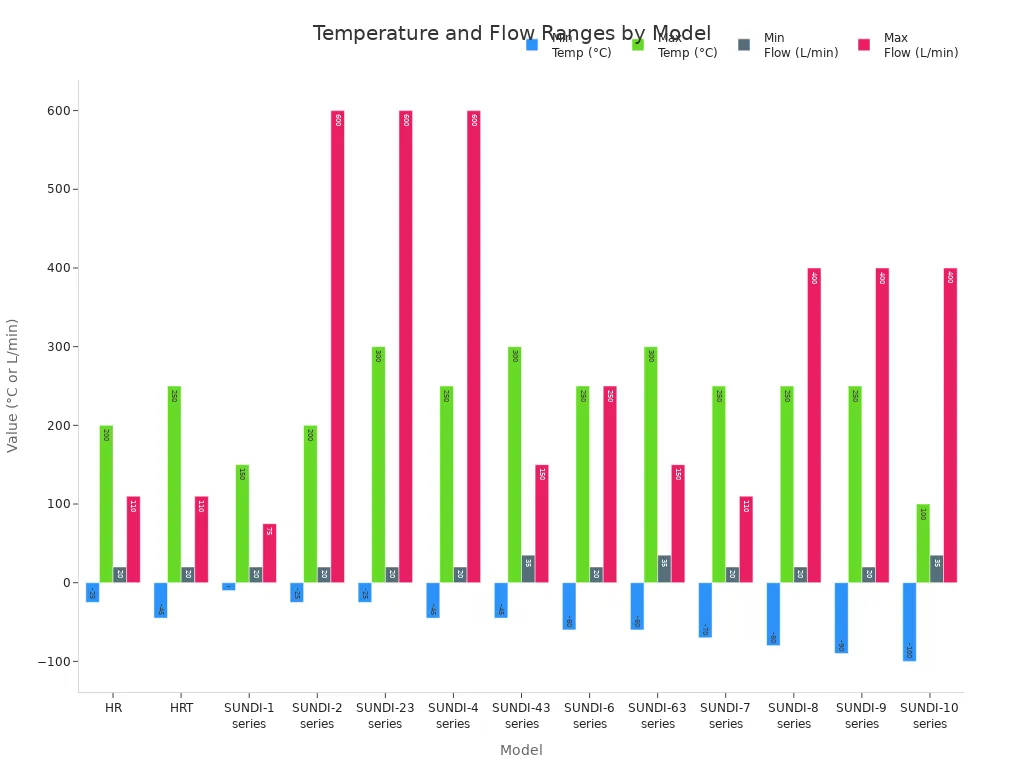
You select a model based on your process needs. Some units handle extreme temperatures and high flow rates, which helps you maintain precise temperature control in demanding environments.
You rely on sensors to keep your process at the right temperature. Modern temperature control units use IoT temperature sensors for real-time monitoring. These sensors give you instant feedback about temperature changes. You can spot fluctuations quickly and respond before they affect your product.
Real-time Monitoring: Sensors show you the current temperature instantly.
Improved Accuracy and Precision: You get exact data, which helps you manage your system more effectively.
Automated Adjustments: The system can change heating or cooling automatically based on sensor data.
Your temperature controller uses this information to adjust the heater or cooling valve. You see the benefits in consistent product quality and reduced waste. Fast adjustments help you avoid problems like overheating or undercooling.
Tip: Use advanced sensors and controllers to improve your temperature control and reduce manual intervention.
You protect your equipment and process by using safety features in temperature control units. These features prevent overheating and system failure. You see the most common safety features in the table below:
Safety Feature | Description |
|---|---|
Ensuring Proper Load Distribution | Spreads out the load among heating elements to prevent overload and maximize efficiency. |
Improving Ventilation | Enhances airflow to dissipate heat, preventing overheating and improving reliability. |
Regular Maintenance and Component Replacement | Routine checks and replacing faulty parts keep your system running smoothly and prevent overheating. |
You keep your system safe by following these practices. Good ventilation and regular maintenance help you avoid costly breakdowns. Proper load distribution ensures your temperature control unit works efficiently.
Note: Always check your system for signs of wear and overheating. Regular maintenance extends the life of your equipment.
When you choose a temperature control unit, you need to understand the different circuit types. Each circuit type affects how your system manages heating and cooling. You can select the best option for your process by learning about direct injection, closed circuit, and isolated circuit designs.
You use a direct injection circuit when you want fast temperature changes. In this setup, the heat transfer fluid flows directly from the temperature control unit into your process equipment. The fluid mixes with the process medium, which helps you reach the target temperature quickly. You often see direct injection in applications where you need rapid heating or cooling, such as in plastic molding or chemical reactors.
Advantages of Direct Injection:
Quick response to temperature changes
Simple design and easy maintenance
Disadvantages:
Possible contamination between process fluid and heat transfer fluid
Limited control over fluid purity
Tip: Use direct injection when speed matters more than fluid separation.
You rely on a closed circuit when you want to keep the heat transfer fluid separate from your process medium. The fluid circulates in a loop between the temperature control unit and your equipment, but it never mixes with the process material. This design helps you maintain fluid purity and prevents contamination. You often use closed circuits in food processing, pharmaceuticals, and electronics manufacturing.
Feature | Benefit |
|---|---|
Fluid Separation | Prevents contamination |
Consistent Flow | Improves temperature control |
Lower Maintenance | Reduces cleaning needs |
You get stable and reliable temperature control with a closed circuit, which is important for sensitive processes.
You choose an isolated circuit when you need complete separation between the temperature control unit and your process. In this design, a heat exchanger transfers energy between two fluids without mixing them. You often use isolated circuits in hazardous environments or when your process fluid must remain uncontaminated.
Key Points:
Maximum protection against contamination
Suitable for high-purity or dangerous materials
Allows you to use different fluids for heating and cooling
Note: Isolated circuits offer the highest safety and flexibility for temperature control in demanding applications.
You rely on temperature control to achieve high-quality results in injection molding. When you keep the mold cavity at the right temperature, you get plastic parts with a smooth, high-gloss finish. If you let the temperature drift, you risk defects like warping, marks, or uneven surfaces. In fact, temperature control errors cause about 20% of rejects in the injection molding industry. By using temperature control units such as screw chillers and mold heaters, you can manage the process more precisely. These systems help you avoid shading and ensure every part meets your standards. Advanced solutions like iQ flow control also boost process consistency and prevent defects before they start.
Maintain optimal mold temperature for uniform gloss and surface quality
Reduce rejects and improve efficiency with precise temperature control
Prevent common defects such as warping and poor finishes
In blow molding, you need to manage several temperature zones to shape plastic products correctly. Temperature control units help you keep each zone within the right range, so you avoid problems like sagging or weak spots. The table below shows the typical temperature ranges for each part of the process:
Temperature Zone | Temperature Range (℃) | Purpose |
|---|---|---|
Barrel Temperature | 190-210 | Melts plastic granulates without causing degradation |
Parison Formation Zone | 200-215 | Ensures even flow for uniform wall thickness |
Mold Temperature | 60-100 | Cools material quickly for strong, stable products |
Critical Consideration | >220 | Avoids thermal degradation and harmful gas release |
You use efficient temperature control to keep each zone stable, which leads to better product strength and appearance.
You depend on temperature control units to keep the extrusion process stable and efficient. If you set the temperature too low, the plastic may not melt completely. If you set it too high, the material can degrade and lose strength. The table below highlights key temperature points in extrusion:
Temperature Type | Description |
|---|---|
Viscous Flow Temperature | Minimum needed for proper plastic flow |
Degradation Temperature | Maximum allowed to prevent damage |
Optimal Melt Temperature | Usually 200-230°C for polyethylene pipe extrusion |
Exit Temperature | Should not exceed 220°C for consistent quality |
Temperature Difference | Should stay within 20°C from entrance to exit of the head |
Proper temperature control ensures the polymer flows smoothly.
You prevent incomplete melting and keep product dimensions stable.
You also see temperature control units used outside plastic manufacturing. In food and beverage production, you use them for blending, brewing, sterilization, and cooking. In healthcare, you rely on them for laboratory equipment, refrigeration, autoclaves, and incubators. These applications show how precise temperature control supports safety, quality, and efficiency across many industries.
Tip: Consistent temperature control in any process helps you reduce waste, improve product quality, and lower energy costs.
Temperature control units give you reliable process stability and product quality. Each component—pump, heater, controller, and cooling valve—works together to keep your system efficient and safe.
Benefit | Description |
|---|---|
Cost Reduction | Avoids waste and lowers energy bills. |
Maintenance Savings | Extends equipment life and prevents breakdowns. |
Product Quality Assurance | Maintains stable temperatures for fewer defects. |
Safety Improvements | Reduces risks from temperature changes. |
You improve efficiency and safety with regular maintenance.
Advanced features like AI and sensors make temperature control units smarter and more reliable.
Consider a temperature control unit for better results in your industrial process.
Manual temperature control requires you to adjust settings yourself. An automatic temperature control system uses sensors to monitor the current temperature and adjusts heating or cooling automatically. You get more consistent results and better temperature stability with automatic systems.
Sensors measure the current temperature and send data to the temperature control system. The system compares this value to the temperature set point. If the temperature sensor detects a difference, the system changes heating or cooling to reach the desired temperature.
Heat transfer moves energy between the temperature control unit and your process equipment. You rely on heat transfer for both heating and cooling. Efficient heat transfer helps you reach the desired control temperature quickly and keeps your process stable.
You can use a temperature control unit for heating and cooling. The unit uses heat transfer fluid and sensors to monitor the current temperature. The temperature control system adjusts the heating or cooling system to match your temperature set point.
Temperature sensors provide real-time feedback about the current temperature. The automatic temperature control system uses this information to adjust heating or cooling. You achieve better temperature regulation and maintain product quality.
