
EMAIL:
lh@longhuamachine.com
TELL/whatsapp:
+8619305527239  English English
Views: 0 Author: Site Editor Publish Time: 2025-10-17 Origin: Site


When you select die casting machines for aerospace components, you focus on high quality pieces with tight tolerances and superior surface finish. In aircraft manufacturing, you need machines from industry leaders like GF Casting Solutions AG and Pace Industries because the aerospace industry demands precision and reliability. Lightweight parts and strict compliance with standards help you reduce fuel consumption and meet safety requirements.
Choose die casting machines that meet strict aerospace standards for quality and precision. This ensures reliable parts that enhance safety and performance.
Select cold-chamber die casting machines for aluminum and copper alloys. These machines are ideal for producing lightweight aerospace components.
Prioritize suppliers with AS9100 certification. This certification guarantees adherence to aerospace quality standards, reducing sourcing risks.
Focus on advanced technologies like automation and digitalization. These innovations improve efficiency, reduce waste, and enhance part quality.
Consider sustainability in your die casting choices. Energy-efficient practices and recyclable materials help meet environmental standards and reduce costs.
When you choose die casting machines for aerospace components, you must focus on several critical factors. The right machine ensures you get reliable parts that meet strict industry standards. Here is a table that outlines the most important selection criteria:
Selection Criteria | Description |
|---|---|
Material Selection | Choosing high-quality alloys free from impurities to ensure superior mechanical properties. |
Die Design Optimization | Utilizing advanced methodologies like FEA and CAE to enhance mold functionality and part quality. |
Rigorous Quality Control | Implementing robust quality assurance measures to detect and mitigate defects throughout production. |
You also need to consider the type of die casting machines for aerospace components. The two main types are hot-chamber and cold-chamber machines. For aerospace, cold-chamber machines work best because they handle aluminum and copper alloys, which are common in aircraft parts. Here is a quick comparison:
Type of Die Casting Machine | Suitable Metals | Description |
|---|---|---|
Hot-chamber die casting machines | Zinc, Magnesium | Injection system is submerged in molten metal. |
Cold-chamber die casting machines | Aluminum, Copper | Molten metal is manually ladled into the injection chamber. |
Tip: Always check if your supplier holds AS9100 certification. This certification proves that the company meets aerospace quality standards and helps you avoid sourcing issues.
You should also factor in cost. Tooling and mold costs can be high, especially if you need complex shapes. Maintenance and machine size affect long-term expenses. Production costs depend on the hourly rate and cycle time, so efficient machines save you money over time.
You cannot compromise on precision when you use die casting machines for aerospace components. The aerospace industry sets the highest standards for safety and performance. Here is how precision requirements compare across industries:
Industry | Precision Requirements | Key Characteristics |
|---|---|---|
Aerospace | Highest level of precision | Critical for military applications, requiring tighter tolerances. |
Other Industries | Lower precision | Less stringent requirements compared to aerospace. |
Precision matters because even a small flaw can lead to failure in flight. Advanced die casting machines for aerospace components help you create lightweight parts with complex shapes. These machines let you control the microstructure of each part, which boosts safety and performance. You also reduce waste and minimize the need for extra machining.
Regulatory requirements play a big role. You must follow strict rules for safety, quality, and the environment. These rules guide your choice of materials and demand strong quality control. By using the right die casting machines for aerospace components, you meet these standards and deliver reliable products.

You rely on aerospace aluminum casting components because they offer a unique combination of strength and lightness. Aluminum die casting produces robust parts that last in demanding environments. You see the lightweight nature of aluminum helping you create components that perform well, even under extreme conditions. The strength-to-weight ratio stands out, giving you better performance in aerospace applications.
You improve maneuverability and increase payload capacity with lighter aerospace aluminum casting components.
You boost range and fuel efficiency by reducing weight, which is essential for modern aircraft.
You maintain structural integrity, even when you design complex shapes for aerospace aluminum casting components.
You balance weight and strength, which is crucial for aerospace aluminum casting components that must endure stress and vibration.
Note: When you choose aerospace aluminum casting components, you enhance durability without sacrificing performance. This balance helps you meet strict safety and efficiency standards.
You find aerospace aluminum casting components in many critical aircraft systems. These parts play a vital role in flight safety and comfort. Here are some of the most common aerospace aluminum casting components you encounter:
Wings: You depend on lightweight aerospace aluminum casting components for stability and lift.
Engine Components: You use aerospace aluminum casting components for turbine blades and housings that need heat resistance.
Seat Frames and Brackets: You select aerospace aluminum casting components to improve cabin comfort and durability.
Landing Gear: You trust aerospace aluminum casting components to withstand stress during takeoff and landing.
Aerospace Part | Role in Aircraft | Why Use Aluminum Casting Components? |
|---|---|---|
Wings | Stability and lift | Lightweight, strong, and durable |
Engine Components | Power and heat management | Heat resistance and structural integrity |
Seat Frames and Brackets | Passenger comfort and safety | Strength and long-lasting performance |
Landing Gear | Support during takeoff and landing | High durability and stress resistance |
You see aerospace aluminum casting components everywhere in modern aircraft. These components help you achieve better fuel efficiency, safety, and reliability.
You need to know which die casting companies lead the aerospace industry. These companies deliver high-precision parts for aircraft, satellites, and defense systems. You can see their impact in every major aerospace project. Here is a list of the top die casting companies that shape the global market:
Gaona: Specializes in aerospace-grade precision sand and gravity die castings. Focuses on turbine housing and engine brackets.
Denison Industries: Delivers castings for military and defense aircraft. Known for landing gear and missile parts.
Impro Precision Industries: Produces thin-wall aluminum investment castings. Supplies engine covers and turbine blades.
Zollern: Offers high-precision aerospace components using vacuum die casting. Manufactures structural panels for satellites.
China Academy of Machinery Science and Technology (CAM): Leads in R&D for aerospace manufacturing systems. Focuses on rocket stage parts.
Consolidated Precision Products (CPP): Provides complex geometry castings for jet engines, including compressor casings.
Precision Castparts Corp. (PCC): A leader in aerospace structural castings. Focuses on fan casings and combustor housings.
Howmet Aerospace: Delivers lightweight solutions, including investment casting for fasteners and engine mounts.
You can compare these top die casting companies by their headquarters, growth rate, and revenue. This table gives you a clear overview:
Company | Headquarters | Estimated CAGR (2021–2025) | 2024 Revenue (USD) |
|---|---|---|---|
Gaona | China | 7.2% | $220 million |
Denison Industries | USA | 6.8% | $140 million |
Impro Precision Industries | Hong Kong | 8.1% | $530 million |
Zollern | Germany | 5.5% | $180 million |
CAM (China Academy of Machinery Science and Technology) | China | 9.3% | $310 million |
Consolidated Precision Products (CPP) | USA | 6.4% | $460 million |
Precision Castparts Corp. (PCC) | USA | 5.9% | $2.6 billion |
Howmet Aerospace | USA | 6.1% | $5.2 billion |
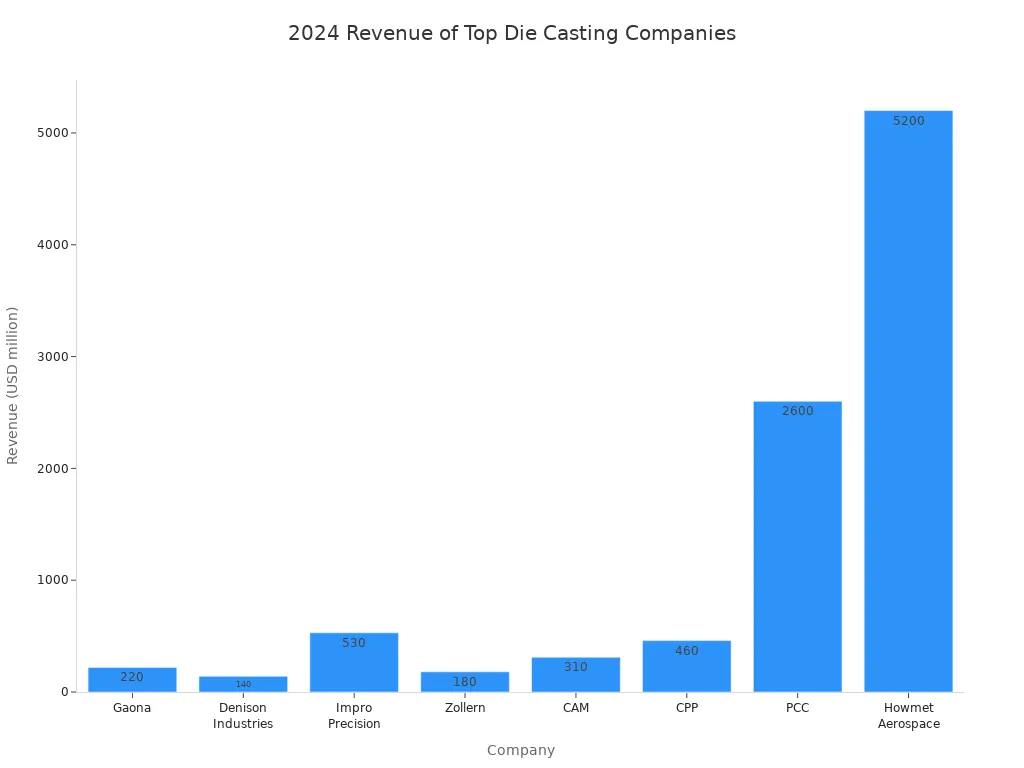
You see that Howmet Aerospace and Precision Castparts Corp. lead in revenue. These top die casting companies set the standard for quality and innovation in aerospace.
You want to choose die casting companies that match your project’s needs. Each company brings unique strengths to the aerospace sector. You can use this table to compare their specialties:
Company Name | Unique Strengths and Specialties |
|---|---|
DyCast Specialties Corporation | Certified coating and metal treatment for RoHS compliance. Advanced quality assurance. Precision aluminum and zinc die-casting. Complete manufacturing solutions. Versatile across aerospace and other sectors. |
Bunty LLC | Expertise in closed die forging and cold forging. Tailored solutions for tight tolerances and complex shapes. Strong client collaboration. Full range of value-added services. Experience in aerospace and defense. |
Gaona | Focuses on precision sand and gravity die castings for turbine housing and engine brackets. |
Denison Industries | Specializes in military and defense aircraft castings, especially landing gear and missile parts. |
Impro Precision Industries | Known for thin-wall aluminum investment casting, producing engine covers and turbine blades. |
Zollern | Delivers high-precision aerospace components using vacuum die casting, including satellite panels. |
CAM | Leads in R&D for aerospace manufacturing systems, focusing on rocket stage parts. |
Consolidated Precision Products | Provides complex geometry castings for jet engines, such as compressor casings. |
Precision Castparts Corp. | A leader in structural castings for aerospace, focusing on fan casings and combustor housings. |
Howmet Aerospace | Offers lightweight solutions, including investment casting for fasteners and engine mounts. |
You can also look at some companies with broad capabilities:
DyCast Specialties Corporation maintains certified coating and metal treatment processes for RoHS compliance. You benefit from their advanced quality assurance and precision aluminum and zinc die-casting. They serve aerospace, automotive, robotics, telecommunications, and medical sectors.
Bunty LLC offers expertise in closed die forging and cold forging. You get tailored solutions for tight tolerances and complex geometries. They provide process analysis, quality inspection, and collaborate closely with clients from design to production.
Tip: When you select from the top die casting companies, always match their specialties to your project’s technical requirements. This approach ensures you get the best results for aerospace applications.
You see that the top die casting companies offer a range of solutions, from lightweight engine mounts to complex jet engine casings. You can rely on their expertise to meet strict aerospace standards and deliver reliable, high-performance components.
You need die casting machines for aerospace components that deliver unmatched accuracy. Modern systems use advanced precision technologies to meet strict aerospace standards. These technologies help you achieve the tight tolerances and flawless finishes that aircraft parts require.
Technology | Description |
|---|---|
Hot Isostatic Pressing (HIP) | Increases fatigue endurance and mechanical strength, which is vital for aerospace safety. |
Vacuum Heat Treatment | Customizes casting properties to match aerospace specifications. |
Non Destructive Examination | Uses digital x-ray and dye penetrant inspection to detect flaws without damaging parts. |
Dimensional Inspection | Employs coordinate measuring and white light systems for automated, accurate inspection. |
Tip: You can trust these precision tools to catch even the smallest defects, ensuring every die casting aluminum machine or zinc die casting machine produces reliable aerospace components.
You see automation transforming how die casting machines for aerospace components operate. Robotic systems and smart manufacturing boost both speed and safety. Automated lubrication and machine tending reduce waste and keep production consistent. Vision systems inspect parts for flaws, so you get higher quality with fewer rejections.
Robotic handling improves workflow and keeps workers safe from molten metal.
Automated lubrication ensures every die casting machine hot chamber or hot chamber die casting machine runs smoothly.
Vision systems catch defects early, saving you time and money.
Sensors and AI help prevent mistakes, leading to better part uniformity.
Smart manufacturing uses AI, IoT, and real-time analytics. You gain better control, less waste, and higher output. Digital twin technology lets you simulate and optimize your die casting process before production starts. IoT sensors monitor every step, giving you data to improve efficiency.
Trend | Description |
|---|---|
IoT and Data Analytics | Real-time monitoring and process optimization for die casting machines for aerospace components. |
Digital Twin Technology | Virtual replicas help you test and refine operations. |
Additive Manufacturing | Enables complex shapes and custom tooling for aerospace parts. |
You benefit from die casting machines for aerospace components that handle a wide range of alloys. Modern machines process aluminum and zinc alloys with high strength and corrosion resistance. This flexibility lets you choose the best material for each part, whether you use a die casting aluminum machine or a zinc die casting machine.
Alloy Type | Maximum Tensile Strength | Key Properties |
|---|---|---|
A380 | 330 MPa | High strength, excellent fluidity, corrosion resistance |
A356 | 310 MPa | Good casting ability, weldability, fatigue resistance |
356-T6 | 240 MPa | Heat-treated, high strength, resistant to cracking |
Note: Material versatility means you can design lighter, stronger, and more reliable aerospace components. This advantage helps you meet the evolving demands of the aerospace industry.
You need to make sure that your die casting machines for aerospace components meet strict industry standards. These certifications show that you follow the highest levels of quality, safety, and reliability. When you choose a die casting aluminum machine, a zinc die casting machine, or a die casting machine hot chamber for aerospace work, you should look for these key certifications:
AS9000: This standard focuses on quality management for aerospace suppliers.
AS9100: You see this as the main certification for aerospace manufacturing. It covers quality, safety, and continuous improvement.
NADCAP: This program checks special processes like heat treating and chemical processing. It ensures your die casting machines for aerospace components meet global aerospace requirements.
NADCA Certification Program: This program verifies the knowledge and skills of die casting professionals.
These certifications act as a badge of honor for companies. They show that you commit to excellence and follow strict rules. You also get independent verification of your processes. Most certifications last three years and require regular updates or re-certification.
Tip: Always check for these certifications when you select a die casting aluminum machine or a hot chamber die casting machine for aerospace projects.
You must use strong quality assurance practices to guarantee the performance of die casting machines for aerospace components. Quality starts with the raw materials. You inspect every batch for purity before using it in a zinc die casting machine or a die casting aluminum machine. You also test the chemical composition of alloy melts and follow ASTM, AMS, and SAE specifications.
During production, you keep mold integrity high and monitor temperatures closely. You use advanced tools for dimensional checks, such as:
Calipers
Micrometers
Coordinate measuring machines (CMMs)
Optical comparators
Modern die casting machines for aerospace components use real-time monitoring and automated inspection. These systems catch defects early and help you maintain high standards. You see these practices required not only in aerospace but also in military, defense, and automotive industries.
Note: Quality assurance protects your reputation and ensures every die casting machine hot chamber or hot chamber die casting machine delivers safe, reliable aerospace components.
You see strong growth in the market for die casting machines for aerospace components across several regions. North America leads with a market size of USD 8.6 billion in 2024. Major manufacturers like Boeing and Lockheed Martin drive innovation and research. Europe follows with USD 6.1 billion, focusing on sustainability and advanced materials. Airbus and other leaders push for greener solutions. Asia Pacific, with USD 4.2 billion, grows quickly due to rising air traffic and government support in countries like China.
Region | Market Size (2024) | Projected CAGR (2024-2033) | Key Factors |
|---|---|---|---|
North America | USD 8.6 billion | N/A | Major manufacturers, strong R&D infrastructure |
Europe | USD 6.1 billion | 6.8% | Sustainability, advanced materials, leading manufacturers |
Asia Pacific | USD 4.2 billion | 8.5% | Rapid industrialization, rising air traffic, government initiatives |
Note: You benefit from regional strengths by choosing die casting machines for aerospace components that match your supply chain and project needs.
You notice sustainability shaping the future of die casting machines for aerospace components. Manufacturers invest in energy-efficient cooling and smart systems to lower energy use. Closed-loop water systems help conserve water. Many companies use recyclable materials for molds, reducing waste. You see more collaboration with suppliers to promote green practices. The rise in global recycled aluminum, from 9 Mt in 1995 to 33 Mt in 2020, supports lower-carbon feedstock for aerospace casting.
Energy efficiency and smart manufacturing reduce costs and environmental impact.
Water conservation protects resources and meets regulatory standards.
Recycling and biodegradable molds cut waste and support circular production.
Collaboration strengthens sustainability across the supply chain.
You need to make smart choices when selecting die casting machines for aerospace components. Material expertise matters. You must understand which alloys work best for your project, whether you use a die casting aluminum machine or a zinc die casting machine. Industry certifications like ISO 9001 and AS9100 ensure quality and reliability. Precision engineering helps you meet strict aerospace specifications. Regular equipment maintenance keeps your die casting machine hot chamber or hot chamber die casting machine running smoothly. Customization and flexible supply chain management help you meet deadlines and adapt to changing requirements.
Focus on material expertise and advanced technologies.
Check for certifications to guarantee quality.
Maintain equipment for consistent performance.
Choose partners with customization capabilities.
Tip: You see the aerospace die casting market growing fast, with a projected market size of USD 3.12 billion by 2034 and a CAGR of 9.34%. Innovation, regional expansion, and strategic collaboration will shape the future. You stay ahead by investing in the right die casting machines for aerospace components and building strong partnerships.
When you select die casting machines for aerospace components, focus on these essentials:
Industry experience and reputation
Manufacturing capabilities for complex parts
Quality control and certifications like AS9100
Material expertise in aluminum and zinc
In-house tooling and mold design
Scalability for high-volume production
Secondary finishing services
Matching machine features and certifications with aerospace standards improves quality, reduces waste, and ensures compliance. Use these criteria and company comparisons to make confident, informed decisions.
You rely on die casting to create precise, lightweight components for aircraft. This process helps you achieve tight tolerances and strong parts. In aerospace, die casting supports safety and performance by producing reliable engine housings, brackets, and other critical aircraft structures.
You select aluminum die casting because it offers a great strength-to-weight ratio. Aircraft need parts that are both light and durable. Aluminum die casting also resists corrosion, which helps your aircraft last longer and perform better in demanding aerospace environments.
Die casting gives you consistent, high-quality parts for aircraft. You avoid defects that could cause failures. In aerospace, every component must meet strict standards. Die casting ensures your aircraft parts fit perfectly and work reliably, supporting safe flights.
You find die casting in many aircraft parts, such as engine covers, landing gear, and control housings. Aerospace manufacturers use die casting for brackets, seat frames, and structural supports. These parts must be strong, light, and precise for safe aircraft operation.
You should check for AS9100 and NADCAP certifications. These show that your die casting provider meets aerospace quality standards. Certified companies deliver reliable aircraft components, helping you meet industry regulations and keep your aircraft safe.
