
EMAIL:
lh@longhuamachine.com
TELL/whatsapp:
+8619305527239  English English
Views: 0 Author: Site Editor Publish Time: 2025-09-22 Origin: Site


A die casting machine lets you create high-precision metal parts by forcing molten metal into a steel mold at high pressure. You get complex shapes with tight tolerances and smooth finishes in less time than most other metal forming processes. The die casting machine market continues to grow, reaching $4.42 billion in 2023 and projected to hit $5.78 billion by 2030.
Year | Market Size (USD Billion) |
|---|---|
2023 | 4.42 |
2030 | 5.78 |
Die casting machines create precise metal parts by injecting molten metal into reusable steel molds under high pressure, ensuring complex shapes and smooth finishes.
Regular maintenance of die casting machines, including cleaning, lubrication, and temperature control, is essential for optimal performance and longevity.
Choosing the right type of die casting machine—hot chamber for low melting point metals and cold chamber for high melting point metals—affects production speed and material options.
Die casting is cost-effective for high-volume production, as it minimizes waste and allows for recycling leftover metal, benefiting both the budget and the environment.
Industries like automotive, aerospace, and electronics rely on die casting for durable, high-quality components, making it a vital process in modern manufacturing.
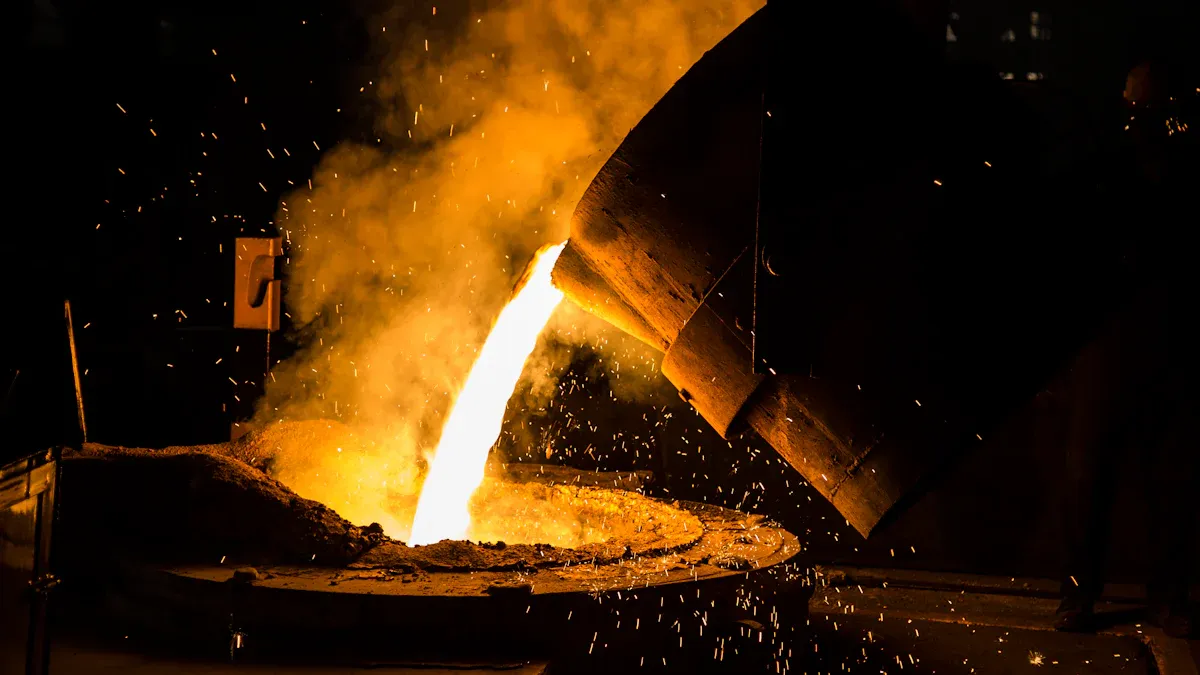
A die casting machine is a specialized device that helps you create metal parts with high accuracy and repeatability. You use this machine to force molten metal into a die, which is a reusable steel mold shaped to match the part you want to produce. The die casting machine operates under high pressure, making sure the molten metal fills every detail of the die cavity. This process allows you to achieve complex shapes and fine surface finishes that would be difficult with other methods.
You will find several main components in a die casting machine, each playing a critical role in the operation:
Die/Mold: Shapes the metal into the desired form with fixed and movable parts.
Injection System: Injects molten metal into the die cavity.
Clamping Unit: Holds the die in place during casting.
Hydraulic System: Powers the movement of machine components.
Ejector System: Ejects the solidified casting from the die.
Control System: Manages the machine's operation.
Cooling System: Controls the temperature during casting.
Lubrication System: Reduces friction in moving parts.
Safety System: Protects operators and the machine from accidents.
Tip: Automation in modern die casting machines boosts productivity and quality. You can rely on robotic systems to handle parts quickly, apply lubrication consistently, and inspect castings for defects. This reduces waste, lowers costs, and improves safety by limiting direct human contact with hot metal and moving parts.
The main function of a die casting machine is to produce metal parts by injecting molten metal into a die at high pressure. This process ensures that the metal fills every corner of the die, capturing even the smallest details. You can use die casting to make parts with tight tolerances, thin walls, and complex geometries.
Die Casting Type | Pressure Range (psi) |
|---|---|
Low-Pressure Die Casting (LPDC) | 2–15 |
High-Pressure Die Casting (HPDC) | 1,500–25,400 |
You benefit from using reusable steel dies because they last for hundreds of thousands of cycles. The lifespan of a die depends on the type of steel, how you use it, and how strictly you test the finished parts. For example, aluminum alloy molds typically last for 80,000 to 100,000 uses, while steel dies can last for 300,000 to 400,000 cycles. Reusing die frames also helps you reduce lead times and lower production costs, making die casting a cost-effective choice for high-volume manufacturing.
Die casting stands out for its efficiency. You can produce large quantities of identical parts with minimal waste. The process uses precise control systems and cooling methods to maintain quality and speed. Automation further enhances productivity by optimizing each step, from metal injection to part ejection. You also improve workplace safety and reduce labor costs by relying on automated handling and inspection.
To keep your die casting machine running smoothly, you need to follow a regular maintenance routine. Clean the die after each run, inspect for wear or damage, and apply lubricants to reduce friction. Control the temperature during casting to prevent thermal fatigue. Store dies properly when not in use and keep detailed maintenance records. Training your staff on proper handling and maintenance procedures ensures the longevity of your equipment and the quality of your die castings.
Recent advancements in die casting technology help you achieve even better results. Rapid prototyping, simulation software, and non-destructive testing allow you to refine your process and detect defects early. Energy-efficient machines and recycling practices reduce your environmental impact. With these innovations, you can meet higher standards for quality, speed, and sustainability in die casting production.
The die casting process follows a series of precise steps to create high-quality metal parts. You start by preparing the die, then inject molten metal under high pressure, and finally cool and eject the finished part. Each step in the process helps you achieve accuracy, efficiency, and minimal waste.
You begin the die casting process by preparing the die. The die consists of two main sections: the fixed half and the moving half. You must clean the die thoroughly to remove any leftover material from previous cycles. Proper cleaning prevents defects in the next casting process.
Next, you apply lubricants or coatings to the die surface. These lubricants help the metal flow smoothly and make it easier to remove the finished part. They also protect the die from extreme heat and wear, which extends its lifespan. The type of lubricant you choose depends on your application and the metal you use.
Lubricant Type | Description | Cooling Efficiency | Use Case |
|---|---|---|---|
Water-based | Preferred for lubrication and cooling of the die. | High | General die casting applications. |
Oil-based | Used for high-quality finishes at increased temperatures. | Lower | Specific applications requiring heat. |
Release agents | Act primarily as agents to facilitate mold release. | N/A | Various die casting processes. |
Insulating coatings | Provide insulation to the die, enhancing longevity. | N/A | High-temperature applications. |
Mold release lubricants must withstand extreme temperatures.
High-quality lubricants ensure mold longevity.
Proper lubricants improve the quality of cast products.
Die casting coatings fall into two main categories: mold coatings (release agents) and punch coatings. You select the right coating based on the type of alloy, the structure of the die, the shape of the casting, and the surface quality you need. The right preparation ensures the die casting process runs smoothly and produces consistent results.
Once you prepare the die, you move to the metal injection step. You melt the chosen metal alloy in a furnace until it reaches the correct temperature. The temperature depends on the type of metal you use. For example, aluminum melts at about 760°F, zinc at 1220°F, magnesium at 1400°F, and copper at 2000°F.
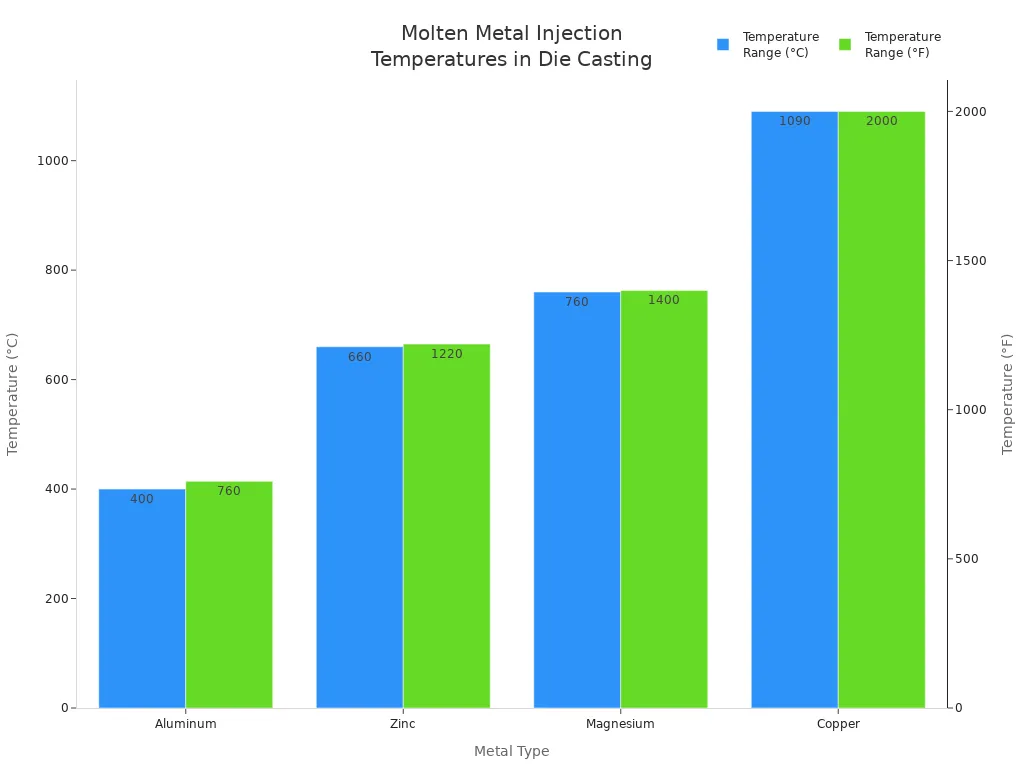
You then inject the molten metal into the die cavity using high pressure. This pressure forces the metal to fill every detail of the die, even in thin or complex areas. The high-pressure injection is what sets the die casting process apart from other casting processes. It allows you to create parts with tight tolerances and smooth surfaces.
The process uses precise control systems to monitor temperature and pressure. You can adjust these settings to match the requirements of each casting process. This flexibility helps you maintain quality and reduce defects.
After you inject the molten metal, the next step in the die casting process is cooling. The die absorbs heat from the metal, causing it to solidify quickly. Cooling time depends on the size and thickness of the part, as well as the type of metal used. Efficient cooling is important because it affects the quality and speed of the casting process.
Once the metal solidifies, you open the die and use the ejector system to remove the finished part. Ejector pins push the casting out of the die cavity. You must handle this step carefully to avoid damaging the part or the die.
You inspect the part for defects and trim any excess material, known as flash. The die is then cleaned and lubricated again, ready for the next cycle. This repeatable process allows you to produce large quantities of identical parts with minimal waste.
Note: The die casting process stands out for its efficiency. You can recycle leftover metal, reduce scrap, and reuse the die for thousands of cycles. This makes die casting a cost-effective and environmentally friendly manufacturing method.
When you explore die casting, you encounter two main types of machines: hot chamber and cold chamber. Each type uses a different method to inject molten metal into the die, and each suits specific alloys and production needs.
Hot chamber die casting machines work best for metals with low melting points. You find these machines commonly used for zinc and magnesium alloys. The molten metal stays in a heated chamber attached to the machine. You dip the injection system directly into the pool of molten metal, then force it into the die under high-pressure.
Metal | Properties | Advantages |
|---|---|---|
Zinc | Low melting point, hardness, toughness | Customizable, smooth surface, energy-efficient production, extended mold life |
Magnesium | Lightweight, high strength-to-weight ratio, good machinability | Improved fluidity, reduced hydrogen porosity, ideal for electrical applications, lighter than steel |
Zinc is popular in automotive and medical supply sectors.
Magnesium works well for connections and housings in medical and laboratory equipment.
Hot chamber die casting gives you fast cycle times, often less than 60 seconds per part. You benefit from quick solidification and efficient production. This method suits high-volume manufacturing where you need many identical parts with smooth surfaces and complex shapes.
Tip: Hot chamber die casting is ideal when you want speed and efficiency for metals that melt easily. You get high-pressure injection, which helps you create detailed parts with minimal waste.
Cold chamber die casting machines handle metals with higher melting points, such as aluminum and copper alloys. You keep the molten metal in a separate furnace, then pour it into the injection chamber for each cycle. The machine injects the metal into the die using high-pressure, but the process takes longer than hot chamber die casting.
Cold chamber die casting lets you work with a wider range of alloys. You use this method for parts that need extra strength or resistance to heat. The cycle time usually ranges from 60 to 120 seconds, so you trade some speed for flexibility in material choice.
You rely on cold chamber die casting when you need to produce parts with complex geometries and high mechanical properties. This method supports high-pressure injection, which helps you achieve tight tolerances and smooth finishes.
You need to understand the differences between hot chamber and cold chamber die casting machines to choose the right type for your project. The table below highlights the main features:
Feature | Hot Chamber | Cold Chamber |
|---|---|---|
Molten Metal Source | Held in a heated chamber pool | Held externally in a separate furnace |
Metal Temperature | Maintained molten between cycles | Injected as needed, solidifies after |
Cycle Time | Faster, less than 60 seconds | Slower, around 60-120 seconds |
Metal Alloys | Limited to low melting point alloys | Suitable for high-melting-point alloys |
High-pressure die casting allows you to create precise, detailed parts with smooth surfaces.
The choice between machine types affects which alloys you can use and how quickly you produce parts.
Hot chamber die casting suits high-volume runs with metals like zinc and magnesium.
Cold chamber die casting works for aluminum, copper, and other alloys that need higher temperatures.
Note: When you select a die casting machine, consider the types of metals, the complexity of your parts, and your production goals. High-pressure die casting gives you flexibility and precision, but each machine type offers unique advantages.
You have many options when choosing alloys for die casting. The most common alloys include aluminum, zinc, and magnesium. Each alloy offers unique properties that make it suitable for different metal die casting applications. You can see the main types and their features in the table below:
Type of Alloy | Materials | Properties |
|---|---|---|
Aluminum | AC 46100 | Affordable, non-corrosive, low melting point, excellent weldability |
Aluminum | AC 46500 | High ductility, strong, ideal for automotive and electrical parts |
Aluminum | ADC 12 | High melting point, expensive, corrosion-resistant |
Aluminum | ADC 10 | Anti-soldering, great machinability, strong, affordable |
Aluminum | A380 | Easy to machine, ductile, wear-resistant |
Aluminum | A383 | Heat treatable, good machinability and castability |
Aluminum | A360 | High strength, corrosion-resistant, soft, ductile |
Aluminum | Al-Si8Cu3 | High strength, good electrical conductivity, used in aerospace |
Aluminum | Al-Si11Cu3 | Good conductivity and strength, corrosion-resistant, easy to machine |
Zinc | Zamak 2 | Low melting point, ductile, good for complex shapes |
Zinc | Zamak 3 | Stable, easy to machine, used for gears, toys, electronics |
Zinc | Zamak 4 | High melting point, ideal for engine parts, low thermal expansion |
Zinc | Zamak 5 | Excellent impact strength, castability, ductility |
Zinc | Zamak 7 | Low melting point, fluid, dimensionally stable |
Magnesium | AZ91D | Good castability, strong, used in automotive, aerospace, electronics |
Magnesium | AM60B | Low density, lightweight, stiff |
Magnesium | AS41B | Non-toxic, high melting point, excellent electrical conductivity |
You use these alloys in die casting because they fill molds quickly and create parts with tight tolerances. Aluminum alloys, for example, give you lightweight and corrosion-resistant parts. Zinc alloys let you make small, detailed components. Magnesium alloys provide strength without adding much weight. You can rely on these materials for most metal die casting needs.
Note: Die casting gives you fast production and close tolerances. You get good material properties, but forging can increase strength and ductility even more.
You usually choose non-ferrous metals for die casting. These metals do not contain iron, so they resist rust and corrosion. You get several advantages when you use non-ferrous metals in metal die casting:
Non-ferrous metals are lightweight. You can make parts for cars and airplanes that need to be strong but not heavy.
These metals resist corrosion. You can use them for outdoor or marine products.
Aluminum die casting parts stay strong and stable, even in harsh environments.
Aluminum alloys give you good dimensional stability and excellent corrosion resistance.
Zinc alloys flow easily into molds, so you can create complex shapes and thin-walled parts.
Magnesium is the lightest structural metal. You get a great strength-to-weight ratio for automotive and aerospace parts.
Metal Type | Advantages in Die Casting | Applications |
|---|---|---|
Aluminum | High strength-to-weight ratio, corrosion resistance, withstands high temperatures | Automotive, aerospace, electronics |
Zinc | Excellent fluidity, ideal for complex shapes and thin-walled components | Consumer electronics, automotive |
Magnesium | Lightest structural metal, excellent strength-to-weight ratio | Automotive, aerospace |
Tip: You should use non-ferrous metals in die casting if you want lightweight, corrosion-resistant, and strong parts for demanding industries.
You gain many advantages when you use die casting for manufacturing. The process stands out for its high production efficiency. You can fill and cool molds quickly, which lets you produce large numbers of die casting parts in a short time. This speed makes die casting cost-effective, especially for mass production. As you increase production volume, the cost per unit drops because you spread the initial die casting tooling costs over more parts.
Die casting gives you consistent, high-quality components every cycle.
You can create complex shapes with tight tolerances, which reduces the need for extra machining.
The process produces excellent surface finishes, so you often skip additional finishing steps.
High-pressure die casting and low-pressure die casting both help you achieve uniform results and prevent part deformation.
High pressures involved in die casting ensure fast and comprehensive filling, leading to consistent cooling that prevents uneven shrinkage and part deformation.
You also benefit from minimal waste. Die casting parts use just the right amount of material, and you can recycle leftover metal. This efficiency supports both your budget and the environment. The benefits of die casting make it a top choice for industries that demand precision and reliability.
You find die casting parts in many industries because of their strength, accuracy, and versatility. The process supports a wide range of die casting applications, from automotive to electronics. Here are some of the most common uses:
Automotive: Engine blocks, transmission parts, and structural die casting parts.
Consumer electronics: Housings, connectors, and heat sinks.
Aerospace and defense: Aircraft components and drone frames.
Industrial machinery: Pump housings, gearboxes, and tooling components.
Household goods: Appliances, plumbing fixtures, and power tools.
Medical devices: Surgical instruments and imaging equipment.
Energy sector: Solar panel frames and wind turbine parts.
Industry | Products/Applications |
|---|---|
Automotive | Engine blocks, aluminum die casting parts, high-performance components |
Construction | Window frames, building frames, bridges, skyscraper die casting parts |
Healthcare | Complex medical devices, pacemakers, dialysis equipment |
Energy Sector | Wind turbines, solar panel brackets, battery housings |
Electronics | Precision die casting parts for smartphones, computers, 5G base station housings |
You see low-pressure die casting used for larger, more complex die casting parts, such as wheels and structural components. High-pressure die casting works best for thin-walled, detailed parts that require tight tolerances. Die casting tooling allows you to produce thousands of identical parts with minimal variation. You rely on die casting parts for their durability, dimensional stability, and excellent surface quality. These advantages explain why die casting remains essential in modern manufacturing.
A die casting machine lets you create complex metal parts quickly and accurately. You benefit from fast cycle times, high dimensional accuracy, and smooth surface finishes. Die casting machines help you save material, reduce waste, and produce strong, durable parts for industries like automotive and aerospace. If you want efficient, high-quality manufacturing, consider how a die casting machine can improve your production process and help your business stay competitive.
You use both terms for the same equipment. A die casting machine or die cast machine injects molten metal into a mold under high pressure. Manufacturers may use either term, but both refer to machines that create precise metal parts.
You can use an aluminum die casting machine for aluminum alloys. For zinc or magnesium, you need a zinc die casting machine or a magnesium die casting machine. Each machine type matches the melting point and properties of the metal.
You clean the die casting machine after each run. Inspect moving parts, lubricate them, and check for wear. Control the temperature and store dies properly. Regular maintenance keeps your die casting machines running smoothly and extends their lifespan.
You find die casting machines in automotive, aerospace, electronics, and medical device manufacturing. Aluminum die casting machines and zinc die casting machines help you produce engine parts, housings, connectors, and more with high accuracy.
You choose a die casting machine for speed, precision, and efficiency. Die casting machines let you create complex shapes with tight tolerances. You save material, reduce waste, and produce thousands of identical parts quickly, especially with aluminum die casting machines and zinc die casting machines.
