
EMAIL:
lh@longhuamachine.com
TELL/whatsapp:
+8619305527239  English English
Views: 0 Author: Site Editor Publish Time: 2026-09-26 Origin: Site


Producing aluminum motor housings, end covers, motor shells, bearing housings, and other electric motor components requires more than selecting a standard die casting machine by tonnage. Motor parts often combine thin walls, cooling fins, cylindrical structures, bearing locations, sealing surfaces, and dimensional requirements within the same casting. These characteristics place demanding requirements on die filling, injection repeatability, mold temperature, casting pressure, extraction, and downstream machining allowance.
For buyers considering a custom aluminum motor die casting machine, the machine should therefore be specified around the actual component, mold, production volume, and quality requirements. A 500T machine may be appropriate for one motor housing, while another project may require substantially higher clamping force, larger die space, or a completely different injection configuration. Ordering equipment based only on a machine catalog can result in insufficient shot capacity, poor mold compatibility, excessive flash, unstable filling, or unnecessary equipment investment.
Longhua Die Casting Machine Co., Ltd. provides a dedicated Aluminum Motor Die Casting Machine solution together with cold-chamber die casting machines and automation equipment. Before placing an order, buyers should confirm the following eight areas so the equipment can be configured around the real motor-part production process.
The first specification should be the casting itself, not the machine tonnage.
“Motor housing” can describe many different products. A compact housing for a small industrial motor has very different casting requirements from a large traction-motor housing, water-cooled EV motor housing, end cover, rotor-related component, or integrated housing with cooling channels.
Send the supplier:
2D part drawing
3D CAD model if available
Finished dimensions
Finished casting weight
Aluminum alloy
Minimum wall thickness
Cooling-fin dimensions
Bearing-seat locations
Number of cavities
Machining allowance
Annual production volume
The drawing helps the supplier identify the total projected area and estimate the metal flow path. It also shows whether the casting contains long thin sections, isolated heavy sections, deep ribs, complex cores, or areas that may be difficult to fill.
Motor housings deserve particular attention because dimensional relationships often matter after casting. Bearing positions, stator interfaces, mounting surfaces, cooling passages, and machined bores need enough dimensional stability and material integrity for downstream machining and assembly.
The supplier should therefore know which dimensions are critical before machine parameters are selected.
If one machine will produce several motor components, provide drawings for the complete planned product family. A machine selected only around the smallest current housing may restrict future molds, while a machine selected around an unrealistic future maximum may increase investment without improving current production.
Machine tonnage should be calculated from the die casting process rather than selected from part weight.
During injection, molten aluminum applies pressure across the projected area of the casting, runner, gates, and overflow system. The die casting machine must provide enough clamping force to keep the mold closed during filling and pressure intensification.
A simplified selection concept is:
Required clamping force = projected area × casting pressure × appropriate process margin
This is why two motor housings with similar weight may require different machines. A wide housing with a large projected area can demand more clamping force than a compact but heavier component.
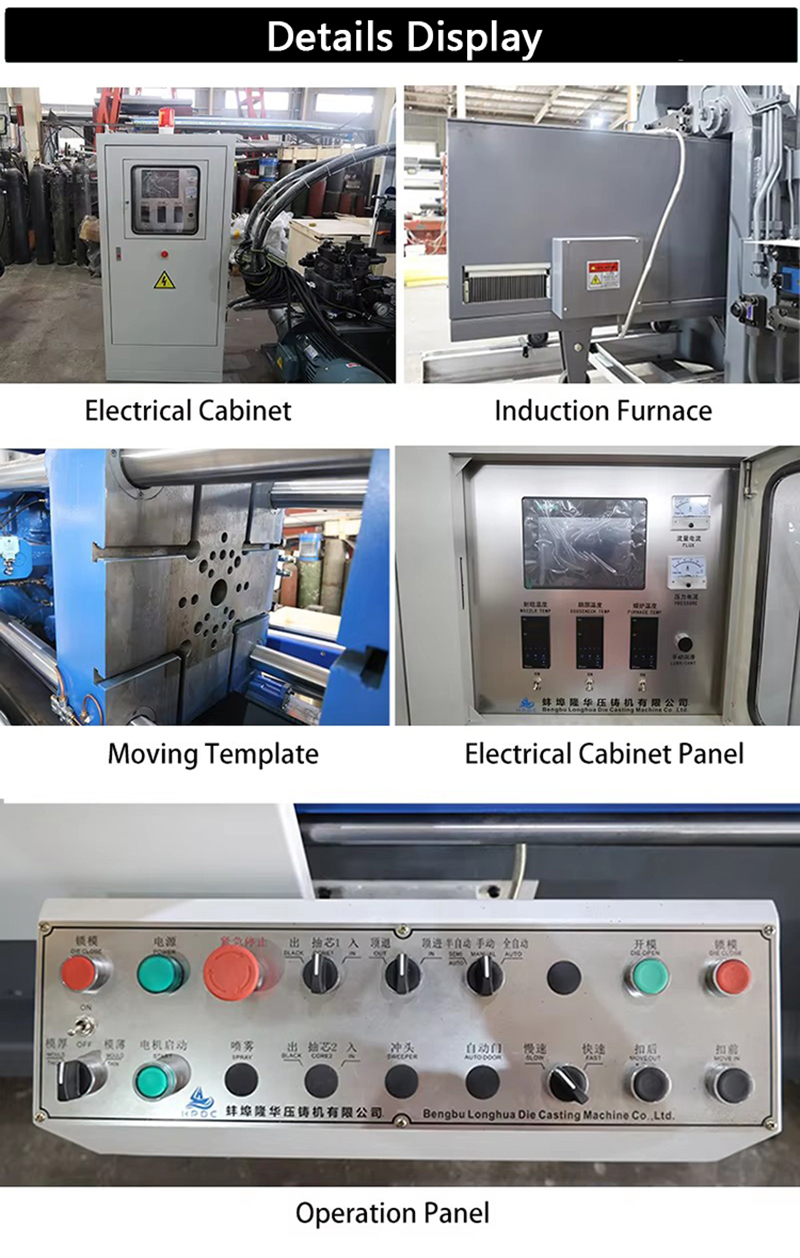
For medium-sized motor components, buyers may consider a 500T die casting machine, but the actual suitability must be checked against projected area, cavity number, casting pressure, and die construction. Longhua's 500T Die Casting Machine can serve as one capacity reference within the broader machine range.
Larger motor housings or multi-cavity tooling may move the project into a higher machine class. Longhua's standard machine portfolio extends to large-tonnage equipment, including configurations up to the 3000T aluminum die casting machine class.
However, choosing 3000T simply because the project involves a large motor is not appropriate. The correct machine should be the smallest capacity that provides sufficient process margin, shot capacity, die space, opening stroke, and production stability.
Oversizing can increase:
Machine purchase cost
Factory footprint
Electrical demand
Cooling requirements
Hydraulic capacity
Furnace size
Robot payload requirements
Sprayer size
Mold-handling equipment
Maintenance cost
Ask the machine supplier to show how the proposed clamping force was determined from your actual casting data.
Clamping force alone cannot determine whether an aluminum die casting machine is suitable.
The injection unit must also deliver the required quantity of molten aluminum at the correct speed and pressure.
The required shot weight includes more than the finished motor housing:
Casting weight + runner + gate + overflow + biscuit + process allowance
If the finished housing weighs 4 kg, the machine may need substantially more than 4 kg of available aluminum shot capacity after the complete feed system is included.
Buyers should send:
Finished casting weight
Estimated runner weight
Total shot weight
Plunger diameter requirements if already known
Shot sleeve dimensions
Filling ratio target if specified
Critical filling time
Required injection pressure
Maximum required injection speed
Motor housings frequently contain thin fins and long flow paths. These areas need rapid and controlled filling before the molten aluminum begins to solidify. At the same time, excessive turbulence can increase air entrapment and porosity.
A customized aluminum motor die casting machine therefore needs stable control of slow-shot, fast-shot, switching position, acceleration, intensification, and pressure development.
The correct injection unit should provide sufficient performance without operating continuously at its absolute mechanical limit.
Buyers should also explain the main casting defects they are trying to avoid. These may include:
Incomplete fins
Cold shuts
Gas porosity
Shrinkage
Flash
Flow marks
Leakage
Dimensional instability
This information helps the supplier configure the injection system around quality requirements rather than only nominal machine capacity.
One of the most common machine-selection mistakes is checking clamping force and shot weight but not verifying whether the die physically fits the machine.
For a motor casting project, send the complete die information:
Die length
Die width
Minimum and maximum thickness
Die weight
Moving-half dimensions
Fixed-half dimensions
Required opening stroke
Core-pull quantity
Core-pull direction
Hydraulic requirements
Ejection stroke
Ejection force
Injection position
The mold must fit between the tie bars with sufficient clearance for installation, removal, hydraulic connections, cooling lines, and maintenance.
Motor housings often require side cores or slides because internal structures, terminal boxes, cooling passages, mounting features, or external geometry cannot always be released using a simple two-part mold.
These core movements affect machine selection and cycle design.
The opening stroke also needs to accommodate more than the casting height. Space is required for the moving die to open, the extractor or robot to enter, the casting to clear the core structures, and the spray head to access the die surface.
If the machine is intended to replace an existing press, send drawings of your current molds and shot system. Compatibility with existing tooling can substantially reduce the cost and disruption of a machine upgrade.
If tooling has not yet been designed, provide the casting model and target cavity layout so Longhua Die Casting Machine Co., Ltd. can evaluate the likely die envelope before finalizing the machine configuration.

Motor components should not be evaluated only by whether the cavity fills completely.
Different motor applications can require specific control of porosity, dimensions, leakage, surface quality, machining allowance, and structural integrity.
For example, a motor housing that will be heavily machined around the bearing seat needs reliable internal metal quality in those areas. A water-cooled electric motor housing may need leak-tight cooling passages. A thin-finned housing requires consistent filling to maintain heat-dissipation geometry.
The RFQ should identify requirements such as:
Dimensional tolerances
Bearing-seat requirements
Machining surfaces
Pressure-tightness
Leakage test requirement
X-ray or CT inspection if required
Porosity acceptance level
Surface finish
Mechanical properties
Critical wall thickness
Traceability requirements
This information affects the complete process.
A project with strict porosity control may require more careful vacuum integration, die venting, filling-profile control, shot-sleeve management, and intensification.
A project with tight dimensional requirements may require better control of mold temperature and repeatable machine settings.
Modern motor production also benefits from recipe storage and process monitoring. If the factory will manufacture several housing sizes, operators should be able to recall the validated machine settings for each mold rather than manually rebuilding the process after every changeover.
Ask the supplier which parameters can be stored, monitored, exported, or connected to factory production systems.
The purpose is not to purchase more digital functions than needed. It is to ensure that the control system supports repeatable casting quality across shifts and operators.
Motor housings can contain a difficult combination of thin sections and thicker structural areas. Controlling thermal balance across the mold is therefore important for stable production.
Before ordering, discuss:
Alloy melting system
Holding furnace
Aluminum delivery method
Metal temperature requirements
Mold temperature controller
Cooling-water circuits
Cooling capacity
Core cooling
Local cooling around heavy sections
Longhua's equipment portfolio includes aluminum melting and holding equipment as well as mold-temperature control products in addition to its die casting machines.
These systems should be considered as part of the production process rather than purchased independently without coordination.
If die temperature becomes unstable, the factory may experience changes in filling behavior, sticking, soldering, dimensional repeatability, solidification time, or cycle time.
Cooling also affects productivity. A machine can complete injection extremely quickly, but the mold cannot open until the casting has solidified sufficiently for extraction.
For thick motor structures, cooling may therefore dominate the cycle.
When requesting a quote, tell the supplier your required production rate and ask whether the proposed mold-temperature and cooling arrangement can support the target cycle consistently.
The furnace must also match the consumption of the casting cell. It should provide sufficient molten aluminum for the planned cycle without creating frequent interruptions or unstable metal temperature.
For automated production, the furnace, ladler, shot sleeve, and machine need to operate as one coordinated process.
A customized motor-production cell should be evaluated beyond the main press.
Depending on production volume, a complete cell may include:
Automatic ladler
Servo ladle machine
Casting extractor
Six-axis industrial robot
Die casting servo sprayer
Conveyor
Trimming equipment
Cooling station
Vacuum system
Furnace
Mold temperature controller
Longhua provides these equipment categories alongside its main die casting machine range.
The Die Casting Servo Sprayer is particularly relevant for motor-housing production because spray consistency affects die cooling, release-agent distribution, surface condition, and total cycle time.
A sprayer should be selected from the actual die dimensions and opening space. Buyers should provide:
Machine tonnage
Die width and height
Spray area
Mold opening stroke
Required spray time
Number of spray circuits
Release agent
Air-blowing requirement
Cooling requirement
Cycle-time target
The extractor or robot should also match casting weight and geometry. A hot motor housing with thin fins may require controlled gripping so that the casting is removed without deformation or surface damage.
For higher-volume lines, ask Longhua Die Casting Machine Co., Ltd. to provide a complete cell layout rather than quotations for independent equipment.
The layout should show:
Machine
Furnace
Ladler
Robot or extractor
Sprayer
Conveyor
Trimming equipment
Safety fencing
Operator access
Maintenance space
Mold-change route
This can prevent integration problems that are difficult to solve after equipment arrives.
The final machine specification should reflect how the factory will actually operate.
Tell the supplier:
Required parts per hour
Daily production quantity
Shifts per day
Operating hours
Target cycle time
Number of motor models
Mold-change frequency
Annual production forecast
Future housing sizes
If the factory produces only one motor housing continuously, the equipment can be optimized around a stable high-volume cycle.
If multiple housings share the same machine, fast mold changes and recipe management become more important. Buyers should ask how easily the machine can switch between plunger settings, spray recipes, robot programs, mold-temperature parameters, and core-pull configurations.
Factory information is equally important.
Provide:
Voltage
Frequency
Available power
Cooling-water supply
Compressed air
Floor space
Foundation information
Crane capacity
Factory height
Machine installation route
Furnace position
Existing production-line layout
Large-tonnage equipment can require substantial infrastructure. Moving from a 500T die casting machine to a much larger machine can change not only the press footprint but also mold weight, crane capacity, furnace size, automation reach, electrical load, and cooling demand.
Finally, confirm what happens after the machine is shipped.
The quotation should clearly state whether it includes:
Installation supervision
Commissioning
Mold trial
Process adjustment
Operator training
Maintenance training
Electrical documentation
Hydraulic diagrams
PLC backup
Spare parts
Remote troubleshooting
On-site technical service
For a custom production line, commissioning is particularly important because successful motor-housing production depends on the complete interaction between the machine, die, alloy, temperature, injection profile, spraying, extraction, and cooling.
A structured RFQ allows the supplier to understand the project faster and reduces repeated technical discussions.
RFQ Item | Information to Send |
|---|---|
Product | Motor Housing / End Cover / Other Motor Part |
Drawing | 2D + 3D if available |
Aluminum Alloy | Project Alloy |
Part Weight | Finished Casting Weight |
Total Shot Weight | Casting + Runner + Overflow |
Dimensions | Overall L × W × H |
Wall Thickness | Minimum and Typical |
Projected Area | If Available |
Cavities | 1 / 2 / Multi-Cavity |
Mold Size | L × W × H |
Mold Weight | Estimated or Actual |
Core Pulls | Quantity and Direction |
Quality | Porosity / Leakage / Dimensions |
Production | Parts per Hour / Day |
Automation | Ladler + Robot + Servo Sprayer |
Cooling | Mold and Part Cooling Requirements |
Factory | Layout + Utilities |
Future Parts | Planned Motor Product Range |
Service | Installation + Training + Commissioning |
The most useful quotation request also includes information about future products.
If the machine will eventually produce three motor housing sizes, send all three drawings even if only one mold is currently ready. This allows the machine manufacturer to determine whether one customized configuration can cover the complete planned range.
A standard machine may be sufficient when the casting fits comfortably within standard clamping force, shot capacity, die space, injection performance, and automation requirements.
Customization becomes more relevant when the project requires:
Unusual die dimensions
Special injection position
Difficult thin-wall filling
Large motor housings
Complex core pulling
High pressure-tightness requirements
Specialized automation
Multiple motor products on one machine
Integration with an existing factory line
Customization should solve a measurable production requirement rather than add unnecessary complexity.
For example, modifying automation to handle a unique motor housing geometry can be justified if it shortens extraction time and reduces damage. Increasing the machine size without a corresponding increase in projected area or mold dimensions may not provide the same value.
The same principle applies when comparing a 500T die casting machine with larger equipment. The correct capacity should be determined from technical data. For very large components, a 3000T aluminum die casting machine may become relevant, but the machine, mold, furnace, robot, sprayer, foundation, and utilities must then be engineered as one much larger system.
Once quotations arrive, compare the technical scope before comparing the price.
A useful comparison should include:
Item | Supplier A | Supplier B |
|---|---|---|
Clamping Force | ||
Tie-Bar Spacing | ||
Die Thickness Range | ||
Shot Weight | ||
Plunger Options | ||
Injection Control | ||
Opening Stroke | ||
Ejection Capacity | ||
Core-Pull System | ||
Servo System | ||
Process Monitoring | ||
Vacuum Interface | ||
Ladler | ||
Extractor / Robot | ||
Servo Sprayer | ||
Furnace | ||
Temperature Control | ||
Installation | ||
Training | ||
Spare Parts |
A lower machine price may exclude the furnace, automation, commissioning, or process support required to produce acceptable motor housings.
The better comparison is therefore the cost of a complete production-ready cell, not only the price of the die casting press.
Ordering a custom aluminum motor die casting machine requires much more information than machine tonnage.
Buyers should confirm the motor component, alloy, projected area, clamping force, shot requirement, die dimensions, core pulls, injection performance, quality requirements, thermal management, automation, production output, factory utilities, and service scope before approving the equipment.
For smaller and medium components, a 500T die casting machine may provide sufficient capacity when the casting and mold fit comfortably within its operating range. Larger motor components may require significantly greater clamping force and shot capacity, potentially extending into much larger machine classes. The correct tonnage should always follow the casting analysis rather than precede it.
Longhua Die Casting Machine Co., Ltd. provides a dedicated Aluminum Motor Die Casting Machine, a broader Die Casting Machine range, and supporting automation including Die Casting Servo Sprayers, robots, ladlers, furnaces, and material-handling equipment.
The more complete the RFQ, the easier it is to configure a machine around real production requirements and avoid expensive changes after installation.
A: Send the motor-part drawing, aluminum alloy, casting weight, projected area, wall thickness, cavity number, total shot weight, mold dimensions, production target, quality requirements, automation needs, and factory utility information.
A: Machine tonnage should be calculated mainly from the total projected area and required casting pressure, while also checking shot capacity, die dimensions, tie-bar spacing, opening stroke, and production requirements.
A: It can be suitable for some motor housings when projected area, total shot weight, mold size, and required casting pressure remain within the machine's practical operating range. The actual part and die data should be reviewed before selection.
A: The machine must inject enough aluminum for the finished casting plus runners, gates, overflow, and biscuit. A machine can have sufficient clamping force but still be unsuitable if the injection system lacks enough shot capacity.
A: Motor housings can contain thin walls, cooling fins, long flow paths, bearing locations, and heavier structural sections. Stable control of filling speed, switching positions, pressure, and intensification helps reduce incomplete filling, porosity, flash, and dimensional variation.
A: Automated production commonly benefits from a die casting servo sprayer because controlled mold spraying affects die temperature, release-agent distribution, cycle repeatability, and casting release. The sprayer should be matched to the die size and machine opening stroke.
A: A machine in this class may be considered for very large projected areas, large dies, heavy shot requirements, or large integrated aluminum components. Factory foundation, utilities, furnace capacity, automation, mold handling, and total investment must also be evaluated.
A: For automated motor production, evaluating the machine, furnace, ladler, robot or extractor, servo sprayer, cooling system, trimming equipment, and safety system together usually makes integration and cycle-time planning more reliable.
