
EMAIL:
lh@longhuamachine.com
TELL/whatsapp:
+8619305527239  English English
Views: 0 Author: Site Editor Publish Time: 2025-10-14 Origin: Site


You gain real advantages when you use an aluminium die casting machine in your manufacturing process. These machines deliver high production speed and reliable precision. You can quickly switch between different part sizes, reducing downtime and keeping up with changing customer needs. Manufacturers optimize for part size and cycle speed by choosing between cold chamber and hot chamber methods. You achieve cost savings and better energy use with modern machine features like real-time monitoring and process optimization.
Aluminium die casting machines provide high production speed, allowing manufacturers to meet tight deadlines and adapt to changing customer demands.
The process ensures precision and consistency, producing parts with tight tolerances and excellent surface quality, crucial for industries like automotive and aerospace.
Cost efficiency is a major benefit, as aluminium die casting reduces waste, saves energy, and lowers production costs while maintaining high quality.
The flexibility of aluminium die casting allows for the creation of complex shapes and features that other methods cannot achieve, enhancing product performance.
Modern machines offer environmental benefits, using less energy and recycling materials, making them a sustainable choice for manufacturers.
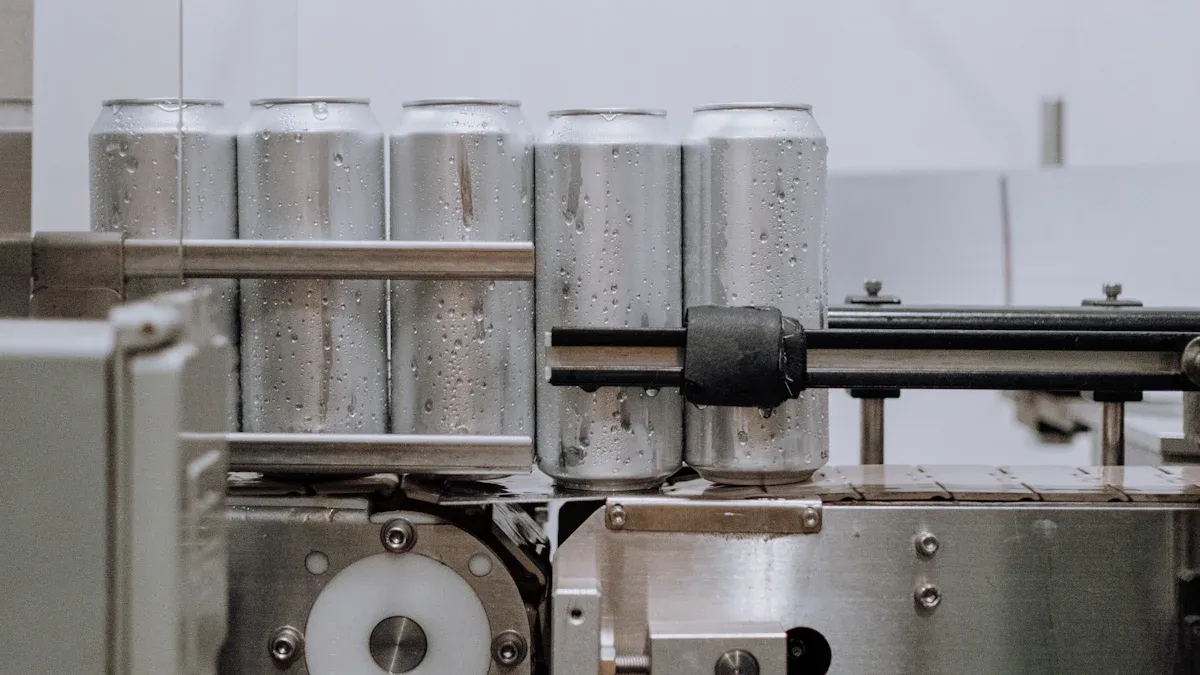
You want fast results in your production line. An aluminium die casting machine gives you that speed. Aluminum die casting stands out for its ability to produce large volumes of parts quickly and efficiently. When you compare this process to metal injection molding, you see a clear difference. Metal injection molding needs more steps and longer processing times because of the sintering process. Aluminum die casting, on the other hand, uses high pressure to force molten aluminum into a mold cavity. This method allows you to create parts at a much faster rate.
Tip: In high-volume manufacturing, the average cycle time for aluminum die casting machines ranges from 40 to 60 seconds. This quick turnaround helps you meet tight deadlines and respond to customer demands.
Automotive manufacturers rely on aluminum die casting for lightweight, fuel-efficient components. The process delivers both speed and cost-effectiveness, making it a top choice for industries that need high output.
You need every part to match your design exactly. Aluminum die casting helps you achieve this goal. The process offers excellent dimensional capabilities, which is crucial for precision manufacturing. You can expect tight tolerances and repeatable results, especially when you follow standards like those from NADCA.
Aluminum die casting produces parts with high dimensional accuracy.
The process minimizes variability, which is important for aerospace and automotive components.
You can create manifolds, housings, and other parts that must meet strict design requirements.
High pressure die casting stands out for its repeatability. Once you optimize your molds and pouring conditions, you can produce thousands of identical parts. The process also gives you excellent surface quality and high tensile strength. Continuous improvements in technology allow you to make even more complex and precise aluminum parts.
You want to keep your costs low while maintaining quality. Aluminum die casting supports this goal in several ways. The process reduces waste, saves energy, and improves productivity. Here is a table that shows the main cost-saving factors:
Cost-Saving Factor | Description |
|---|---|
Energy Consumption | Optimizing energy use in aluminum die casting machines lowers costs and supports sustainability. |
Automation Investments | Upfront costs pay off through long-term labor savings and higher production efficiency. |
Labor Fees | Training and efficient workforce management reduce labor costs and boost productivity. |
Scrap and Waste Management | Recycling and lean practices cut material waste and save money. |
Quality Control Measures | Fewer defects and less rework mean lower costs and happier customers. |
Transportation and Logistics | Better shipping and logistics planning reduces operational expenses. |
Environmental Compliance | Meeting regulations saves money over time and builds a positive brand image. |
Modern aluminum die casting machines also offer environmental benefits. They use less energy, recycle aluminum residues, and reduce emissions with advanced filtration. Some machines from the 1980s still run today, showing that proper maintenance can give you a long-lasting investment.
Note: Energy modeling and smart scheduling can help you save 10 to 15% on energy costs without hurting your profits.
You get a process that balances speed, precision, and cost efficiency. Aluminum die casting helps you stay competitive in today's fast-paced manufacturing world.
You can achieve efficient and high-quality results by understanding each step of the aluminum die casting process. This process uses high-pressure techniques to shape aluminum into precise components. Each stage plays a key role in the overall performance and reliability of your parts.
You start the die casting process by injecting molten aluminum into a steel mold at high pressure. High-pressure die casting uses rapid injection and solidification. This method fills the mold cavity quickly, capturing fine details and producing parts with excellent surface finish. You reduce defects such as porosity, cold shuts, and misruns by controlling injection speed and pressure. Most aluminum die casting machines operate in a pressure range of 70-140 MPa, which suits automotive and aerospace needs. For parts with very fine details, you may use pressures up to 200 MPa. High-pressure injection also allows you to create thinner wall sections, improving part quality and reducing material use.
Tip: Optimizing die temperature and injection parameters helps you avoid defects and ensures smooth metal flow.
You need strong clamping to keep the mold closed during the high-pressure phase. Cooling channels inside the die regulate temperature, which is vital for proper solidification. This step shortens cycle times and improves the strength and hardness of your aluminum parts. Gradual and controlled cooling prevents thermal shock and warping. Placing cooling channels near thick walls and hot spots ensures even cooling, which maintains dimensional stability. Preheating the mold before casting also reduces the risk of thermal shock.
Consistent temperature control leads to better part integrity.
Proper cooling management helps you avoid stress concentration and deformation.
Once the aluminum solidifies, you remove the part from the mold. Including draft angles in your design makes ejection easier and faster. This step increases production throughput and keeps your die casting process efficient. Quick and smooth part removal also reduces the risk of damaging the finished product. After ejection, you may trim and deburr the part to achieve the final dimensions and surface finish.
Step Number | Step Name | Contribution to Efficiency |
|---|---|---|
4 | Injection | High-pressure injection captures intricate details, ensuring dimensional accuracy and reducing defects. |
5 | Solidification | Rapid cooling leads to a finer grain structure, enhancing strength and durability of the parts. |
6 | Ejection | Minimizes stress and deformation during part removal, maintaining dimensional accuracy. |
You can rely on the aluminum die casting process to deliver consistent, high-quality parts at a fast pace. Each step, from high-pressure injection to part removal, supports your goal of efficient and reliable production.
Aluminum die casting gives you the flexibility to create a wide range of aluminum parts for many industries. You can take advantage of this process to produce complex shapes, achieve excellent surface finishes, and meet the needs of demanding applications.
You can use aluminum die casting to make shapes that are hard to achieve with other methods. This process lets you design aluminum parts with:
Intricate shapes and fine details
Multiple features combined into one part
High precision and tight tolerances
Undercuts and thin walls
Complex internal features
You can create aluminum parts with thin sections and complicated forms that machining or forging cannot match. This flexibility helps you reduce assembly steps and improve product performance.
You get a high-quality surface finish when you choose aluminum die casting. The process produces smoother surfaces than sand casting. You can see the difference in the table below:
Casting Method | Surface Finish Quality | RMS Value Range |
|---|---|---|
Sand Casting | Rougher surface finish | 75-150 RMS |
Die Casting | Superior surface finish | Up to 20 RMS |
Investment Casting | Best surface finish | Not specified |
You can further improve the finish of your aluminum parts with post-processing steps. These include:
Machining for precise dimensions
Deburring to remove sharp edges
Polishing for a glossy look
Heat treatment to boost strength
Anodizing or electroplating for protection
Painting for color and durability
Trimming and shot blasting for a clean surface
These steps help you meet both functional and cosmetic requirements for your aluminum parts.
You will find aluminum die casting in many industries. The process supports the production of key aluminum parts for:
Industry | Primary Products |
|---|---|
Automotive | Engine blocks, wheels, transmission cases, pistons, structural components |
Construction | Window frames, building frames, bridges, skyscrapers |
Healthcare | Ultrasound systems, pacemakers, dialysis equipment, medical robots |
Energy Sector | Piping, drilling machinery, wind turbine impellers, solar panel brackets |
Electronics | 5G base station housings, smartphones, drones, computers, home appliances |
You see aluminum die casting used most in the automotive sector. You can produce engine blocks, wheels, and other aluminum parts that need strength and low weight. The market for aluminum die casting continues to grow as more industries demand lightweight and durable aluminum parts.
You gain clear advantages when you choose an aluminium die casting machine for your manufacturing needs. The machine delivers high strength, lightweight parts, and excellent thermal conductivity. See the main benefits below:
Benefit | Description |
|---|---|
Thermal Conductivity | Ensures better performance and safety for heat-sensitive components. |
Cost-Effectiveness | Lowers production costs with high efficiency and recyclability. |
Lightweight | Improves fuel efficiency in automotive and aerospace applications. |
High Strength | Provides durability for high-stress uses. |
Corrosion Resistance | Extends product lifespan, especially outdoors. |
With AI-driven process optimization, you improve efficiency and reduce defects. An aluminium die casting machine supports a wide range of industries, making it a smart choice for modern production.
You use an aluminium die casting machine to shape molten aluminum into precise parts. The machine forces metal into a mold using high pressure. You get consistent results and can produce complex shapes quickly. This tool supports many industries that need reliable components.
You control each step of the manufacturing process with an aluminium die casting machine. High-pressure injection, careful cooling, and fast part removal help you achieve tight tolerances. You reduce defects and create parts with smooth surfaces and strong mechanical properties.
You can achieve a high volume of production with aluminium die casting machines. These machines run fast cycles and handle large batches. You meet market demand and keep costs low. Many manufacturers choose this method for automotive and electronics parts.
You clean and inspect your aluminum die casting machine regularly. You check hydraulic systems, lubricate moving parts, and monitor temperature controls. Routine maintenance helps you avoid breakdowns and extend the life of your equipment.
You find aluminium die casting machines in automotive, electronics, healthcare, and construction. These machines produce engine blocks, housings, frames, and medical devices. You benefit from lightweight, strong, and corrosion-resistant parts in each sector.
