
EMAIL:
lh@longhuamachine.com
TELL/whatsapp:
+8619305527239  English English

Views: 0 Author: Site Editor Publish Time: 2026-10-20 Origin: Site


Used die casting machines keep production lines running without the cost of new equipment. Manufacturers across many industries rely on these machines to produce precise metal parts at high volumes. Whether you buy or sell, a clear process protects your investment.
You will follow five steps: 1) Set your goal and budget, 2) Assess machine condition and specs, 3) Research market value, 4) Find and vet parties, 5) Negotiate and close. Each step includes practical tips for both buyers and sellers. This guide helps you move through the process with confidence and avoid costly mistakes.
Define your production needs and budget before you shop for a die casting machine.
Inspect key components and verify documents to avoid hidden repair costs.
Research market value with at least five comparables from industry databases.
Vet every buyer or seller carefully to protect your money and equipment.
Negotiate price and terms, then complete paperwork with safe payment methods.
Buyers must define production needs before shopping. Start with the part you plan to cast. Lightweight aluminum components for consumer electronics often run on machines in the 200T–400T range. Automotive parts like engine housings and transmission cases demand 1,000T–4,000T. Complex thin-wall designs for aerospace or medical devices typically need at least 800T.
Machine type follows alloy choice. Hot-chamber machines (20–400 tons) suit zinc and magnesium. Cold-chamber machines (100–4,000 tons) handle aluminum. Hybrid models (200–1,000 tons) work with mixed alloys. Underestimating closing force for larger products causes flash or incomplete filling. Always calculate required closing force from the product's projection area and expected injection pressure.
Sellers must clarify their preferred path. You can sell directly to a dealer, pursue consignment, or arrange a trade-in. Each option carries different timelines and returns. Your stated goal is to recover as much capital as possible while minimizing expenses.
Buyers should budget beyond the upfront price. A used 500-ton machine might list at $150,000–$250,000, while a new one costs around $400,000. Factor in potential maintenance, upgrades, and operational costs. A hydraulic rebuild alone can run approximately $50,000. Condition and age matter greatly—used machines cost 40–70% less than new ones, and units under 50,000 hours are preferred.
Sellers set asking prices using tonnage, brand, and condition. Tonnage is the biggest cost driver. A 100-ton machine might sell for around $80,000, while a 3,000-ton unit commands $1.2M–$1.8M. Trusted brands like Buhler, Toshiba, and Ube command higher prices. Automation features such as PLC controls and robotic removal add significant value. A basic 500-ton machine might fetch $400,000, but with automation, that price rises to $600,000. Refurbished OEM machines cost about 20% more but include limited warranties.
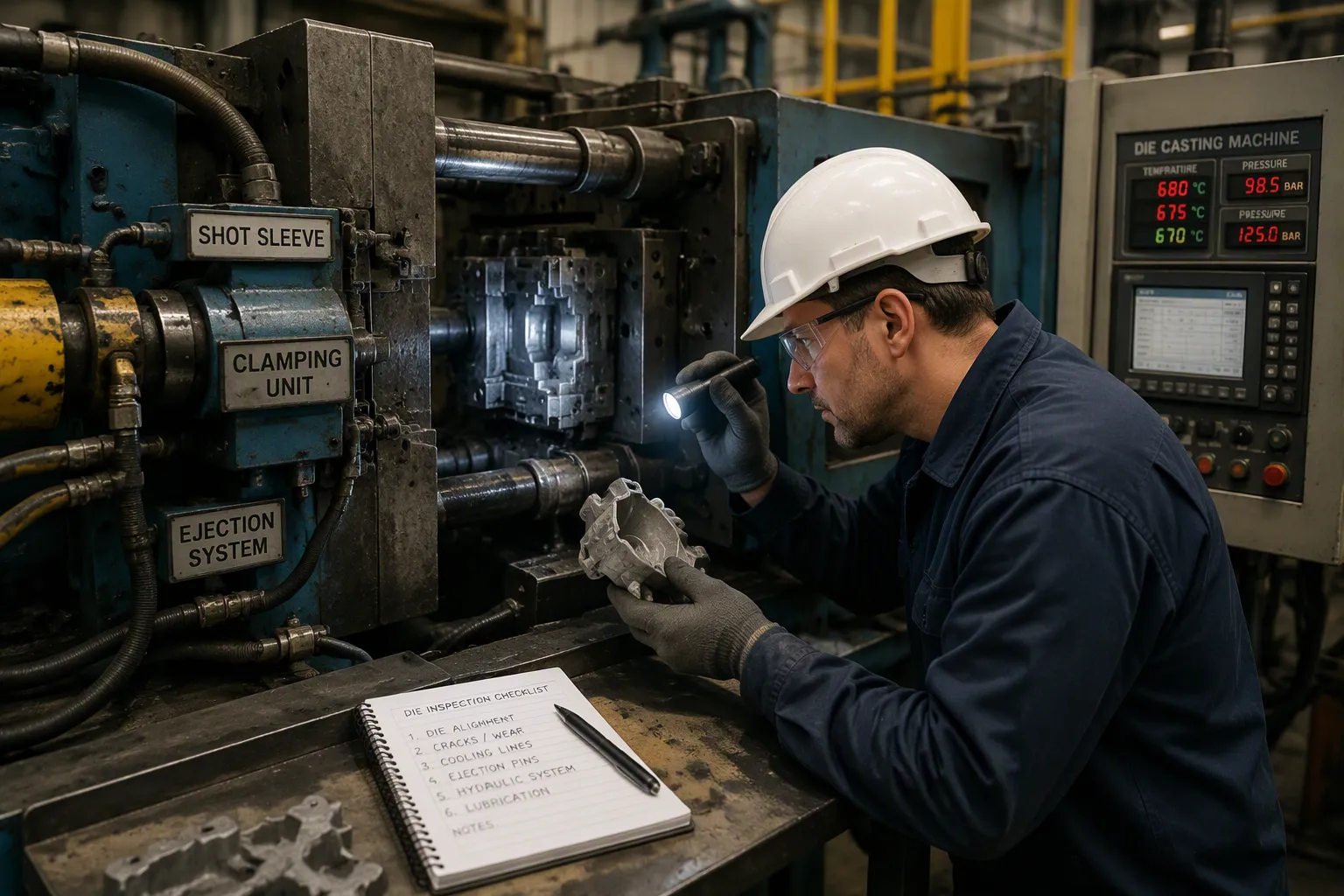
A thorough inspection protects you from hidden repair bills. Walk the floor and check each major system against the table below. Bring a flashlight, a sample casting, and a notepad.
Key Component | Inspection Items |
|---|---|
Check for visible cracks or damage; verify die alignment | |
Shot System | Inspect shot sleeve for wear; check necessary shot pressure |
Clamping System | Verify clamp force and pressure; check for leaks in the hydraulic system |
Ejection System | Test ejection system for proper operation; assess ejection speed and pressure |
Temperature Control | Verify correct melt temperature; validate die temperature control |
Lubrication System | Review lubrication system adequacy; inspect for proper lubricant mixture |
Cooling System | Check water intake and output temperature; inspect cooling channels for blockages |
Casting Quality | Inspect finish and dimensions of a sample casting; check gates and runners for defects |
Run the machine under power when possible. Watch the clamping unit cycle and listen for unusual noise. A worn shot sleeve or a leaking hydraulic line signals expensive repairs ahead.
Brand reputation shapes long-term parts availability and resale value. Colosio, Haitian, and Koei machines hold strong positions in the used market. Each brand carries its own support network and spare-part pricing.
Paperwork confirms the machine matches its advertised capability. Ask for the owner's manuals, hydraulic schematics, electrical schematics, mechanical drawings, and the PLC ladder logic program. Missing documentation lowers value and complicates future maintenance.
Technical specifications deserve equal scrutiny. Confirm locking tonnage, shot range, shot weight, distance between tie bars, and dry cycle time. Locking tonnage classifies a die casting machine, such as an 800-ton unit. Shot range stays flexible because you can adjust the shot sleeve and plunger diameter. Shot weight usually appears as a range for each machine size. Distance between tie bars sets the maximum die size the machine accepts. Dry cycle time measures the full casting process without molten metal and without casting cooling time. Larger machines generally run slower dry cycles. Add cooling time to the dry cycle to estimate real production output.
Specifications vary by brand and year, so verify every number against the original data sheet.
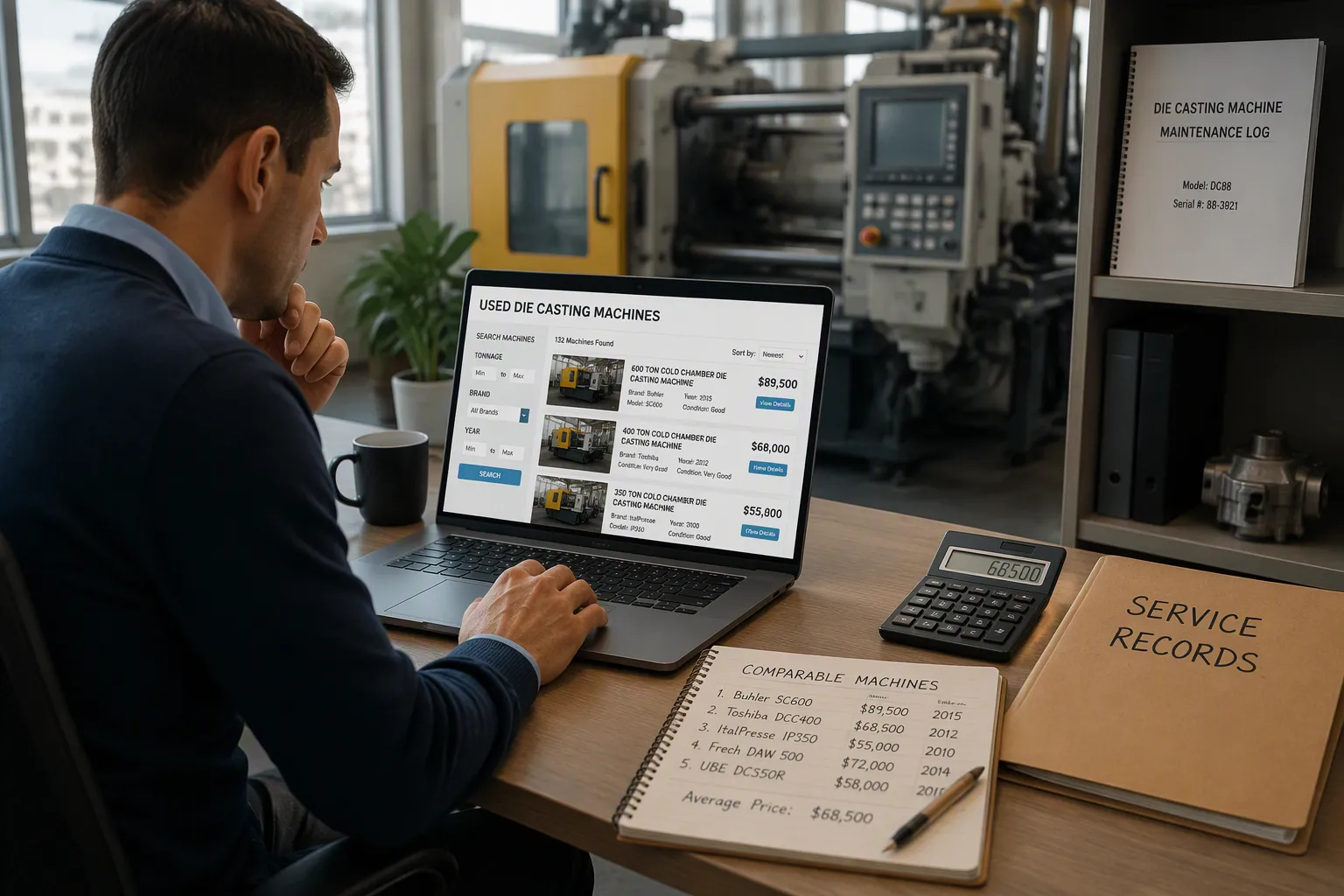
Start your valuation research on established listing platforms. Surplus Record, MachineTools.com, and Machineseeker.com publish asking prices and completed sales for used equipment. Search by tonnage, brand, and year to build a set of comparable listings. Compare listings across all three sites to spot outliers. Track how long each listing stays active. A machine that sells quickly was priced well; one that lingers was priced too high. These platforms also let you filter by region, which helps you estimate freight exposure before you commit.
Collect at least five comparables before you settle on a number. Adjust each comparable for differences in condition, options, and location. Freight costs vary widely by region, so a distant machine may cost more than a local one at the same asking price. Note the listing date on every comparable. Record your sources and dates, because the market shifts with demand from automotive and consumer goods sectors. A valuation built on stale data will mislead you during negotiation.
Condition drives price more than any other single factor. A well-maintained die casting machine with complete service records justifies a premium over an identical unit with unknown history. Age matters, but hours of operation and rebuild history matter more. A machine with a recent hydraulic rebuild holds value better than an older unit that has never been serviced. Request oil analysis reports and vibration readings when available. Inspectors should document every wear item, because buyers discount heavily for uncertainty.
Brand strength shapes both asking price and resale potential. Established names carry reliable parts networks and strong buyer demand. Included tooling, dies, and automation packages add measurable value, so price them separately from the machine itself. Consult specialized dealers such as diecastmachinery.com for valuation insights. These dealers track real transaction data and can confirm whether your target price matches current market conditions. Ask dealers for recent closed deals in your tonnage class. Their input protects both sides from anchoring on unrealistic numbers.
You need a wide reach to find the right counterparty. Start with specialized dealers. Die Casting Machinery (diecastmachinery.com) serves buyers and sellers of used equipment and offers consignment services for surplus machines. Under consignment, the dealer markets your machine, handles buyer inquiries, and manages the sale while you retain ownership until it sells. Beta Die Casting Equipment accepts trade-ins, which lets you apply the value of your current machine toward a replacement. Trade-in deals close faster than direct sales and reduce your storage and marketing costs.
General marketplaces expand your pool of prospects. Post and search on Surplus Record, MachineTools.com, Machineseeker.com, and FISS Machines. Industry Facebook groups also connect you with regional buyers and sellers. Each channel attracts a different audience, so list your die casting machine on more than one platform. Cross-posting takes little effort and multiplies your exposure.
Verification protects your money and your equipment. Ask every prospect for business credentials first. Request a company registration, a tax ID, and a physical address. Confirm the address matches the business name. A legitimate dealer or manufacturer will provide these details without hesitation.
Check references next. Ask for two or three recent transactions in the same tonnage class. Call those references and ask about payment speed, inspection cooperation, and follow-through. Review the counterparty's transaction history on the platforms where they list. A long record of completed deals signals reliability. A new account with no history deserves extra caution.
Trust your inspection rights as a final filter. Insist on a supervised inspection before money changes hands. A serious buyer will welcome the chance to verify condition. A seller who blocks inspection or rushes the timeline may hide problems. Walk away from any deal that feels pressured.
Move the conversation beyond the sticker price. Bargain over non-price elements instead: down payment, interest rate, first payment date, warranty, service contract, consumables, spare parts, and training. These terms often matter more than a small discount.
Protect your cash flow by bundling post-sale add-on costs into the financing. Rigging, plumbing, electrical work, training, and tooling all belong in the deal rather than in your pocket. Push the first payment date as far out as possible, ideally until the machine runs and generates revenue. A 120-day window or a date tied to a later training session works well. Consider paying full price with $0 down instead of chasing a large discount. Sales staff often earn incentives on overall deal price, so they can help secure favorable financing terms. You can also negotiate the price up by adding tooling or consumable credits, so those items get financed rather than paid in cash. One machinist secured $5K in tooling by showing the boss that financing the tooling upfront was cheaper than buying one tool per month over five years.
Paperwork closes the deal and protects both sides. You need a bill of sale, a warranty disclaimer, and a transfer of ownership document. Read every clause before you sign.
Use safe payment methods such as escrow or a verified bank transfer. Never release funds before you confirm ownership. For logistics, flatbed and drop deck trailers position wide and high casting machines. Multi-axle trailers load or unload free-standing cargoes. Expert drivers and loaders handle each Die Casting Machine, and pilot cars escort safe deliveries. A dispatch coordinator can identify a suitable carrier within an hour. Specialized shipping departments manage heavy machinery every day. Die and mold upenders rotate heavy tools for inspection and repair without improvised forklift movements. Size the upender for the complete tool weight, footprint, center of gravity, and duty cycle.
You now have a clear path through the used die casting machine market. Set your goal and budget first. Assess condition and specs next. Research market value with real comparables. Find and vet every party carefully. Negotiate price, terms, and paperwork to close the deal.
Take action with these steps in hand. Buyers gain confidence when they inspect machines and verify documents. Sellers attract serious offers when they price fairly and present complete records. Thorough preparation and due diligence protect your investment and reduce risk.
Consult specialized dealers or industry professionals when a deal feels uncertain. Their market knowledge and transaction experience guide you toward a successful outcome.
Match tonnage to your part and alloy. Lightweight aluminum components for consumer electronics run on 200T–400T machines. Automotive housings demand 1,000T–4,000T. Hot-chamber machines suit zinc and magnesium, while cold-chamber machines handle aluminum. Calculate required closing force from your product's projection area and expected injection pressure.
Check the die, shot system, clamping unit, ejection system, temperature control, lubrication, and cooling. Run the machine under power when possible. Listen for unusual noise and watch the clamping cycle. A worn shot sleeve or leaking hydraulic line signals expensive repairs ahead.
Search Surplus Record, MachineTools.com, and Machineseeker.com for comparable listings. Collect at least five comparables and adjust for condition, options, and location. Condition and brand drive price most. Consult specialized dealers like diecastmachinery.com for real transaction data.
List on specialized dealer sites and general marketplaces. Die Casting Machinery offers consignment services. Beta Die Casting Equipment accepts trade-ins. Post on Surplus Record, MachineTools.com, Machineseeker.com, FISS Machines, and industry Facebook groups. Cross-posting multiplies your exposure.
You need a bill of sale, a warranty disclaimer, and a transfer of ownership document. Use escrow or a verified bank transfer. Never release funds before confirming ownership. For logistics, flatbed and drop deck trailers handle wide casting machines, and pilot cars escort safe deliveries.
