
EMAIL:
lh@longhuamachine.com
TELL/whatsapp:
+8619305527239  English English

Views: 0 Author: Site Editor Publish Time: 2026-10-22 Origin: Site


The top 10 die casting machine brands in 2026 are Buhler Group, L.K. Machinery, Frech Group, Idra Group, UBE Machinery, Shibaura Machine, Yizumi Holdings, Kurtz Ersa, ItalPresse Gauss, and Albertini (Sodic). These manufacturers earned their positions through market share, technological innovation, global reach, and customer satisfaction. Each brand profile below covers founding year, location, specialties, achievements, and applications. This structure supports easy comparison across die-casting solutions. Buhler leads the sector with energy-efficient systems. L.K. Machinery dominates large-tonnage die-casting production. Idra drives mega-casting advances for electric vehicles. The ranking reflects verified performance data and industry recognition. These leaders shape global die-casting standards.
Buhler leads with energy-efficient machines. L.K. Machinery excels in large-tonnage production. Idra drives mega-casting for electric vehicles.
Each brand has unique strengths. Match the machine to your production needs. Consider tonnage, materials, and automation.
Check certifications like ISO 9001 and IATF 16949. They ensure quality and open doors to regulated industries.
After-sales support is crucial. A strong service network reduces downtime and keeps your production running smoothly.
The industry moves toward larger castings and smarter controls. These top brands will shape the future of die casting.
This ranking evaluates each company on four weighted factors. Market share carries the most weight. Technological innovation follows closely. Global reach and customer satisfaction complete the assessment. Analysts reviewed public financial disclosures, patent filings, and installation data across major regions.
The methodology also considers after-sales service networks and machine tonnage ranges. A die casting machine serves different production scales. A brand with strong automotive partnerships may rank higher than one focused on smaller components. These criteria produce a balanced view of the high pressure die casting machine manufacturers worldwide.
The table below lists the top ten die-casting machine brands with a one-line descriptor for each. Full profiles appear in the sections that follow.
Rank | Brand | One-Line Descriptor |
|---|---|---|
1 | Buhler Group | Swiss pioneer in energy-efficient cold chamber systems |
2 | L.K. Machinery | China's largest builder of large-tonnage machines |
3 | Frech Group | German leader in automation-integrated equipment |
4 | Idra Group | Italian innovator behind the Giga Press |
5 | UBE Machinery | Japanese specialist in vacuum die-casting technology |
6 | Shibaura Machine | Precision-focused Japanese builder with IoT systems |
7 | Yizumi Holdings | Fast-growing Chinese manufacturer in smart casting |
8 | Kurtz Ersa | Historic German brand in low-pressure casting |
9 | ItalPresse Gauss | Italian expert in aluminum casting solutions |
10 | Albertini (Sodic) | Custom engineering specialist for gravity casting |
These manufacturers represent diverse strengths. Some excel in tonnage capacity. Others lead in digital integration or specialized alloys. Buyers should match each brand's specialty to their production requirements.
Buhler Group began operations in 1860 in Switzerland. The company grew into a global market leader in die casting technology. Its cold chamber machines serve demanding industrial sectors. The Carat series handles large structural parts with high precision. The Ecoline series offers a cost-effective option for smaller production runs. Both series reflect the brand's focus on energy-efficient solutions. Buhler equipment reduces power consumption during each cycle. This advantage matters for plants that run continuous shifts.
The company operates as a high-pressure die casting machine manufacturer with a worldwide service network. Its machines support automotive structural parts and aerospace components. These parts require tight tolerances and consistent quality. Buhler meets those demands through advanced process control.
Buhler's technical edge comes from several integrated systems. The table below summarizes the main innovations and their benefits.
Technological Innovation | Key Benefit / Description |
|---|---|
Unique Shot Control | Real-time closed-loop control that automatically corrects deviations, leading to high-quality cast parts, shorter cycle times, and up to 30% increased productivity. |
DataView Control System | An intuitive touch screen interface for central control of the die-casting system, which can reduce programming times by up to 25%. |
Peripheral Integration | Seamless control of peripheral devices (e.g., SmartVac, BuhlMark, BuhlSpray, BuhlRob, BuhlLadle) via a single display unit for a smoother, automated process. |
Proportional Technology | State-of-the-art technology that controls the high-power injection unit to compensate for process fluctuations and ensure stable production. |
Flexible Design | Allows for tailored die-casting solutions to meet precise requirements for various applications, including automotive parts, white goods, and consumer electronics in aluminum or magnesium. |
These innovations support a wide range of end markets. Buhler die casting machine installations serve powertrain production, e-mobility programs, and two-wheeler manufacturing. Each application benefits from the same core strengths. The equipment delivers repeatable results across long production campaigns.
L.K. Machinery began operations in 1979 in Hong Kong. The company expanded its manufacturing base into mainland China and grew into the largest die casting machine manufacturer in China. Its core specialty is large-tonnage cold chamber machines. These machines serve industries that demand high clamping force and consistent shot repeatability. L.K. also builds real-time control systems that monitor injection parameters during each cycle. This technology helps operators catch deviations before they produce scrap.
The company ranks among the leading high-pressure die casting machine manufacturers worldwide. Its product range covers cold chamber systems, magnesium injection molding, and squeeze casting platforms. Each line targets a distinct production need. The TPI Thixomolding Module offers flexible magnesium solutions for lightweight sustainability. It switches between cold chamber and semi-solid casting and saves up to 50% energy. Suitable markets include smart wearables, AR glasses, and aerospace components. The SCHB Series horizontal squeeze casting machine handles high-precision parts such as knuckles and battery trays. It features 210 bar squeeze pressure and ultra-controlled speed from 0.02 to 0.3 m/s. The GU Series double-gantry 5-axis machining center tackles large-scale complex aluminum auto parts, including subframes and compartments.
L.K. invests heavily in research and development. The company has established 12 R&D centers globally and holds more than 300 patent certificates. These patents cover special casting, injection molding, automatic control, and material technology. The brand has earned recognition at major industry events. A Gold Medal at the International Exhibition of Inventions in Geneva came in 2008. Medals from the same exhibition and the MIS Industry Award followed in 2022. The Guangdong Provincial Key Areas Research and Development Program selected L.K. in 2019.
University partnerships strengthen its technical foundation. L.K. established the Tsinghua-LK High-tech Die-casting Technology Research Center with Tsinghua University in 2000. That collaboration produced a large-ton magnesium alloy die casting machine. Later agreements with Zhejiang University in 2021 and Shanghai Jiao Tong University in 2022 expanded its research into intelligent die-casting equipment. These applications now support 5G components and electric vehicle parts. The equipment serves customers who need reliable output at scale.
Frech Group started business in 1949 in Germany. The company grew into the European market leader among high-pressure die casting machine manufacturers. Its product range covers cold/hot chamber die-casting machines, and each type targets a distinct alloy family. Cold chamber systems handle aluminum, while hot chamber systems serve zinc. Frech also builds automation integration into its platforms. Robots, sprayers, and dosing units connect to the main control system. This design reduces manual handling and stabilizes cycle times. The company holds ISO certifications for its quality and environmental management systems. These credentials support its standing as a trusted brand in Europe and beyond.
The FRECH Natum cold chamber series represents a next-generation platform. Engineers rebuilt the machine from the ground up. Advanced injection technology improves shot consistency. A 3-plate closing unit delivers exceptional rigidity under load, fast closing and opening speeds, superior platen parallelism, and long-term reliability. These traits suit demanding and challenging die casting applications in aluminum. Frech showcased the Natum at the NADCA Die Casting Congress and Tabletop in Grand Rapids, and FRECH USA offers it in North America.
The FRECH W80 hot chamber machine brings a different set of innovations. Real-Time Control monitors and adjusts process parameters during production. The FRECH Dosing System (FDS) manages metal delivery with precision. A fully integrated servo sprayer handles die lubrication automatically. This equipment supports zinc die casting for automotive and industrial components. Both series show how the company pairs machine hardware with process intelligence. Buyers gain repeatable output and lower scrap rates across long production runs.
Idra Group began operations in 1946 in Italy. The company built a reputation for high-tonnage machines and large structural castings. Its Giga Press line stands as the most recognized product in its portfolio. This heavy-duty die casting machine produces single-piece vehicle structures that replace dozens of smaller welded parts. Idra holds a dominant position in the gigacasting market. Its rear underbody segment alone captured 51.4% market share in 2025. The company partners with Tesla and other automakers pursuing mega casting strategies. Idra equipment supports electric vehicle body structures and other large-format applications.
The Giga Press delivers measurable production advantages. The table below summarizes key performance metrics.
Metric | Value |
|---|---|
Cycle time per casting | ~80–90 seconds |
Hourly output | 40–45 parts |
Daily output per unit | ~1,000 castings |
Rear underbody cost reduction | ~40% |
These figures show why the brand attracts major automakers. Tesla's Model Y went from dozens of casted parts to just a couple of castings using the Giga Press. Elon Musk confirmed the Giga Press introduction allowed Tesla to cut 600 robots from the Model 3's assembly line. Tesla claims it can now produce a Model Y in just 10 hours.
Industry forecasts point to broader adoption. IDRA's general manager, Riccardo Ferrario, predicted that by 2035, "80% of automakers will use Giga Presses… at least for BEV cars." Toyota, GM, Hyundai, Volvo, and Polestar are either actively investing in or have announced plans to invest in gigacasting technology. This die-casting approach reshapes how manufacturers design vehicle platforms. The shift toward mega castings reduces part counts and simplifies assembly. Idra remains at the center of this transformation.
UBE Machinery began operations in 1914 in Japan. The company built its reputation on cold chamber machines and vacuum die casting technology. Its vacuum systems pull air from the shot sleeve and cavity before injection. This step reduces porosity in the final part. UBE holds ISO 9001 certification for its quality management systems. The company also maintains a global automotive supplier network that serves major vehicle brands.
Its machines support high-precision manufacturing and molding. Key industries include automotive, appliances, and consumer goods. UBE equipment is recognized for precision, efficiency, and durability. Common applications cover engine blocks and transmission cases. These parts demand consistent density and dimensional accuracy. UBE meets those demands through stable process control.
The product range includes injection molders from 401–500 ton, 601–700 ton, and 901 ton and over. UBE's electric injection molders provide low-emission, energy-efficient solutions suited to eco-conscious businesses. These traits matter for plants facing tighter environmental rules.
In August 2024, UBE Machinery Corporation, Ltd. introduced a newly developed die casting machine for giga casting. This machine uses aluminum alloy to integrally mold body structure parts for battery electric vehicles (BEVs). The launch places UBE among the die-casting brands pursuing large single-piece castings. This die-casting approach cuts part counts and simplifies vehicle assembly.
Buyers evaluating a new die casting machine should weigh these strengths. UBE combines a long engineering heritage with newer giga casting research. The brand suits automakers that need reliable output and lower emissions. Its vacuum technology also fits structural parts that cannot tolerate internal defects.
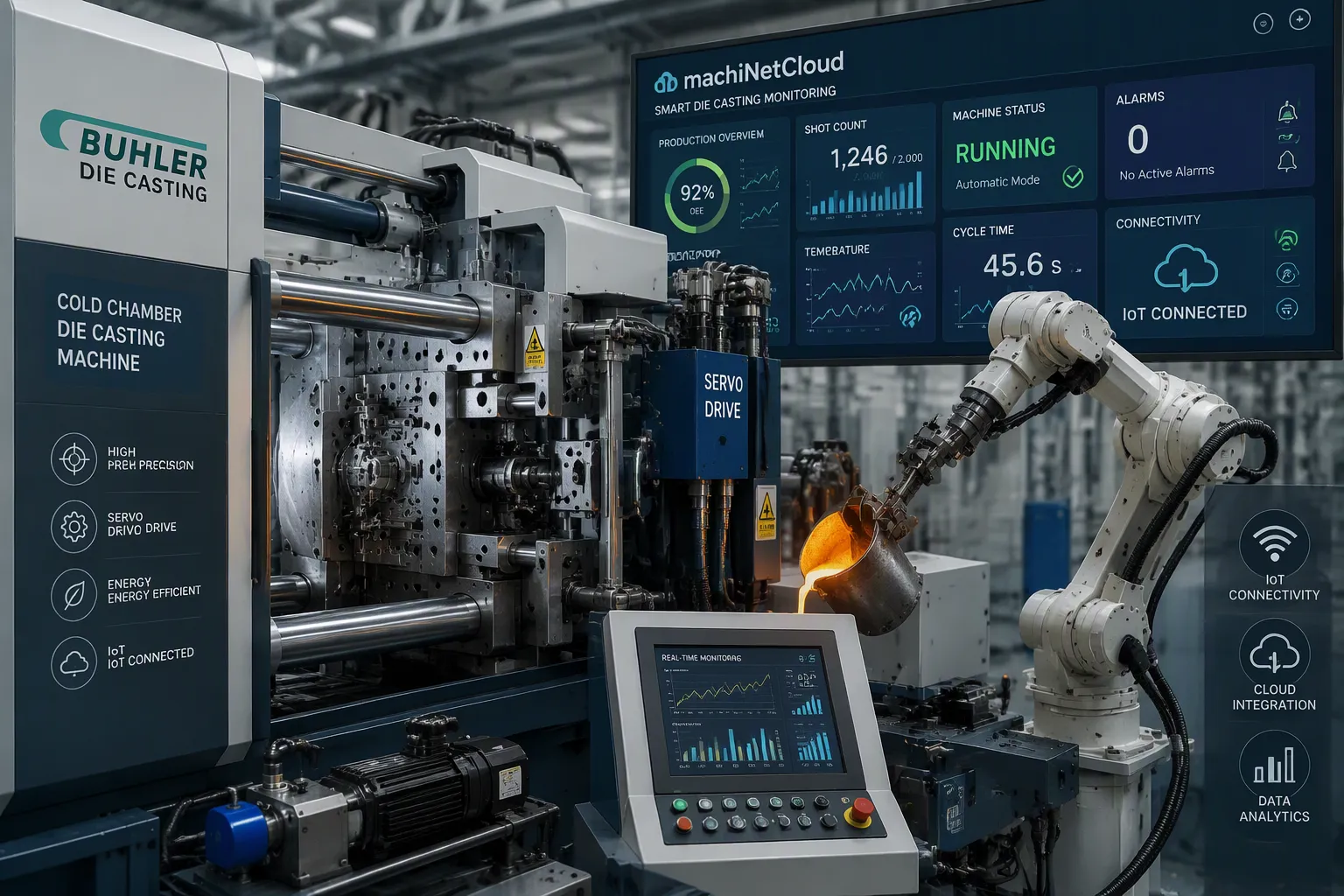
Shibaura Machine began operations in 1938 in Japan. The company built its reputation on precision cold chamber machines and IoT-enabled systems. Its die casting machine lineup serves electronics and automotive parts production. Shibaura holds a strong position among high-pressure die casting machine manufacturers. The brand's engineering heritage spans more than eight decades. Advanced research and development drive its product evolution. A global service network supports customers across multiple regions.
The company's regional coverage includes North America (United States, Canada, Mexico), South America (Brazil), Europe, and Africa. This footprint ensures responsive support for international clients. Shibaura has established the Nano Process Division and launched sales of precision machine tools in the U.S. The company also advanced after-sales service enhancements and expanded its customer portal across core product lines. These steps strengthened its technological and service foundations.
Shibaura integrates several technological advancements into its equipment. The table below summarizes key innovations and their benefits.
Technological Advancement | Application / Benefit |
|---|---|
Automation | Robotic ladles and auxiliary components handle molten metal with precision, improving workplace safety and ensuring consistent quality. |
IIoT | Sensors enable real-time data exchange for predictive maintenance. machiNetCloud provides real-time monitoring and identifies energy waste. |
TOSCAST System | Programmable multi-stop position ejection enables self-degating dies, eliminating additional trimming steps. |
Servo Motors | Electric servo motor-driven machines minimize environmental footprint and save cycle time, space, and maintenance. |
Advanced Shot Control | Reduces porosity in die castings, which can affect aesthetics, structural integrity, and functionality. |
Integrated Ladle | Provides repeatable precision dosing, critical for the die-casting process and improving Overall Equipment Effectiveness. |
Squeeze Master | Reduces targeted porosity, allowing complex shapes that would otherwise be impossible to produce efficiently. |
Vacuum System with TOSCAST Monitoring | Allows production of low-porosity, high-quality castings with predictable mechanical properties. |
The TOSCAST die casting system features programmable multi-stop position ejection. This technology allows the die to automatically trim gates, runners, and flash in a single stroke. As a result, dies eliminate the need for additional trimming steps, achieving true automation in the die-casting process.
Yizumi Holdings began operations in 2002 in China. The company grew into a global provider of advanced die casting machines and smart manufacturing solutions. Its product portfolio covers die casting machines, Thixomolding machines, mold making, industrial automation, and robotic automation. This breadth allows Yizumi to serve customers across the entire production chain. The company listed on the Shenzhen Stock Exchange and expanded its reach into international markets. Yizumi now supports 3C products and new energy vehicles with its equipment.
The Mg II-Plus Series Thixomolding Machine offers one-stop development support from material to molding. This capability helps manufacturers move from concept to production faster. Yizumi also developed the LEAP 10000 die casting machine for large EV components.
YIZUMI LEAP 10000 Die Casting Machine for Large EV Components
Yizumi's Next² 2-Platen Die Casting Machine demonstrated fully automated operation during a live event. The system has already run fully automated at customer sites for over 70,000 cycles. This record shows proven reliability and efficiency at scale. The RHEO Series Al Rheocasting Machine introduces an ultra-low speed and high pressure approach. This method redefines high-performance casting for aluminum rheocasting applications.
The company's latest technology aluminum die casting machines target higher-end applications. Key specifications appear below.
Feature Category | Details |
|---|---|
Locking Forces | 3,800 kN to 10,000 kN |
System Upgrades | Injection, control, locking, and energy-saving systems |
Control Technology | Yi-Cast real-time closed-loop control technology |
Design Purpose | Improve overall equipment effectiveness in complex die-casting operations |
Target Application | Higher-end die casting applications requiring improved repeatability, control, and operating performance |
These high-end aluminum die casting machines serve customers who need repeatable output. Yizumi will exhibit at the Die Casting Congress & Tabletop 2026 in Grand Rapids, MI, Booth #308. The die-casting industry continues to adopt smarter systems. Yizumi positions itself at the center of that shift.
Kurtz Ersa began operations in 1779 in Germany. The company carries one of the longest engineering heritages in the metal casting industry. Its foundry division specializes in low-pressure and gravity casting systems. This aluminum die casting machine brand serves manufacturers who need precise fill control and low turbulence during pouring. The company operates as a full-range equipment supplier. Its portfolio covers machines, automation, and process monitoring tools. Kurtz Ersa maintains a global service network. This reach supports customers across Europe, Asia, and the Americas.
The brand's core strength lies in aluminum alloy die casting for structural components. Low-pressure systems produce parts with low porosity and high mechanical strength. Gravity casting suits thicker sections and simpler geometries. Both methods serve automotive lightweighting programs. Automakers use these machines to produce chassis parts, battery housings, and structural nodes. Aerospace manufacturers also rely on Kurtz Ersa systems for critical components. These parts demand strict quality control and repeatable results.
Kurtz Ersa integrates advanced process control into its die-casting platforms. Sensors monitor metal temperature, fill pressure, and die conditions in real time. Operators receive immediate feedback on process deviations. This capability reduces scrap rates and improves part consistency. The company also develops automation solutions for loading, unloading, and post-casting handling. These systems reduce manual labor and stabilize cycle times.
The brand's application focus centers on lightweight construction. Automotive customers use Kurtz Ersa machines to cast aluminum structural parts that replace heavier steel assemblies. This shift supports fuel efficiency and electric vehicle range targets. Aerospace applications include components that require tight dimensional tolerances and internal integrity. The company's long engineering history provides a foundation for these demanding sectors. Its global service organization ensures rapid response when production issues arise. Buyers seeking a proven die casting machine for low-pressure or gravity processes should consider Kurtz Ersa. The brand combines centuries of manufacturing knowledge with modern process intelligence.
ItalPresse Gauss began operations in Italy during the 1960s. The company built its reputation on low-pressure die casting technology. This focus allows the brand to deliver high-quality machines and automated solutions for demanding sectors. Automotive and aerospace manufacturers rely on ItalPresse Gauss equipment for precision work. The company joined the Norican Group, which strengthened its industry capabilities and global reach. Its primary operations remain in Italy, with additional presence in China and Mexico.
The table below summarizes the brand's core attributes and market position.
Attribute | Details |
|---|---|
Key Specialty | Low pressure die casting technology, including high-quality die casting machines and automated solutions |
Target Sectors | Automotive and aerospace |
Core Benefits | Enhanced productivity and minimized scrap rates |
Customer Support | Equipment upgrades and training services |
Innovation/Achievement | Monitizer platform integrating smart technologies to optimize production processes |
Industry Affiliation | Part of the Norican Group |
Global Presence | Primarily Italy, with additional presence in China and Mexico |
These specialties position ItalPresse Gauss as a provider of aluminum alloy casting solutions for structural components and wheels. The brand's low-pressure systems produce parts with low porosity and high mechanical strength.
ItalPresse Gauss integrates several technological advancements into its product line. The HMe Retrofit upgrades existing machines with modern control software. This package delivers real-time data, advanced diagnostics, and a modern interface. The company also builds two-platen (toggle-free) and three-platen high-pressure die casting machines. Shot monitoring, control, and diagnostic systems come standard on many platforms. Robotics and automation connect with peripheral equipment for complete turn-key auto-cells.
Gravity die casting solutions offer flexible configurations for varied production needs. These systems maintain tight tolerances for precision, longer die life, and structural rigidity. Applications span automotive, electronics, domestic heating, telecom, motors, household appliances, and industrial equipment. The brand supports light alloy die casting for aluminum and magnesium. ItalPresse Gauss has completed more than 3,500 worldwide installations and demonstrated technological leadership since the 1970s. This track record supports its standing among the top die-casting machine brands in 2026.
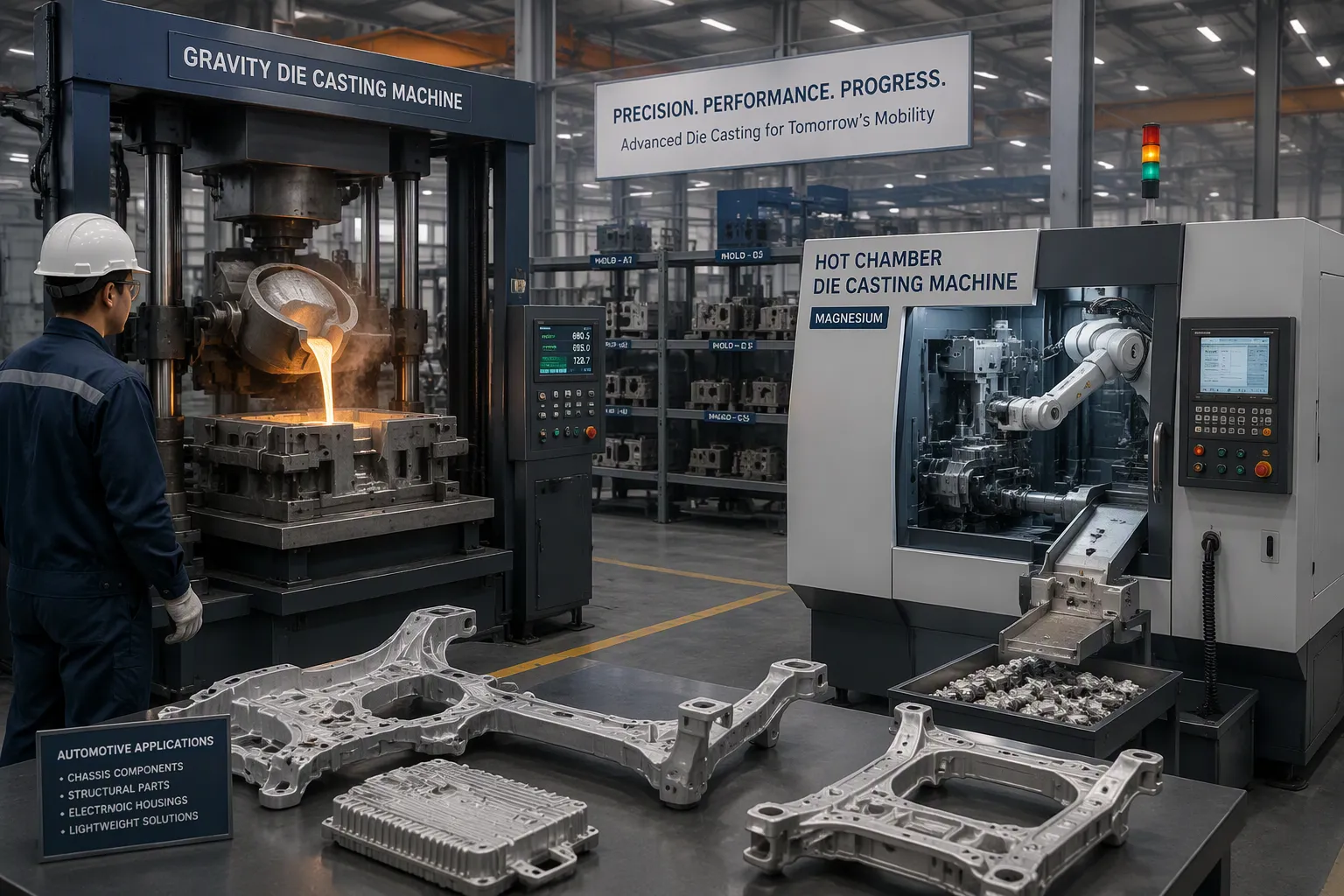
Albertini began operations in Italy during the 1960s. The company built its name on gravity and low-pressure die casting machines. These systems serve manufacturers who need controlled fill rates and minimal turbulence during pouring. Albertini holds a mid to high-end market position. This standing reflects decades of custom engineering work for European customers. The brand also operates alongside Sodic, a Japanese manufacturer known for precision hot chamber machines. Sodic equipment suits magnesium parts production especially well. Both companies rank among the leading players in the metal castings die casting machine market.
The table below summarizes the core strengths of each brand.
Company | Specialty / Positioning |
|---|---|
Albertini (Italy) | Historical brand with mid to high-end market positioning |
Sodic (Japan) | Precision hot chamber machines, well-suited for magnesium parts |
These specialties complement each other. Albertini focuses on gravity and low-pressure solutions for structural work. Sodic brings hot chamber expertise for smaller, precision components. Together they cover a broader range of production needs.
Albertini emphasizes custom engineering over standardized platforms. The company designs each machine around specific customer requirements. This approach suits automotive and industrial casting applications. Gravity casting works well for thicker sections and simpler geometries. Low-pressure systems produce parts with low porosity and high mechanical strength. Automotive customers use this equipment for structural components and chassis parts. Industrial applications include housings, brackets, and machine components.
Sodic's hot chamber machines serve a different segment. Magnesium parts require careful temperature control and fast cycle times. Hot chamber systems handle these demands well. The equipment supports electronics housings and lightweight components for transportation.
Both brands maintain a strong European market presence. Albertini's Italian base provides access to major automotive suppliers across the continent. Sodic's Japanese heritage brings precision manufacturing standards. Industry analysts recognize both companies as key players with unique strengths. Specific achievement details remain limited in public disclosures. Their consistent market presence speaks to reliable performance across decades of operation.
Buyers seeking gravity or low-pressure solutions should evaluate Albertini. Those needing hot chamber capability for magnesium should consider Sodic. Both brands offer proven die-casting technology for demanding applications.
The top die casting equipment manufacturers share a common foundation of industry certifications. ISO 9001 serves as the baseline quality management standard for most suppliers. Automotive production supply chains require IATF 16949 certification. Aerospace applications demand AS9100D compliance. Medical device components need ISO 13485. Environmental management systems follow ISO 14001. Defense-related work often requires ITAR registration. These certifications determine which regulated sectors a supplier can serve.
The table below summarizes common certifications across leading manufacturers.
Certification | Primary Application |
|---|---|
ISO 9001 | Baseline quality management |
IATF 16949 | Automotive production |
AS9100D | Aerospace components |
ISO 13485 | Medical devices |
ISO 14001 | Environmental management |
ITAR | Defense-related work |
A supplier's certification scope directly affects the documentation packages it can deliver. Buyers in regulated industries should verify credentials before committing to a die-casting partnership.
The global die-casting machine brands exert substantial influence on manufacturing worldwide. The US aluminum die casting market reached $10.49 billion in 2025. Aluminum represents 57% of the US die casting market. Automotive accounts for 83% of OEM demand. North American automotive die casting alone reached $12.68 billion in 2025. The US die casting sector employs more than 50,000 workers.
These manufacturers drive technological advancement across regions. Buhler's Carat gigacasting platform has sold more than 50 machines across OEMs. The Carat 840 and 920 models reach up to 92,000 kN clamping force. Volvo selected Buhler over competitors for its gigacasting needs. Shibaura Machinery is developing 6,000 to 12,000-ton ultra-large machines for automotive underbody applications.
MRFR identifies the OEM capital commitment cycle as the dominant strategic force reshaping the aluminum die casting machine competitive landscape: each OEM gigacasting decision is effectively a 10–15-year machine supplier relationship.
The equipment manufacturer that secures production references before 2026 will structurally dominate the next OEM capital cycle through 2035. Global market share concentrates among brands with proven gigacasting capabilities. Yizumi established an R&D center in Aachen, Germany, to gain early access to European OEM specification discussions. This strategic positioning reflects the intense competition among manufacturers for the second wave of gigacasting investments.
Selecting the correct machine begins with clamping force. The machine's tonnage must exceed the expansion force generated during injection. This force equals the casting's projected area multiplied by the expected injection pressure. Insufficient tonnage causes flash, incomplete filling, or mold deformation. Excessive tonnage wastes energy and increases mold wear.
Several factors shape the tonnage decision:
Material properties: Aluminum requires moderate injection pressure, while denser zinc demands higher pressure. Magnesium flows easily and may allow a 10–20% reduction in pressure estimates.
Wall thickness: Thin walls need higher injection pressure to fill the cavity completely.
Production scale: High-volume runs demand higher tonnage and faster cycle times.
Safety margin: A factor of 1.2 is standard; use 1.5 for complex molds or new setups.
After-sales support matters equally. A reliable supplier provides responsive service, training, and spare parts. Buyers should verify a manufacturer's regional service network before committing. Reputable manufacturers also offer process consultation when defects persist despite correct settings.
The cost of aluminum die casting machines varies widely by tonnage, automation level, and brand reputation. Hot-chamber machines (20–400 tons) suit zinc and magnesium. Cold-chamber machines (100–4,000 tons) handle aluminum. Hybrid machines (200–1,000 tons) offer flexibility for mixed alloys.
A high-quality die casting equipment purchase involves more than the initial price. Buyers must weigh energy consumption, maintenance requirements, and expected service life. An aluminum die casting machine brand with proven reliability reduces downtime and scrap rates over time. These savings often offset a higher upfront investment.
Evaluating die-casting equipment requires matching machine capacity to actual production needs. Overbuying wastes capital. Underbuying limits growth. Consulting an experienced die-casting expert helps buyers avoid both errors.
Tesla adopted the Idra Giga Press for its Model Y production line. This machine produces a single-piece rear underbody casting. The casting replaces dozens of smaller welded parts. Tesla confirmed the Giga Press introduction allowed the company to cut 600 robots from the Model 3 assembly line. Tesla also claims it can now produce a Model Y in just 10 hours.
The Giga Press delivers a cycle time of roughly 80 to 90 seconds per casting. Each unit produces 40 to 45 parts per hour. Daily output reaches approximately 1,000 castings per machine. These figures demonstrate the production scale this die-casting approach enables. The rear underbody cost dropped by about 40 percent. This saving comes from fewer parts, less welding, and simplified logistics.
Tesla's choice of Idra produced measurable gains across the assembly process. Part counts fell dramatically. Assembly steps became simpler. Factory floor space requirements decreased. The die-casting process also improved structural consistency because a single casting eliminates many joint interfaces.
Other automakers noticed these results. Toyota, GM, Hyundai, Volvo, and Polestar are either actively investing in or have announced plans to invest in gigacasting technology. Industry forecasts suggest that by 2035, 80 percent of automakers will use Giga Presses for battery electric vehicles. This prediction came from Idra's general manager, Riccardo Ferrario.
Brand selection shaped these outcomes. Idra held 51.4 percent market share in the rear underbody segment in 2025. That dominance reflects proven reliability at production scale. A buyer who selects a proven brand gains more than equipment. That buyer gains a manufacturing strategy validated by real production data.
The top 10 die casting machine manufacturers in 2026 each bring distinct strengths to the global market. Buhler leads in energy efficiency, L.K. Machinery dominates large-tonnage production, and Idra drives mega-casting for electric vehicles. Frech, UBE, and Shibaura serve precision automotive needs. Yizumi, Kurtz Ersa, ItalPresse Gauss, and Albertini cover smart manufacturing, low-pressure, and gravity casting applications. These brands prove that no single machine fits every production line. Their innovations set the standard for quality and performance. Buyers should weigh tonnage, cost, reputation, and after-sales support before committing. The die-casting industry will keep evolving toward larger castings and smarter controls. These die-casting leaders will shape that future.
Buhler Group holds the top position. The Swiss manufacturer earned this rank through market share, energy-efficient technology, and a worldwide service network. Its Carat and Ecoline series serve automotive and aerospace applications. Buhler's Shot Control system improves productivity and part quality.
Large structural castings for electric vehicles require high clamping force. Idra's Giga Press produces single-piece underbody castings with cycle times around 80 to 90 seconds. L.K. Machinery and Yizumi also build large-tonnage machines for EV components. Buyers should match tonnage to projected casting area and injection pressure.
Low-pressure systems fill molds slowly with minimal turbulence. This approach reduces porosity and suits structural aluminum parts. Kurtz Ersa and ItalPresse Gauss specialize in this technology. High-pressure machines offer faster cycle times for high-volume production. The die-casting method chosen depends on part geometry and quality requirements.
ISO 9001 provides the baseline quality standard. Automotive suppliers need IATF 16949 certification. Aerospace work requires AS9100D compliance. Environmental management follows ISO 14001. These credentials determine which regulated industries a machine can serve. Verification protects buyers from compliance gaps.
Production downtime costs money. A responsive service network reduces repair delays and keeps lines running. Buhler, Frech, and Shibaura maintain global support operations. Training programs help operators maximize equipment performance. Spare parts availability affects long-term operating costs. Buyers should evaluate support coverage before committing to a purchase.
