
EMAIL:
lh@longhuamachine.com
TELL/whatsapp:
+8619305527239  English English

Views: 0 Author: Site Editor Publish Time: 2026-10-19 Origin: Site


Die casting in 2026 is being reshaped by smarter machines, advanced alloys, and simulation-driven design. The die casting machine market is projected to grow from US$4.1 billion in 2026 to US$6.1 billion by 2033 at a 6.1% CAGR. Four innovation pillars drive this shift: advanced alloys for lightweighting, digital engineering and simulation, automation and smart manufacturing, and sustainability and energy efficiency. These forces raise a central question: what are these innovations, and how do they change production across automotive, aerospace, and electronics? Manufacturers now face a clear choice: adopt these tools or fall behind.
Smart die casting machines use real-time data to improve quality and reduce waste.
Advanced aluminum and magnesium alloys make parts lighter and stronger for electric vehicles and aircraft.
Simulation and AI shorten development time and cut defects before production starts.
Robots and IoT sensors automate tasks and predict maintenance needs, boosting efficiency.
Recycling alloys saves energy and money while supporting sustainable manufacturing.
Die casting machines have evolved through three distinct phases. Early machines relied on manual operation, where workers controlled metal pouring and part extraction by hand. The industry then moved to automated systems, which introduced programmable logic controllers and robotic arms for repetitive tasks. Today, the latest trends point toward smart, connected machines that integrate real-time data analytics, predictive maintenance, and automated control systems.
These smart machines deliver measurable gains. They achieve faster cycle times, reduce material waste, and minimize energy consumption. The integration of IoT and AI enhances casting precision and supports lean production practices. Manufacturers now treat smart die casting machine platforms as strategic assets for optimizing output and reducing operational risks.
Three forces converge in 2026 to make this year a genuine inflection point. First, electric vehicles demand larger, integrated castings for battery housings, motor frames, and unified chassis sections. Structural megacasting can reduce curb weight by 10-15%, which brings critical range benefits. Second, lightweighting pressure extends beyond automotive. Aerospace efficiency targets and electronics miniaturization push demand for higher strength-to-weight ratios. Magnesium alloys offer up to 30% weight savings compared to aluminum.
Third, digital tooling has matured. Simulation technologies now predict metal flow behavior and solidification patterns, identify porosity risks early, and reduce tooling iterations. Automation and smart manufacturing practices have also reached practical maturity. Robots handle ladling, die spraying, part extraction, trimming, and inspection. Real-time monitoring of temperature, pressure, and cycle data enables predictive maintenance and automated parameter adjustments. These three forces together explain why 2026 marks a turning point rather than just another year of incremental change.
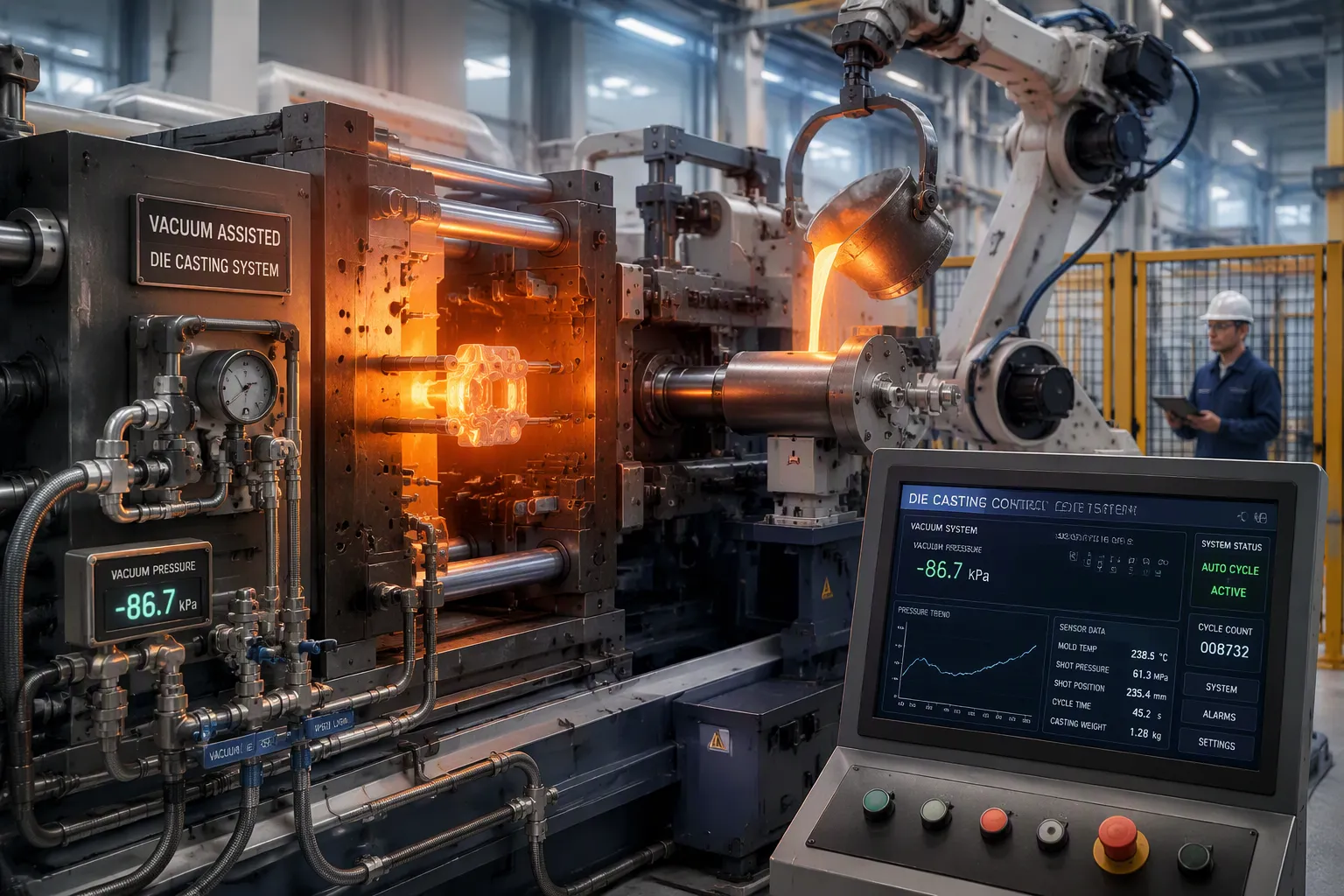
Modern die casting machine design centers on tighter process control. Sensor-integrated platforms now adjust parameters in real time and shrink the margin of error during each shot. Simulation software optimizes casting design before production begins, which lowers human error and reduces repeated trials. These technological advancements in die casting deliver better cost-effectiveness and sustainability outcomes.
Vacuum-assisted die casting represents one of the most impactful technological advancements in recent years. The process pushes air out of the die before metal enters the cavity. This step allows the cavity to condense under pressure and improves both mechanical properties and surface finish. The sequence follows a defined path: operators prepare the shot by bringing melt to target temperature and dosing the correct metal volume into the shot sleeve. The vacuum circuit then opens and draws the cavity down to the setpoint, often under 100 mbar. Phase one pushes metal to the gate. Phase two accelerates to high gate speed while vacuum remains active to pull residual gases out. Intensification pressure feeds shrinkage during solidification. Vacuum valves close, the casting solidifies, the die opens, and ejector pins remove the part.
High-pressure die casting processes benefit from a clear choice between two vacuum levels. The table below compares them.
Feature | Vacuum-Assisted Die Casting | High Vacuum Systems |
|---|---|---|
Evacuation level | Partial evacuation of the die | Near-total evacuation with lowest residual gas content |
Use case | Moderately demanding castings | Critical, demanding parts |
Porosity reduction | Measurable reduction | Drastic reduction |
Cost/complexity | Lower cost and complexity | Higher cost, tightly sealed dies, optimized vacuum channels, larger pumps |
Mechanical properties | Improved fill behavior | Superior and more consistent tensile strength, elongation, fatigue performance |
High-capacity die casting machines with fast shot control and precise gate velocity enable these results. Vacuum pumps, control valves, accumulators, and sealed dies with robust parting-line seals complete the equipment set. Electric servo motor driven machines save cycle time, space, and maintenance. The TOSCAST monitoring system improves vacuum performance and reduces porosity with predictable, repeatable mechanical properties.
Real-time monitoring transforms how operators manage die casting equipment. Embedded sensors, PLCs, thermal imaging, and IoT data acquisition continuously analyze molten metal temperature, injection pressure, die temperature, cooling rate, cycle time, and material flow dynamics. This live visibility enables early detection of deviations that could affect part quality.
Adaptive control takes the next step. Supervised and reinforcement learning models predict defects such as porosity, shrinkage, cold shuts, and surface irregularities before they occur. The machine then automatically corrects process settings. This reduces defect formation and improves casting precision. Predictive maintenance identifies wear in dies, injectors, and hydraulic systems. A cloud dashboard provides live KPIs, quality metrics, and defect probability scores. The result: lower scrap rates, less unplanned downtime, and stronger operational efficiency.
A deep learning-based real-time prediction (ReP) model was developed to predict the 3D temperature field distribution in continuous casting on a millisecond timescale, achieving a mean absolute error of 4.19 K and a mean absolute percent error of 0.49% on test data. By combining the ReP model with Bayesian optimization, the researchers realized rapid decision-making intelligent adaptation of operating parameters for continuous casting with high predictive capability.
This finding supports the broader principle that real-time monitoring and adaptive control can improve process performance in die casting-like operations. The combination of live data and automated correction gives manufacturers a powerful tool for consistent quality.
Aluminum die casting dominates lightweighting strategies across modern manufacturing. The process delivers thin walls, high strength, and excellent surface finishes. Advanced aluminum alloys now push these benefits further. Engineers tune alloy chemistry for better thermal performance and thin-wall capability. Magnesium alloys offer even greater weight savings, though they demand tighter process control.
Precision high-pressure die casting (HPDC) supports electric vehicles by producing lightweight, dimensionally accurate components. These parts handle thermal management, EMI shielding, and structural integrity in one piece. Aluminum die casting provides valuable EMI shielding for sensitive electronics. Motor controller and on-board charger housings rely on HPDC precision and repeatability. Companies with aluminum, zinc, and magnesium die casting capabilities can match the right alloy to each application.
Electric vehicles require exceptionally light parts to maximize range. They also need efficient heat dissipation, EMI shielding, and high functional integration. Precision HPDC meets these lightweighting requirements by enabling motor housings with thin walls. These housings integrate cooling channels and fin structures directly into the casting. Battery housings and large aluminum chassis components benefit from the same approach. Large aluminum chassis production uses these techniques to cut weight without sacrificing stiffness.
Aerospace manufacturers adopt similar strategies. HPDC innovations deliver lightweight components for aircraft systems. Electronics and medical devices also gain from these advances. Aluminum die casting remains the preferred method for large aluminum chassis and structural parts. The combination of advanced aluminum alloys and precise process control enables thinner walls, higher strength, and better surface finishes. Aluminum die casting continues to set the standard for demanding applications. Large aluminum chassis production and battery housings illustrate how lightweighting drives design decisions. Aluminum die casting gives engineers the freedom to consolidate parts and reduce assembly steps.
Virtual prototyping replaces physical trial runs with computer models. Engineers build a digital replica of the die and simulate how molten metal fills the cavity. Mold flow analysis predicts flow fronts, air entrapment, and solidification patterns before a single tool is cut. This simulation-driven design approach shortens development cycles and reduces costly rework.
The smart manufacturing comparison shows the impact. Traditional tool design required multiple trial runs and modifications. Simulation plus AI optimization shortened the development cycle by 40%. Engineers now test gating systems, cooling channel layouts, and overflow locations in a virtual environment. They identify porosity risks and cold shuts without touching the shop floor. This shift from physical iteration to digital iteration saves both time and material.
AI models analyze melt temperature, die temperature, injection speed, and cooling time. They automatically adjust these parameters for best results. The system optimizes cycle stages such as filling, solidification, and ejection to cut downtime. Predictive algorithms also optimize furnace heating and cooling for energy savings. These capabilities form the core of simulation-driven process optimization.
AI-driven computer vision inspects castings through X-ray and CT scans. It identifies micro-defects better than manual inspection. Machine learning predicts defect likelihood based on process parameters and suggests corrective action. AI classifies castings into quality grades in real time. Tooling management benefits as well. AI forecasts die wear, lubrication needs, and tool breakages before they occur. Generative design tools improve die geometry, gating systems, and cooling channels for minimal defects and longer die life.
The results are measurable. The table below compares traditional and smart manufacturing models.
Application Area | Traditional Model | Smart Manufacturing Model | Measured Improvement |
|---|---|---|---|
Process parameter setup | Experience-dependent, lengthy changeover time | AI automatic optimization, one-click setup | Mold change time reduced by 30-50% |
Tool design | Multiple trial runs and modifications | Simulation + AI optimization | Development cycle shortened by 40% |
Quality inspection | Manual random sampling | Fully automated AI inline inspection | Missed defect rate reduced to <1% |
Equipment maintenance | Scheduled maintenance or run-to-failure | Predictive maintenance | Unplanned downtime reduced by 60% |
These technological advancements integrate with industry 4.0 technologies. IoT sensors feed live data into AI models for continuous optimization. Digital twins create virtual replicas of the die casting line. Manufacturers simulate new designs or process changes before implementation. PhysicsX partnered with a leading aerospace manufacturer to deploy AI-driven defect prediction and mold optimization tools. The system ran over 100x faster than previous methods. Within weeks, the manufacturer reduced scrap rates and accelerated throughput.
Robotic handling sits at the center of die casting automation. A six-axis robot performs part extraction, sensing, quenching, error-proofing inspections, and gate removal. The sequence follows a defined path. The robotic arm picks the hot part directly from the mold, places it on a cooling rack, moves it to the trim die for flash removal, and transfers it to the packaging station. This flow improves process reliability and throughput. It also reduces manual handling and operator exposure to heat.
Automated cells deliver measurable gains across several areas. The table below summarizes the main benefits.
Benefit Area | Outcome |
|---|---|
Production efficiency | Faster and more stable cycle times |
Quality consistency | Balanced die temperature, longer die steel life, less scrap |
Cost reduction | Lower operating costs, reduced tooling costs, less waste |
Safety | Less worker contact with molten metal and hot components |
Process control | Monitoring systems signal robots to reject nonconforming castings |
Flexibility | Robots replace trim dies on large single-cavity dies |
Reliability | Six-axis robots handle extraction, quenching, and inspections |
These technological advancements support industry 4.0-enabled automation. Robots also deburr parting lines automatically before operator intervention. The result is consistent and safe handling of hot, sharp, and heavy parts.
IoT sensors feed live data into predictive models. These models track die wear, injector condition, and hydraulic system health. The system forecasts tool breakages and lubrication needs before they occur. This capability reduces unplanned downtime and extends die life. It also lowers maintenance costs and increases capacity.
Industry 4.0 technologies connect these sensors to a central dashboard. Operators see real-time equipment health and defect probability scores. The system flags anomalies and schedules maintenance at the right moment. This approach improves safety and flexibility for process adjustments and changeovers. Die casting automation now depends on this connected layer. Automation and smart manufacturing together create a self-monitoring production environment. The combination of robotics and IoT gives manufacturers greater quality, uptime, and operational control.
Modern die casting machines now prioritize sustainability and energy efficiency through smarter power systems. Servo-hydraulic designs deliver savings with variable speed control, reduced oil temperature rise, and lower idle energy consumption. Their improved precision also raises product quality, which lowers scrap rates and rework. Over time, these benefits streamline operations, cut maintenance demands, and strengthen process reliability.
Electric and hybrid-electric machines replace traditional hydraulic units. Electric servo motors consume energy only when active, unlike hydraulic systems that run continuously. They also provide precision control for better shot-to-shot consistency and lower noise pollution. Advanced thermal management adds further gains. Induction heating melts metal with minimal heat loss, and smart cooling systems use variable-speed pumps and sensors to adjust cooling flow based on die temperature. IoT sensors and AI analytics support real-time monitoring, predictive maintenance, and process parameter optimization. Together, these designs reduce energy use while maintaining quality.
Recycled aluminum and zinc alloys cut the need to extract virgin raw materials. Die casting with recycled alloys generates minimal waste because scrap and residues re-enter the production cycle continuously. This reuse promotes a circular economy and reduces overall waste generation. Recycling aluminum cuts greenhouse gas emissions by up to 95%, while zinc recycling lowers energy consumption and waste.
Metric | Primary Production | Recycled Production | Savings/Benefit |
|---|---|---|---|
Aluminum energy use | ~45 kWh/kg | ~2.8 kWh/kg | |
Aluminum CO2 emissions | ~12 kg CO2/kg | ~0.6 kg CO2/kg | ~95% reduction |
Aluminum vs. virgin ore | Requires bauxite ore extraction | Uses only ~5% of virgin energy | Conserves non-renewable resources |
Zinc recycling | Energy-intensive primary production | Lower melting point, less fuel, lower temperatures | Reduced energy consumption and emissions |
Metals recycle indefinitely without losing their properties, which makes them ideal for a circular economy. Diverting alloys from landfills saves space and prevents soil and groundwater contamination from metal leaching. Recycled materials are often cheaper than new ones, stabilizing prices and reducing production costs. A 2024 aerospace study found a mid-sized manufacturer processing 500 tons of specialized alloys annually saved about $3.8 million through recycling initiatives.
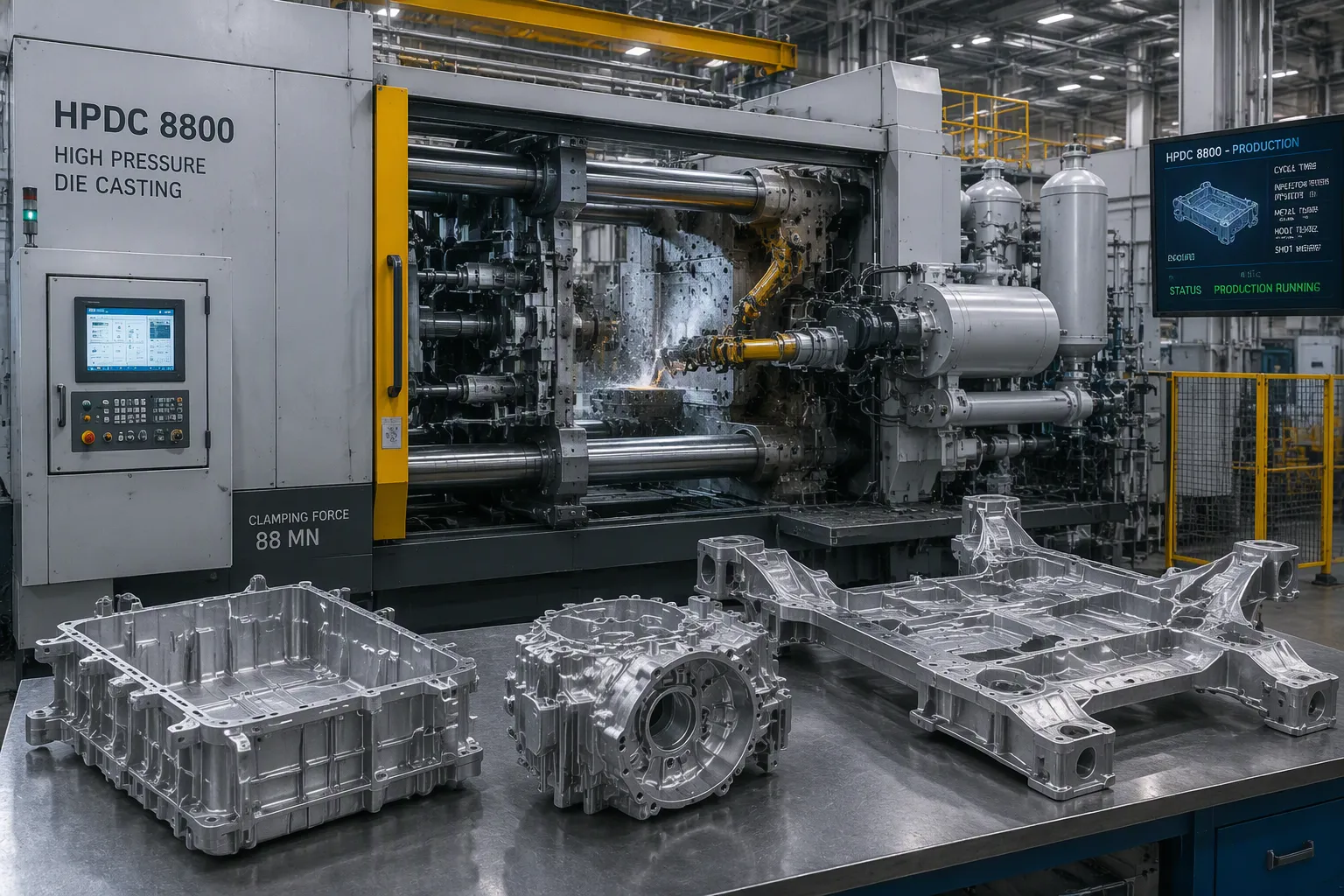
The die casting machine market is projected to grow from US$4.1 billion in 2026 to US$6.1 billion by 2033 at a 6.1% CAGR. These figures reflect broad adoption across major industrial sectors. Each sector applies the four innovation pillars in different ways.
Automotive remains the largest adopter of die casting innovations. The sector uses die-cast parts in four main categories: engine components, transmission parts, body assemblies, and other applications such as suspension, brakes, and ADAS sensor housings. Pressure die casting dominates production volume. Vacuum die casting now serves safety-critical structural parts because it minimizes porosity. Squeeze die casting handles high-strength applications like suspension and brakes.
The shift toward automotive electrification reshapes demand. Electric vehicles require a much higher proportion of lightweight, precision-engineered components. Gigacasting expands die casting content per vehicle dramatically. Battery housings, motor housings, power electronics enclosures, and structural frames are fast-growing application areas.
Automotive & EVs drive several measurable outcomes. High-pressure die casting machines now deliver 6,000 to 9,000 tons of clamping force, which is 25% to 40% more powerful than older models. A single-piece die-cast rear underbody reduces component count from 70 to 2, cuts assembly time by 35%, and improves torsional rigidity by 15%. Modern molds last over 200,000 cycles, which is 30% more than in 2021. The EV die casting market will reach roughly $24.1 billion by 2030 at a 12.3% CAGR. Asia-Pacific holds 63% of global EV die-casting capacity.
Aerospace, electronics, and energy sectors adopt the innovation pillars through distinct priorities. The table below summarizes their key drivers and material preferences.
Sector | Key Drivers | Preferred Materials | Example Applications |
|---|---|---|---|
Aerospace | Extreme environment performance, fuel efficiency, payload capacity | Aluminum, magnesium alloys | Turbine housings, structural parts |
Electronics | Miniaturization, advanced functionality, portability | Aluminum, magnesium alloys | Smartphones, laptops, home appliances |
Energy | High conductivity, wear resistance, renewable energy systems | Copper and lead-based alloys, aluminum | Power generation components, miniature precision parts for renewable energy |
Aerospace manufacturers need components that withstand extreme environments. Turbine housings and structural parts require precision die casting for strength and durability. The push for fuel-efficient aircraft drives adoption of lightweight materials. Magnesium alloys offer approximately 30% weight reduction potential compared to aluminum, which supports aerospace, automotive, and portable electronics applications.
Electronics manufacturers demand intricate, highly accurate, and miniaturized parts. Smartphones, laptops, and home appliances spur investment in die casting technologies that deliver precision and support lightweight design for portability. The energy sector relies on die casting for niche components requiring high conductivity and wear resistance. Power generation and renewable energy systems use copper and lead-based alloys, as well as miniature precision parts. These three sectors together drive advancements in lightweight material adoption, precision component demand, and specialized applications. They shape the die casting machine market's growth trajectory across all four innovation pillars.
Advanced alloys, digital engineering, automation, and sustainability now work as one system. Together they drive faster, cleaner, and more precise die casting. The 2026 die casting machine does more than refine old methods. It unlocks new product designs and new business models. Engineers can consolidate parts, cut weight, and hold tight tolerances in one pass.
Companies like Amfas International help manufacturers adopt these advancements through die casting expertise and technology integration. Producers who embrace these tools gain a clear edge. Those who wait risk falling behind. The path forward favors bold adoption of future-ready die casting solutions.
A smart machine connects sensors, PLCs, and IoT data acquisition into one control loop. It monitors melt temperature, injection pressure, die temperature, and cycle time in real time. Adaptive control then corrects process settings automatically. This combination reduces scrap, limits unplanned downtime, and holds casting precision across long production runs.
High-pressure die casting machines now reach 6,000 to 9,000 tons of clamping force. That range is 25% to 40% more powerful than older models. The added force supports large structural parts such as battery housings and single-piece underbodies. It also helps manufacturers hold tight tolerances on thin-wall sections.
Aluminum dominates lightweighting strategies. Magnesium follows and offers up to 30% weight savings over aluminum. Zinc is also used. Engineers select the alloy based on thermal performance, thin-wall capability, and the strength the application demands.
Simulation plus AI optimization shortens the development cycle by 40%. Engineers test gating systems, cooling layouts, and overflow locations in a virtual environment before cutting any tool. AI-driven inline inspection cuts the missed defect rate below 1%. Predictive maintenance then reduces unplanned downtime by 60%.
Recycled aluminum uses about 95% less energy than primary production and cuts CO2 emissions by a similar margin. Metals recycle indefinitely without losing properties. A 2024 aerospace study found a mid-sized manufacturer processing 500 tons of specialized alloys annually saved about $3.8 million through recycling initiatives.
